
The 2026 World Cup transforms Iranian American support for Team Melli into a fractured dilemma, as U.S.-Iran war and regime repression clash with athletic loyalty, forcing fans to navigate patriotism, morality, and political gamesmanship.
For Iranian Americans, the 2026 World Cup transforms the once-unreserved support for Team Melli into a fractured, deeply personal calculus, where geopolitics now outweighs athletic pride. This shift renders supporting Iran a conflicted act, as the host nation’s war with the participants blurs the line between team and regime, forcing fans to navigate loyalty and morality. Yet the very act of supporting Iran in this turbulent climate exposes a profound irony: while the U.S. government actively undermines the team’s preparations, the tournament still offers a fleeting glimpse of global unity, albeit one shadowed by repression and realpolitik.
Supporting Iran in a Geopolitical Minefield
In past World Cups, Iranian Americans supported Team Melli, as Iran’s team is known, practically unreservedly. The idea: Support the team, hate the regime. In the 2026 World Cup, though, both the geopolitics and the concept of fair play have become more conflicted, given that one of the hosts has been at war with one of the participants.
In the stands and at watch parties, some quarters of the Iranian American community have shifted to “The team is the regime.” On the field, the United States government has hampered the Iranian team’s ability to train and travel like other teams.
At Persepolis, a Persian restaurant in New York City that was showing the Belgium-versus-Iran game, older fans acknowledged the dissonance. President Trump said he would deliver Iran from the ayatollahs; “Help is on its way,” he messaged on Truth Social. Instead, he got outplayed by Iran and, to borrow an American football term, was forced to punt.
Aria Aydin, a 24-year-old engineer working on a tech start-up, is a second-generation Iranian American who is rooting for his home team, the United States, but also backing the squad of his family’s homeland. “It’s a bit weird,” Mr. Aydin said.
Shifting Allegiance and Supporting Iran
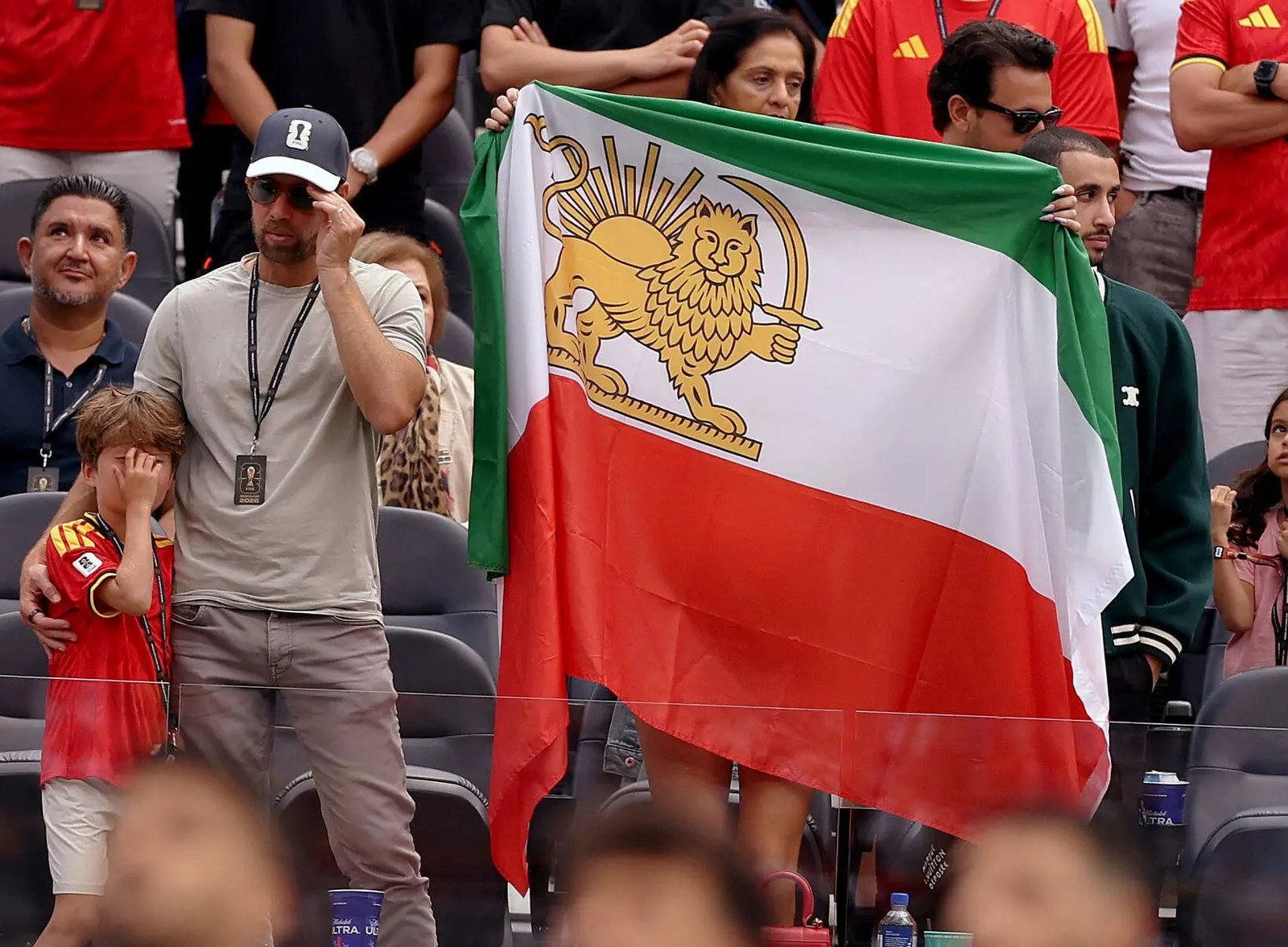
There have been protests outside SoFi Stadium, where Iran played its first two matches, and near the field where Iran has been holding its prematch workouts. At matches, some fans have booed Iran’s national anthem and displayed a prerevolutionary lion-and-sun Iranian flag, even though FIFA has banned it from stadiums. At Persepolis, one staff member wore a lion-and-sun T-shirt.
Team Melli once stood as a symbol of resistance, and Iran’s matches have sometimes been marked by antigovernment chants. The players sometimes voiced support for protesters or refused to sing the national anthem. That space has all but disappeared as the government has become more repressive. Iran’s star player in 1998, Ali Daei, had a street named after him in Tehran. That street is now being renamed because he apparently didn’t show enough enthusiasm for the current government.
This year Team Melli purged a player who did not show sufficient loyalty to the regime. And the government has reportedly become more deeply involved in the team’s administration, leaving little room for dissenting views.
“The pressure on the players is enormous. They know that if they get out of line, their World Cup dreams are over,” said Dan Gaspar, a former Iranian national team goalkeeping coach now with Ghana. Iranian players were compelled to join pro-regime demonstrations.
Regime Proxy or Team for Supporting Iran
It’s possible the resurgent, goal-happy American team will face Iran in the knockout round. That outcome isn’t likely, however, in part because Iran isn’t that good and because the Trump administration, which is not at all conflicted in characterizing Team Melli as a regime proxy, is going out of its way to undermine its preparations.
Despite having its first three matches in the United States, the team had to shift its training base from Arizona to Mexico because the United States denied visas to staff members it said had no sporting roles. The squad was told it could spend only 24 hours in the United States for each match. Other teams typically get to match locations two days in advance and have a chance to practice at the stadium where they’ll play. After matches, they usually stay locally rather than return immediately to their training sites, which gives them proper recovery time. Just try relaxing your muscles on a plane after running six miles while kicking a ball.
The Iranian soccer federation threatened to file an official protest, which has as much a chance of getting relief as Panama does of finding the net. The Iranians expect no less. “There’s probably no team better prepared for this kind of treatment than Iran,” said Mr. Gaspar. “They’ve been ostracized for years, so they’re used to it.”
Certainly, when it comes to matters of war, the last thing any combatant wants is a level playing field. That’s why an army seeks to eliminate the enemy’s air defenses or take control of the high ground. Or the Strait of Hormuz. In all things Trump, whether politics or sports, especially golf, cheating your opponent isn’t a sign of moral weakness; it’s a strategy.
Supporting Iran Amidst Political Gamesmanship
The Iranians left the stadium in Los Angeles on a high note, having held off Belgium, one of the best teams in the world, helped by the fact that the Belgians had a player sent off. Rules still matter on the field. Before departing for Mexico, they left a note of appreciation for the fans and for Los Angeles — Tehrangeles to Iranian Americans — thanking them for being welcomed, despite the conflict. The United States has even relented, allowing the Iranians 48 hours in the country for their critical match against Egypt on Friday night in Seattle.
This is, in some way, the World Cup at its best. It allows a nation such as Iran, run by a mob of murderous theocrats, the brief redemption of participation in a global sporting get-together. No one has to like Iran’s government, but it’s possible to enjoy its team’s play. This World Cup represents a better version of the United States, too. Despite the Trump administration’s bad sportsmanship, we are once again — at least for the run of the Cup — a country that welcomes foreigners. If some Iranian Americans have decided not to support the Iranian team, that’s fine, too. They are free to do so.