
New polling data reveals that Palestinian public opinion has shifted away from armed struggle and Hamas, with rising support for negotiations, yet deep contradictions remain over disarmament and the viability of a two-state solution.
Palestinian public opinion shifts sharply
Recent public opinion polls conducted among the Palestinian public indicate a significant weakening of the “resistance is winning” narrative and reflect a profound conceptual shift. This shift moves the center of gravity from supporting Hamas’s strategy of resistance toward a pragmatic approach that is acutely aware of its costs.
This process of disillusionment is evident in the unprecedented drop in support for “armed struggle” as an effective means of achieving national goals, alongside a surge in willingness to return to channels of diplomatic negotiation and non-violent popular resistance. Trends emerging from longitudinal surveys by the Palestinian Center for Policy and Survey Research (PCPSR) and a comprehensive survey by the Institute for National Security Studies (INSS) indicate that Hamas has lost its exclusivity in leading the Palestinian street. They also highlight a growing civil need not for the advancement of national aspirations, but for practical solutions focused on personal and family survival.
Israel and the international community must exploit this crack in Hamas’s legitimacy by strengthening pragmatic Palestinian actors, creating a clearly defined political horizon, and advancing a humanitarian-civilian response integrated with alternative governance mechanisms to Hamas, while thwarting the restoration of its civil and ideological hold on the Gaza Strip. Such a course could also lead to a positive shift in Israel’s international standing and tighten cooperation with the US administration in a manner that serves Israeli interests regarding Iran and Lebanon.
Background
The collapse of the “resistance is winning” narrative represents one of the most prominent and significant findings in two recent surveys conducted among the Palestinian public: the INSS survey from June 2026 and the PCPSR survey from August 2026. This is particularly evident when compared with earlier surveys, primarily those conducted by the PCPSR since the outbreak of the war. While the October 7 attack was initially perceived by large segments of the Palestinian public as a historic achievement, over time, the destruction of the Gaza Strip, the heavy human toll, and Hamas’s lack of any political or military horizon have forced this public to confront reality.
PCPSR Surveys – A Comparative Perspective
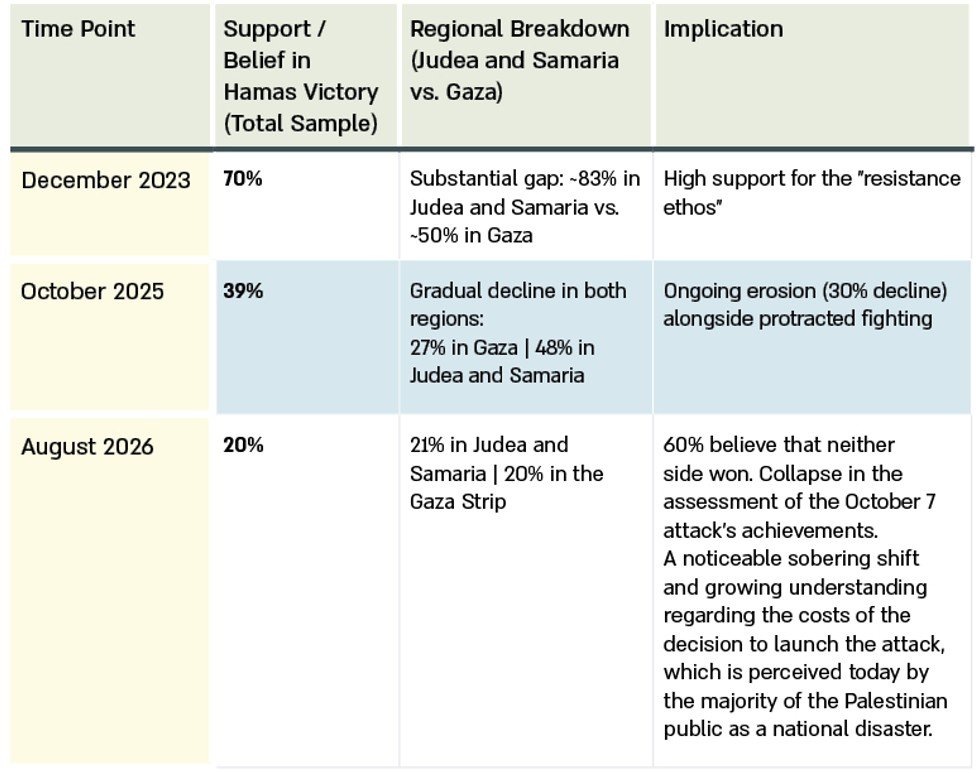
PCPSR surveys conducted between December 2023 and August 2026 show that Palestinian public trust in Hamas’s ability to achieve “victory” in the campaign has suffered a severe blow, steadily eroding over the course of the fighting.
As shown in the comparative table below, approximately one month after the outbreak of the war, 70% of Palestinians in the Gaza Strip and Judea and Samaria believed that Hamas would emerge victorious. By August 2026, that figure had fallen dramatically to just 20%. At the same time, while support for the “ethos of resistance” was high at the beginning of the war, by its conclusion, 60% of Palestinians believed that neither side had won.
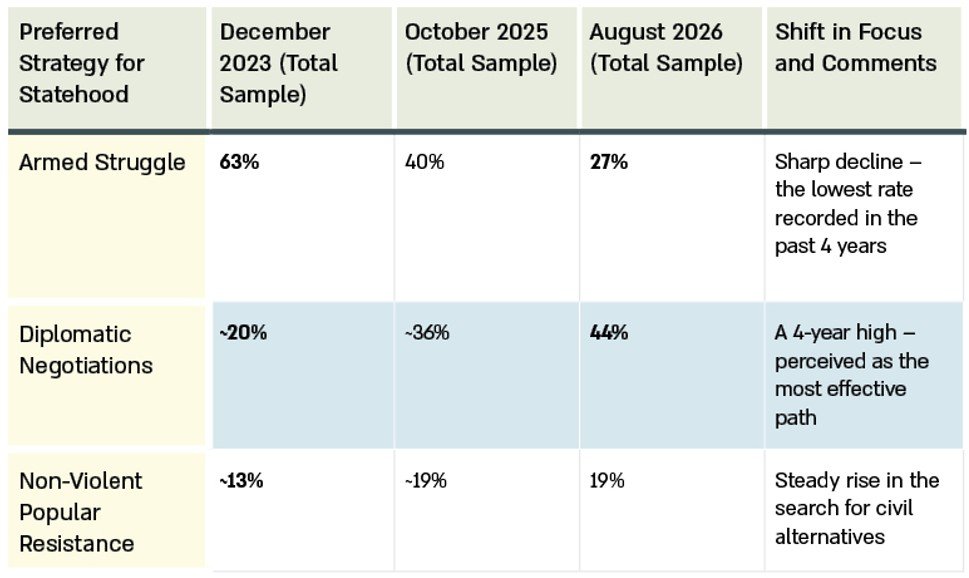
The most profound shift emerging from the PCPSR surveys concerns perceptions of the preferred national strategy: the abandonment of Hamas’s strategy of “armed struggle” in favor of a return to political and diplomatic channels, as well as popular resistance:
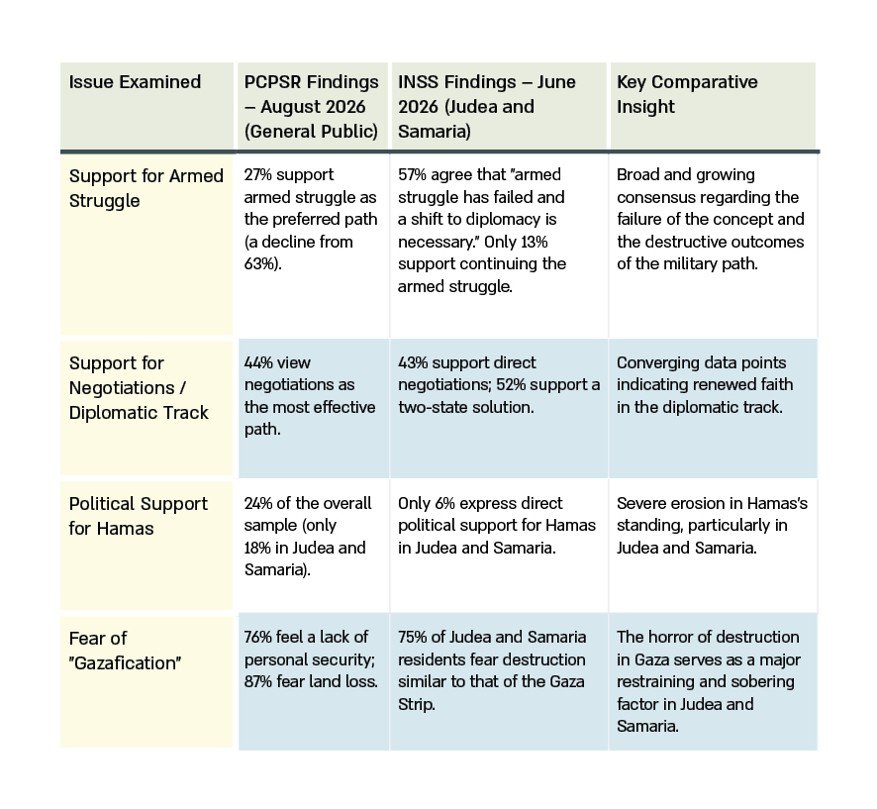
Comparative Table: Judea and Samaria–2026 Surveys (PCPSR and INSS)
A comparison of the data from the August 2026 PCPSR survey with those of the June 2026 INSS survey conducted among the Palestinian public in Judea and Samaria confirms and reinforces the broader trends:
Implications
PCPSR Findings
Longitudinal surveys continued to reveal a persistent structural gap between Judea and Samaria and the Gaza Strip: While residents of Judea and Samaria generally maintained more hawkish positions over time (due to their distance from direct fighting), residents of Gaza, who experienced the destruction and humanitarian suffering firsthand, led the decline in support for Hamas and its actions.
As early as the 2024–2025 surveys, a drop in support for restoring Hamas rule in the “day after” began to emerge, alongside a growing demand for the involvement of technocratic elements, the Palestinian Authority, or international entities to assume responsibility for civilian governance.
INSS Survey Findings
INSS in-depth reviews demonstrated that, as the collapse of civilian infrastructure intensified and disillusionment with the resistance’s ability to protect the population grew, Hamas’s legitimacy as the vanguard of the national camp eroded severely.
The rise of the pragmatic stream: Data showing that 52% support a two-state solution, 43% support negotiations, 13% support non-violent resistance (a total of 56% supporting non-military alternatives), and 57% believe armed struggle has failed, reflect the weakening exclusivity of the “unity of arenas and resistance” narrative and a growing understanding of the costs of political isolation.
Palestinian public opinion holds contradictions
An analysis of the Palestinian public sentiment at this juncture reveals a sharp internal dialectic, reflecting the painful clash between deeply rooted emotion and ethos, and a realistic recognition of the consequences of destruction and military failure. Dialectics involves an encounter between thesis and antithesis and is therefore inherently an expression of opposites. As a philosophical approach, dialectics attempts to reconcile these opposites through dialogue and synthesis. However, if one is required to reconcile the contradictions or to explain how they can coexist, a logical fallacy occurs whenever dealing with a concept intended to present an idea coherently.
Regarding the Palestinian dialectic, the debate is far from exhausted, and the logical fallacy has not been convincingly explained. This is not a case of complementary opposites; rather, it is an expression of internal ideological struggles among Palestinians as individuals and as a collective. The ethos of armed resistance remains deeply embedded in the psychological foundations of Palestinian society, even as Palestinians confront the painful experience of its failure. This ethos is reflected in the majority’s aspiration for a single Palestinian state (in two variations presented in the INSS survey) and in the stance that both sides lost (27% believe that neither side won the war, and 38% believe both sides lost—according to the June 2026 INSS survey).
This is an encounter between head and heart: an unresolved predicament, a form of despair that continues to nourish hope, but not yet a conscious choice of a particular path. The longstanding Israeli assumption that, for Palestinians, Israel’s defeat is paramount and worth the price of their own failure, is currently being challenged.
Alongside a significant decline in support for Hamas (which does not translate into an increase in support for Fatah, as neither organization enjoys the appreciation or recognition of the majority of the Palestinian public) and a rise in support for negotiations that would lead to the establishment of a Palestinian state, there is very strong opposition to disarming Hamas; 50% believe that armed resistance has benefited the Palestinian national struggle.
Additionally, Iran and the Houthis enjoyed broad support. While this can be explained as support for Israel’s enemy, who is perceived as harming Palestinians, it reflects endorsement of the armed resistance pursued by radical actors. Furthermore, the Palestinian public expressed significantly greater support for senior Hamas official Khalil al-Hayya for the presidency compared to Abu Mazen (regardless of the fact that Marwan Barghouti remains the leading candidate).
Moreover, despite growing support for negotiations toward a two-state solution, a clear two-thirds majority of respondents in the August 2026 PCPSR survey opposed requiring electoral candidates to accept the PLO’s commitments, including its agreements with Israel, as a condition for running. Only 27% were in favor of this requirement. Support was higher in the Gaza Strip than in Judea and Samaria: 35% and 21%, respectively. In the October 2025 survey, opposition to this requirement was somewhat lower, at 63%. It is unclear how these findings can be reconciled with support for the two-state solution.
Another figure pointing to the intensity of the dialectic within the Palestinian public is the attitude toward the personal sense of security among Palestinian residents of Judea and Samaria. 76% of residents report a lack of personal security, yet only 10% believe that settler violence and settlement expansion are the most important issues requiring immediate attention.
Furthermore, despite the dramatic rise in settler violence and Jewish terrorism, and despite significant expansions of settlements and takeovers of Palestinian land, there is a decline in support for Hamas and armed resistance. If this finding is isolated from the contradictory data (the dialectic), an explanation for this anomalous phenomenon is warranted. It remains unclear whether this stems from a form of despair and resignation to the situation, whether as a result of a complete loss of trust in the Palestinian Authority and political factions (Hamas and Fatah), fear of the “Gazafication” of Judea and Samaria due to violent Israeli responses to broad popular resistance (an intifada), or something else entirely.
Below are prominent examples reflecting the above trends, as illustrated by data from the August 2026 PCPSR survey:
Support for Negotiations vs. Rejection of PLO Commitments: Alongside the rise in support for negotiations and a two-state solution (52% in the PCPSR survey, 56% in the INSS survey), 66% of respondents in the PCPSR survey oppose requiring electoral candidates to accept the PLO’s commitments and previous agreements with Israel.
Recognition of Armed Struggle Failure vs. Rejection of Disarmament: Despite the decline in support for armed struggle and the acknowledgment of its failure, 72% of respondents in the PCPSR survey oppose disarming Hamas before a complete Israeli withdrawal. This contradiction stems from a deep-seated fear that disarmament would lead to renewed fighting rather than an Israeli withdrawal.
Civilian Distress vs. Loss of Trust in Institutions: According to the PCPSR survey, 65% of Palestinians now view the Palestinian Authority as a burden, and 83% believe corruption exists within its institutions. At the same time, 58% believe the two-state solution is no longer viable due to settlement expansion.
Leveraging Victory: Insights and Recommendations for Israeli Strategy
Israel can—and perhaps should—interpret the deep cracks in the ethos of armed resistance and the Palestinian public’s unprecedented willingness to pursue negotiations as an Israeli victory. However, these trends do not merely represent the conclusion of a military campaign; they constitute a rare strategic window of opportunity. A military and perceptual victory unaccompanied by a political initiative could dissipate and give rise to another wave of frustration and violence. To leverage the outcomes of the war and transform tactical and cognitive achievements into a durable strategic shift, Israel must formulate a strategy guided by a clear compass—a roadmap that will enable it to shape the operational environment and advance its vital interests.
Roadmap for Strategic Leverage of Victory
Outlining a Political Horizon and Infrastructure for a Palestinian Settlement
The Palestinian public’s disillusionment with Hamas and the rise in support for negotiations (44%) demand an Israeli response in the form of a clear political horizon. Israel should initiate a framework for a gradual, phased settlement based on direct agreements and practical mechanisms:
In the Gaza Strip: Advance a comprehensive civilian-economic rehabilitation plan conditioned on the dismantling of military infrastructure and the removal of Hamas from centers of power. This should integrate local technocratic elements and international/Arab forces in the spirit of the 20-point plan.
In Judea and Samaria: Bolster economic-civilian stability, reduce friction, and strengthen reformed, effective governance mechanisms capable of filling the perceived vacuum. This is necessary to prevent a spillover of terrorism due to a lack of political momentum, while establishing and encouraging mechanisms to accelerate essential reforms within the Palestinian Authority.
Achieving a Breakthrough in Normalization and Expansion of the Abraham Accords
An Israeli political initiative in the Palestinian arena is the key to advancing normalization and expanding the Abraham Accords. Presenting a credible framework for a settlement will restore momentum, with an emphasis on a historic breakthrough toward establishing official relations with Saudi Arabia and additional Muslim states. Such normalization will generate new spheres of opportunity regarding the Palestinian issue and provide regional, economic, and security backing for arrangements on the ground.
Tightening the Alliance and Coordination with the US Administration
Israel’s willingness to lead a proactive political move will bring about an unprecedented restoration of relations and trust with the US administration and Congress. This close strategic coordination will enable Israel to:
Enlist the United States in efforts to thwart Iran’s nuclear program and establish a new and stable security reality on the northern border vis-à-vis Hezbollah and Lebanon.
Mobilize the United States and the international community to lead regional reconstruction and security initiatives and help shape a new regional architecture.
Fortify Israel’s international standing and curb unilateral initiatives and boycotts in international forums, such as the UN and the International Criminal Court in The Hague.
Restoring Israel’s Global Positioning and International Legitimacy
Shifting Israel’s focus from managing a military conflict alone to leading regional political solutions will transform its international image. This will strengthen Israel’s diplomatic, scientific, and economic relations with Europe and other countries and restore its status in the West as a strategic, technological, and values-based asset.
Conclusion
If victory is measured not only by the number of military targets destroyed, but also by the extent to which the opposing public internalizes the limits of force and the costs of radicalism, the data show that the Swords of Iron War has created unprecedented cracks in the psychological infrastructure of Palestinian armed struggle. This can be regarded as an Israeli victory, albeit an incomplete one, primarily because Israel has yet to impose its terms on Hamas for ending the war and because this achievement has not yet been translated into reality through political action.
As of August 2026, the Palestinian public presents a picture of despair, but also of growing disillusionment with Hamas’s hubris of victory. It understands the price of the destruction and expresses a greater willingness than in the past to pursue diplomatic channels and negotiations. The Palestinian public’s recognition of the devastation brought upon it by Hamas serves as a foundation for the demand, shared by both Israel and Abu Mazen, that Hamas must not be integrated under any circumstances into the new governance mechanisms being established in the Gaza Strip, and that it must be fully disarmed, without compromise.
Combining this perceptual victory with a bold political initiative will enable Israel not only to halt the resurgence of Hamas rule in the Gaza Strip, but also to “take the bull by the horns,” by outlining a new strategic horizon and a roadmap for continuously shaping the region in a manner that serves and advances a range of vital Israeli interests.