
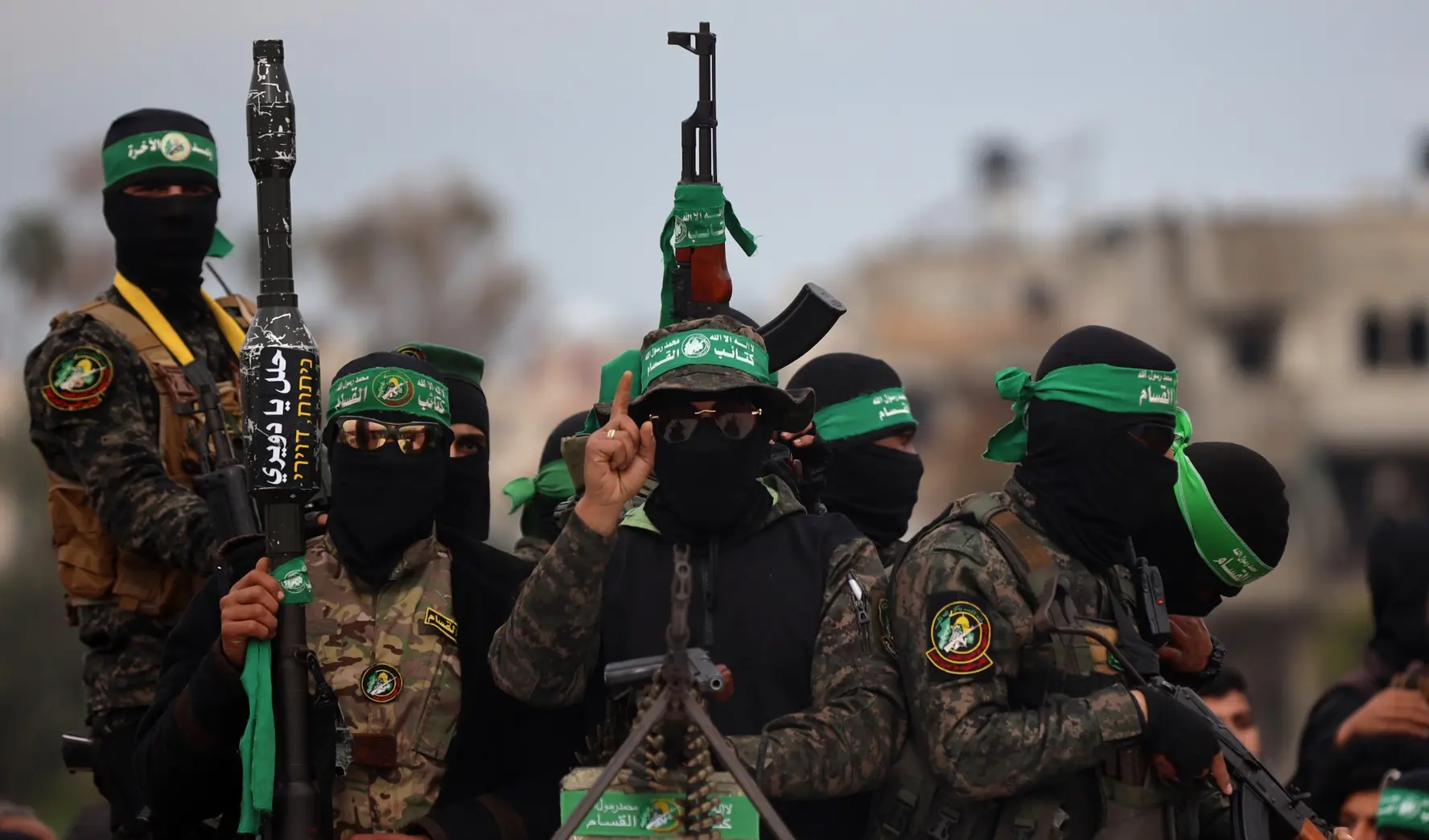
Peace is a prerequisite to the ambitious economic development plans that could transform Gaza. Securing that peace, however, requires addressing the future role of Hamas’s fighters.
In a recent RAND essay on the challenges of implementing Phase II of the Gaza Peace Plan, I warned that while demobilizing Hamas was desirable, it could create new dangers. Could Hamas veterans instead be paid and trained to return to their roots as a spiritual and social movement to perform tasks that contribute to reconstruction?
This drew comments from readers who doubted that Hamas could make such a transformation. Their skepticism is understandable—I share it. In the current circumstances, all of the options have major drawbacks, although some might be worth further exploration as negotiations proceed or come to an impasse.
Demobilization
There is no indication that Hamas will voluntarily demobilize. Demobilization could be forced by defunding. Qatar, which provides Hamas with financial support, might be persuaded to stop subsidizing Hamas fighters, thereby forcing a reduction in their ranks. Iran’s support will be harder to stop.
However, untethered Hamas fighters, facing sudden loss of livelihood, psychologically unable to return to normal civilian life, could pose new security problems if they turn into marauding gangs engaged in looting, kidnapping, and extortion.
Indefinite Custody
This option is a nonstarter. Hamas did not surrender. Few of its fighters are prisoners. Most of those captured during the conflict have been released. Capturing Hamas fighters now would require the renewal of military operations—a hard fight to the end.
Theoretically, individual fighters could be arrested. The peace plan states that “Hamas members who commit to peaceful coexistence and to decommission their weapons will be given amnesty.” Presumably, if they do not turn in their arms, they could face arrest and incarceration. The plan gives the International Stabilization Force (ISF) the responsibility for disarming and demobilizing Hamas, and therefore for dealing with noncompliant fighters. It is not clear that countries that may participate in the ISF are willing to assume this responsibility.
De-Radicalization
A number of countries have experience with de-radicalization programs aimed at persuading individuals to replace violent ideologies with values that allow their reintegration into society. Saudi Arabia claims an 80 percent success rate in turning around violent extremists in its prisons. These programs appear to work best when the subjects are a captive audience in custody, and government can intervene to provide education and jobs, to engage families, and even to arrange marriages. That is not the situation in Gaza.
Forced Departure
Following its civil war in 1970, Jordan expelled thousands of Palestinian militants. Most moved to Lebanon where, following Israel’s invasion in 1982, 14,000 PLO fighters were evacuated, mainly to Tunisia. The idea of moving Hamas fighters out of Gaza has come up several times as a means of ending the current conflict. Hamas rejects the idea.
The 20-point peace plan states that “no one will be forced to leave Gaza” but that “members of Hamas who wish to leave Gaza will be provided safe passage to receiving countries.” Assuming any nation will accept them, a large-scale relocation of Hamas fighters and their families might contribute to peace in Gaza, but creating a Hamas diaspora could pose new threats.
In October 2023, Hamas called for a global jihad against Jewish communities. It has not carried out terrorist operations abroad, although the war has inspired attacks. However, European authorities have uncovered terrorist plots and arms caches linked to Hamas, which suggests that Hamas still contemplates international operations. The deportation of Hamas fighters could increase the likelihood of a shift in strategy and the resources available to implement it.
Repurposing
Could Hamas be persuaded to pursue a more peaceful path? The Muslim Brotherhood, which began in the 1920s and of which Hamas is an offshoot, was originally a spiritual and social movement that performed social services and set up hospitals, schools, sports clubs, and business enterprises. Israel itself encouraged Islamist movements in Gaza as a counter to the nationalist Palestine Liberation Organization (PLO). It viewed them as less dangerous, and allowed them to build mosques, schools, and clinics.
The emergence of Hamas as a more violent incarnation of the Palestinian resistance movement in the late 1980s forced Israel to rethink that strategy. However, even as recently as 2023, Israel reportedly asked Qatar to continue funding Hamas as a means of “buying quiet.” That quiet was shattered by the horrific Hamas terrorist attack on October 7, 2023.
The bloody war that followed, in which tens of thousands of Gazans died, has not persuaded Hamas to abandon its cause. That commitment does not preclude ceasefires or strategic pauses, which can last for many years. During that time, circumstances can change.
It is hard to imagine masked gunfighters becoming caregivers. Critics argue that “leopards cannot change their spots,” adding that the Muslim concept of taqiyyah (prudence or self-protection) allows deception. However, we are not talking about conversion, but behavior. If pragmatism dictates a lengthy truce and cloaking one’s true feelings by temporarily laying down arms and adopting a new role in society, that may suffice to allow economic development and political progress.
“De-Hamas-ization” and Reintegration
The peace plan states that Hamas will “not have any role in the governance of Gaza, directly, indirectly, or in any form.” This, in my view, applies to Hamas as an armed organization, not to individuals. Hamas is deeply embedded in all aspects of Gazan society and government. It is not easy to draw a clear dividing line between Hamas and the population of Gaza.
According to an IDF report, 6,000 Gazans invaded Israel on October 7, 2023, of whom 3,800 were elite Hamas forces; 2,200 were from other terrorist formations or civilians. Civilian supporters also assisted Hamas during the conflict. Identifying and establishing the degree of individuals’ involvement with Hamas to deprive them of any future role in society would require a mammoth undertaking and could impede reconstruction.
Doing Nothing
Protracted inactivity could erode Hamas’s fighting capabilities. Created for conflict, it may not easily survive a long truce. Less motivated individuals will abandon the organization to seek more rewarding opportunities. The fanatics will turn on each other. Ordinary Gazans will turn away.
The ceasefire does not make Hamas a passive actor. Hamas leaders have their own ideas about its future. How they might respond will be the subject of a future essay.