
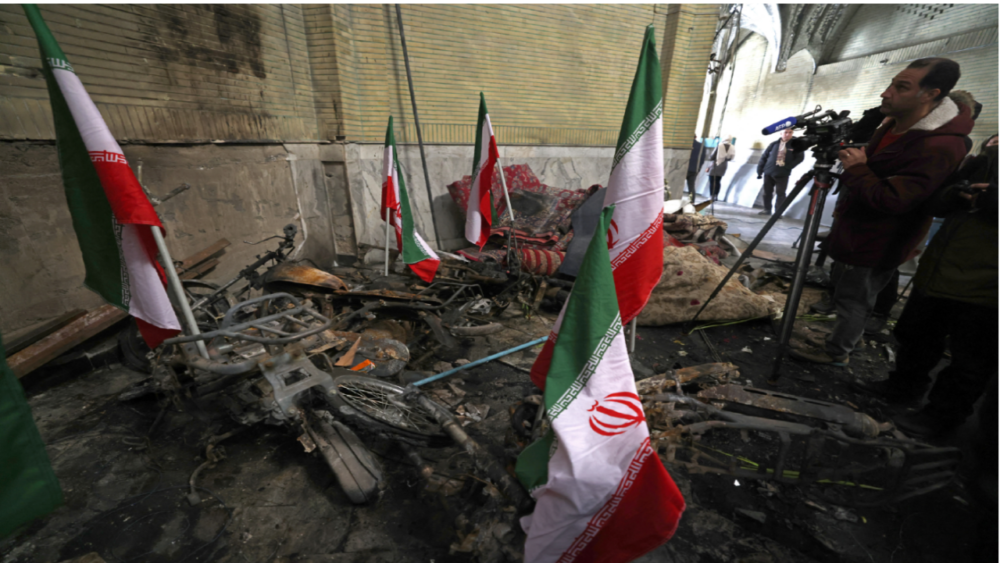
We’ve had countless pronouncements over the years about the demise of the Iranian regime. The terror unleashed this time by the clerics in Tehran — with estimates of 10,000 to 20,000 killed and more than 10,000 detained in recent protests — makes things different.
The clerical dictatorship has an expiration date, which is now near. One way to think of an accelerated timetable is to ask whether the Russians and Chinese are ready to abandon Tehran.
For years now, Xi Jinping and Vladimir Putin have shared a common interest in joining Iran to thwart American power and check Western influence across the Middle East and North Africa. That objective hasn’t vanished. But with Iran in crisis, Moscow and Beijing may be starting to hedge. Neither will place bets on what increasingly looks like a losing hand.
Iran has been preparing for transition. Supreme Leader Ayatollah Ali Khamenei turns 87 in April. Succession planning has been underway. Fierce competition for power between Revolutionary Guard commanders, mullahs and loyal technocrats has been brewing. Herein lies an opening for U.S. policymakers.
In December, protests started due to a deepening economic crisis. Hyperinflation, a collapsing rial (one American dollar is now worth over one million rial), and surging living costs recently drove Tehran bazaar merchants to the streets.
Despite the recent unspeakable barbarism of security forces, protesters are back. Discontent now runs wide and deep across the country and across generations. The appetite for reform is by all accounts gone. The suffering people of Iran are done with mullah dictatorship.
Throughout the last year, both China and Russia labored to shield Iran from sanctions and measures against Tehran’s nuclear non-compliance. Iran and its strategic partners Russia and China may still be keen to show a common front — for the moment. But cracks in the alliance are showing.
All three countries sent ships to a recent BRICS naval exercise, the “Will for Peace 2026,” that took place off the coast of South Africa. Iran withdrew from the exercise, however, nudged reportedly by its great power friends.
In April, Xi is scheduled to host President Trump in Beijing. China plays global chess, but surely it has bigger fish to fry than helping prop up a failing regime the Americans want gone. With an eye to Taiwan — and visions of spheres of influence — the Chinese want a grand bargain. Will Xi allow a wobbly and fragmenting Iran to gum things up?
In November, the Americans intercepted a Chinese ship headed to Iran with parts for conventional weapons. Beijing made not a peep. And China has actually angered Iran with its support for the United Arab Emirates’ claim over three islands in the Persian Gulf.
The Chinese party line in reference to those raging protests across Iran was mild rhetorical support for the regime. On Jan. 12, the Chinese Foreign Ministry expressed “hope” that Tehran “will overcome the current difficulties and uphold stability in the country.” Nor did Beijing offer its strategic partner air defense support last summer or call on the U.S. to restrain Jerusalem during the 12 Day War.
Much of the same applies to Russia and Russo-Iranian ties. For Moscow, Tehran is now a disposable ally.
Indeed, Russia has been dependent on Iranian drones and missiles for its war against Ukraine. Moscow has been purchasing nearly $3 billion worth of missiles since 2021, but Iranian stockpiles are finite and may well be running dry. After all, Iran relies on China for components to refurbish its missile program — and that is now subject to American interdiction. From Moscow’s perspective Tehran is useful in fighting the West as long as Iran can deliver.
But calculations are shifting. Russia was essentially quiet throughout the recent mass protests. National Security Council secretary Sergei Shoigu condemned “foreign interference” in Iran, mirroring Tehran propaganda, but he did not dare mention the U.S. or Israel by name. That’s a departure from last summer when the Russians were keen to condemn U.S. strikes on Iran.
Whether Trump strikes Iran again or not, there are other ways to hasten the demise of a tyrannical regime that has been a curse for the Iranian people and a destructive and destabilizing force for the region and beyond. China and Russia are key pieces to the puzzle.