
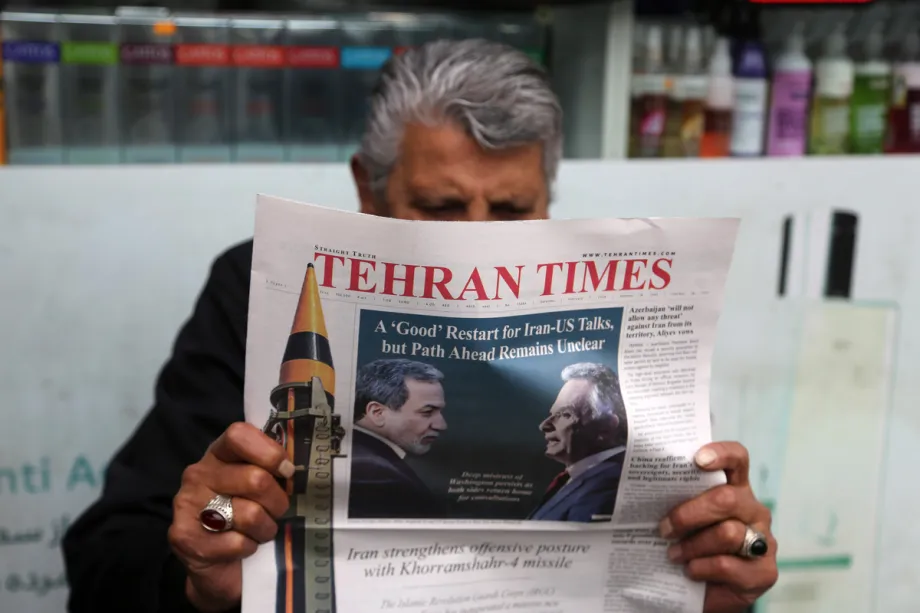
Economic warfare failed to break Iran, forcing Washington to negotiate. Tehran adapted through strategic partnerships and distributed deterrence, while sanctions accelerated global de-dollarization. Talks now reflect mutual constraint: neither side can impose terms unilaterally in a multipolar landscape.
For years, Washington addressed Tehran through pressure. Sanctions were tightened layer upon layer. Naval deployments in the Gulf were amplified. Political rhetoric framed Iran as a state that would eventually yield under economic suffocation. The assumption was that sustained coercion would fracture internal stability and compel compliance.That expectation has not materialised.
The Limits of Economic Warfare
When the United States withdrew from the Joint Comprehensive Plan of Action under Donald Trump, the calculation was clear. Economic strangulation would either collapse Iran’s internal cohesion or force it back to the table on terms defined by Washington.
Instead, Iran adapted. It expanded its nuclear leverage. It strengthened strategic partnerships beyond the Western orbit. It consolidated internal deterrence structures. Sanctions inflicted undeniable hardship, particularly on ordinary citizens, but they did not break state continuity. They did not trigger capitulation.
Economic warfare, when overused, produces adaptation. States under prolonged pressure search for alternatives — financial, diplomatic, and strategic. In doing so, they alter the very architecture that sanctions depend upon.
Legitimacy and the Politics of Naming
Western security discourse frequently reduces regional actors aligned with Iran to “proxies.” The term implies external manipulation and strips political agency. Yet movements such as Hamas, Hezbollah, and Ansar Allah emerged from local histories marked by occupation, invasion, blockade, and political exclusion.
Whether one agrees with all their tactics is not the analytical starting point. The relevant fact is that these formations are rooted in social constituencies and sustained by lived conditions. They cannot be understood merely as instruments of Tehran. Their legitimacy, in their respective societies, is not defined in Washington or Brussels.
The power to name opponents has historically rested with dominant powers. But moral vocabulary does not automatically confer moral authority. Resistance movements, however controversial, arise from political realities that cannot be erased by terminology.
Iran’s alignment with these actors is strategic. It creates distributed deterrence across multiple theatres. It ensures that escalation cannot be confined to a single, easily isolatable battlefield. This is not traditional warfare in the sense of open terrain and massed divisions. It is a networked model of deterrence shaped by geography, demography, and political embedding.
Military Superiority and Political Outcomes
American strategic discourse continues to invoke aircraft carriers, surveillance systems, and alliance networks as markers of enduring dominance. These assets remain formidable. Yet recent history has demonstrated that technological superiority does not automatically translate into stable political outcomes.
In Vietnam, in Afghanistan, and in Iraq, overwhelming firepower did not produce durable legitimacy. Military victories on paper failed to secure lasting political settlement.
Negotiations occur when the projected cost of war exceeds its conceivable benefit.
NATO and the Question of Cohesion
Western policymakers often cite NATO as evidence of unshakeable unity. Yet the alliance’s internal tensions and the strains revealed during the prolonged war in Ukraine have exposed limits to seamless coordination. Strategic consensus is not automatic. Economic pressures, domestic political divisions, and energy concerns complicate decision-making.
Formal alliances exist on paper. Political appetite for another large-scale Middle Eastern confrontation is considerably thinner.
The aura of automatic Western alignment has diminished, even if the institutional structures remain intact.
The Shifting Financial Terrain
The U.S. dollar continues to anchor global finance. However, the repeated use of sanctions as a geopolitical tool has accelerated efforts to diversify away from dollar dependency. Bilateral trade in local currencies has expanded among sanctioned and non-sanctioned states alike. Discussions within BRICS forums increasingly focus on alternative clearing mechanisms. Several sanctioned countries have increased gold reserves as a hedge against financial isolation.
This is not a sudden collapse of dollar dominance. It is a gradual recalibration. Financial power remains substantial, but it is no longer unquestioned. When economic systems are weaponised, alternative pathways inevitably develop.
Iran understands that geography and resources create structural bargaining power. Washington understands that destabilising a region so central to global markets carries consequences far beyond bilateral confrontation.
Israel, Dependency, and the Limits of Force
Israel’s security architecture is deeply intertwined with American political and military support. Aid packages, diplomatic shielding, and intelligence cooperation form structural pillars of its strategic posture. This interdependence shapes regional calculations.
Military campaigns in Gaza have demonstrated overwhelming destructive capacity. Yet force has not delivered final political resolution. Resistance has not evaporated under bombardment. Destruction does not automatically translate into durable security.
Across the region, this pattern reinforces the perception that military dominance without political accommodation perpetuates cycles rather than ending them.
A World Adjusting
The United States remains a powerful actor with unmatched technological capabilities and extensive alliances. Iran remains constrained economically but resilient strategically. Neither occupies a position of absolute supremacy.
What has changed is the margin of unilateral action. Coercion without decisive victory exposes limits. Negotiation becomes necessary when escalation risks multiply across domains — military, financial, and diplomatic.
Iran seeks stability to rebuild its economy and address internal pressures. It does not benefit from war. The United States seeks containment without another protracted conflict that would drain resources and political capital.
The current talks reflect mutual recognition of constraint. The age in which Washington could dictate terms without consequence is receding. What replaces it is not chaos, but negotiation shaped by distributed power.