
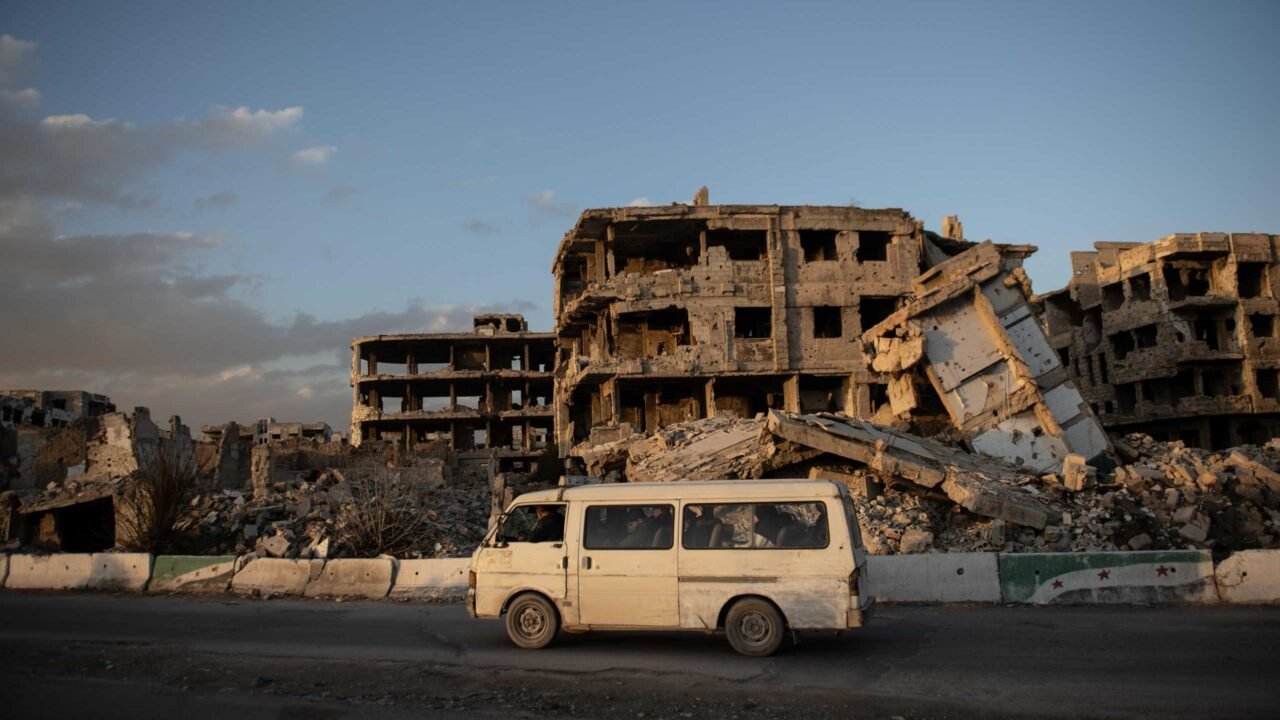
It has been over a year since Bashar al-Assad fled Damascus on a Russian jet in the middle of the night. In the ruins of his brutal regime, Syria has made remarkable progress. There is more stability, deepening international engagement, previously unimaginable sanctions relief and an end to the torture state. Most recently, there has been a political deal between Damascus and the Kurdish-led Syrian Democratic Forces (SDF) in the country’s northeast, which though tenuous, has averted wider conflict. Now, however, the country faces new threats as devastating conflict engulfs the region following US-Israeli strikes on Iran. Syria has a long way to go before it has functioning governance, economic growth and lasting stability.
To get there, Damascus needs a clear, unified vision. Since the fall of Assad and the swearing-in of the country’s transitional government a year ago, ECFR has regularly met Syrians from across the country’s geographic and political spectrum. They recognise the country’s significant gains but are concerned that these could be lost amid a lack of direction for the country’s political transition and economic recovery. And as the gap widens between progress on the international scene and the still stark economic reality on the ground, popular frustrations could grow. To help stem this trajectory and support Syrians rebuild their state from the rubble of dictatorship, European governments need to increase focused diplomatic engagement and financial support to address specific needs hanging over the still fragile country.
The search for a political vision
According to a number of Syrians we spoke to there is still no coherent roadmap for the country’s political transition. The president, Ahmed al-Sharaa, has given little clarity on a new constitution, the separation of powers, electoral timelines and institutional reform, while restricting the space for new politics. Mechanisms of transitional justice are also largely absent, without which reconciliation and lasting stability will remain difficult to secure. Political processes such as the national dialogue were tightly controlled by the leadership and seen by many Syrians as a one off event aimed at satisfying foreign partners rather than cementing genuine political inclusion.
Implementing political reform to anchor a stable new Syria was never going to be quick or easy, but some Syrians we spoke to worry about a lack of political will to institutionalise proper governance. Instead of a rupture with the past, they see a recycling of old practices. Decision-making is highly personalised with power concentrated in a narrow circle that prioritises loyalty over expertise. Institutional structures remain unclear and legal frameworks are ambiguous. The new authorities are also consolidating power in unaccountable bodies, such as the new presidentially-controlled sovereign wealth fund and a new political secretariat.
While there is wide freedom of expression, many civil society groups—which developed significant capacity over the past 15 years of conflict—feel sidelined from playing a meaningful role in Syria’s transition. The EU-sponsored Day of Dialogue, held inside Syria for the first time last November, included strong representation from civil society, but once again many Syrians we spoke to struggled to identify any tangible outcomes of this engagement.
However the government may now be recognising the need for a more inclusive approach. There are indications that a more representative government could soon be formed. The recent move to grant Syrian Kurds full citizenship rights, long denied to them, was also an important recent step demonstrating a necessary focus on minority rights. But this political question remains a major issue still hanging over the transition.
An economic crisis
In conversations with Syrian analysts there is also concern at the slow pace of economic growth—though again, the government inherited a broken state that will take years to rebuild.Damascus has already made monumental gains in securing major sanctions relief from Europe but more importantly from the US whose measures have global restrictive power. On the ground, however, the benefits are hard to find: Syria’s economy grew by just 1% in 2025 and over 90% of the population still live in poverty. Inflation and cost-of-living pressures remain severe. While there has been progress in delivering improved electricity supplies in some areas, many Syrians cannot afford their electricity bills, amid the lifting of electricity subsidies and recent price hikes. A surge of job opportunities is needed to counter the economic allure offered by destabilising militias or drug networks.
Protests against unemployment and cost-of-living pressures across the country are warning signs. If conditions do not improve quickly, this could give an opportunity for armed actors like the Islamic State group (ISIS) and former regime elements to mobilise local grievances against the new government.
This dissatisfaction is compounded by the fact that the needs of local communities—sewage systems, housing and electricity, for example—are not addressed in a visible national strategy, despite the government’s move towards greater decentralisation. Foreign donors are also reported to face central restrictions on their ability to work directly with local actors to address some of these needs.
Just like the country’s political situation, Syria needs a clearer and more inclusive strategy for its economic recovery. To some Syrians we spoke with, the government’s approach is too top-down and neoliberal, disconnected from the country’s traditional business community, and overly focused on the promise of big-ticket Gulf investments. Moreover, without wider reform aimed at creating a more business-friendly environment, the sanctions relief will not generate investments that address the population’s day to day needs. Investors still face huge regulatory ambiguity, security risks, outdated financial systems and unreliable energy infrastructure that prevents them from doing business in Syria.
Improved security control and geopolitical risks
The number of security incidents, including ISIS attacks, has decreased in the past year (but the recent escape of some ISIS prisoners is concerning). The government has also managed to contain the risk of internal ruptures by more extreme elements within its base given its past as an al-Qaeda affiliate. However, Damascus still faces deep challenges: Syria’s internal security situation is delicate, and the country sits at the heart of a volatile neighbourhood. For the moment, the regional war unleashed by US attacks on Iran has not impacted Syria, but this could easily change given that three of its direct neighbours—Israel, Lebanon and Iraq—are involved in the conflict.
On a positive note, the Ministry of Interior has moved to strengthen its internal systems and assert greater responsibility over the country’s myriad security actors. In some areas, such as Homs, where local tensions remain high, government forces’ professional responses to security incidents have prevented new cycles of escalation. And following the violence last March that saw more than 1,400 Alawites murdered, communal relations appear to be slowly improving on the ground—though minority groups still have deep concerns over their status in the new Sunni dominated country and face ongoing security threats.
Wider command and control systems have also improved, as demonstrated by the government’s more careful recent military campaign against Kurdish-led Syrian Democratic Forces (SDF) in northeastern Syria—as compared to the surge of uncontrolled violence that engulfed the coast in March 2025 The eventual integration agreement with the SDF was largely based on this force, but the deal’s initial stages are unfolding better than expected: government security personnel are moving peacefully into Kurdish towns, while the government has appointed Kurdish figures to new government positions. The SDF leader also joined the Syrian foreign minister’s delegation to the Munich Security Conference in an unprecedented show of unity.
A big question hanging over the government is its ability to move towards a similar settlement with the Druze community in southern Syria, where hundreds were killed last summer in clashes between local and government forces. While negotiations are ongoing and there has been some low-level progress, the two sides appear locked into hard line positions over competing visions of the new state. Parts of the Druze community want to cement their regional autonomy (much as the SDF hoped and failed to do), while Damascus seeks to reestablish central control.
But here the government also faces a bigger geopolitical challenge. Israel, which has occupied swathes of new Syrian territory since Assad fell, is supporting Druze grievances with the apparent aim of keeping the country weak and fragmented and to confront growing Turkish influence. Syria has long been a battleground for regional rivalries, and even though it is currently managing to insulate itself from the current war, external interventions continue to cast a destabilising shadow over the country.
Recommendations for European support
European states need to keep assessing how and where they can make a positive difference in supporting lasting stability, which remains a core European interest given the country’s place at the heart of the Middle East and its direct impact on European migration and security concerns. For the EU, Syria should be seen as the perfect partner to showcase and advance the opportunities afforded by the new Pact for the Mediterranean, with a wider range of tools that could be quickly deployed by the new DG MENA. This could be based on more high-level coordination with the other actors engaged in supporting Syria’s transition, especially Turkey and Saudi Arabia.
Political
Europeans need to keep encouraging the government in Damascus to see the importance of implementing a meaningfully inclusive transition. This should involve supporting the government move towards genuine state consolidation, including clarifying the role of parliament, establishing legal clarity and judicial independence, and ensuring accountability in state bodies. It should also focus on a more institutionalised role for civil society.
Europeans could offer specific training and capacity assistance for Syria’s new parliament to support its development as a meaningful legislative actor, as well as providing legal expertise on issues related to transitional justice and property rights, the latter of which is also critical for reconstruction prospects.
Economic
Europeans cannot and will not bring the same money to the table as Arab Gulf states, but they can and should dedicate more funds which could help address critical gaps. In terms of direct assistance, European governments should invest heavily in regenerating the country’s electricity infrastructure given its necessity for wider reconstruction, building on recent steps by Italy and Norway to support the restoration of the key Deir Ali power station. Here Germany could also support the re-entry of Siemens into Syria, given its past role in the country’s energy sector.
On a more sectoral level, European efforts could focus on revitalising the banking sector so sanctions relief can bear fruit and deliver investment inflows. This could start with the transfer of technical know-how to the outdated sector. It could also involve encouraging correspondent banking channels, connecting European banks directly with the Syrian central bank to facilitate financial inflows. This could be accompanied by clearer European government guidance and direct support for European firms looking to enter the market.
To improve donor coordination, European capitals should work with Damacus to establish a standing committee to organise an effective division of labour, clearly assessing what is needed in Syria and which external actors can meet them. This process could also involve developing a more institutionalised framework to facilitate direct donor engagement with local communities.
Security
The country’s security sector restructuring and modernisation presents an opportunity for valuable European support in areas at the core of lasting stability—and could be a key area of cooperation with Turkey which is assuming a lead role in supporting Syria’s security sector modernisation. European states have extensive experience providing this form of assistance through civilian CSDP missions. In Syria this could include providing training in civil policing and specialised areas such as counter narcotics, kidnappings and crypto crimes, as well as a particular focus on increased assistance on detention oversight, while also channelling attention to the critical question of reintegration for those being released. Europeans should also press Israel to end its cycle of destabilising interventions in the country.
Making change last
In the year since the transitional government was sworn in, Syrians have made remarkable progress in escaping the grip of the Assad regime. The challenge now is to root the transition in a truly inclusive political and economic vision and consolidate this within Syria’s institutions. Europeans should be fully invested in working with the government and wider population to support this push towards a brighter future—not least at this moment of escalating regional conflict when Syria needs as much support as it can get to protect itself from wider forces of upheaval.