
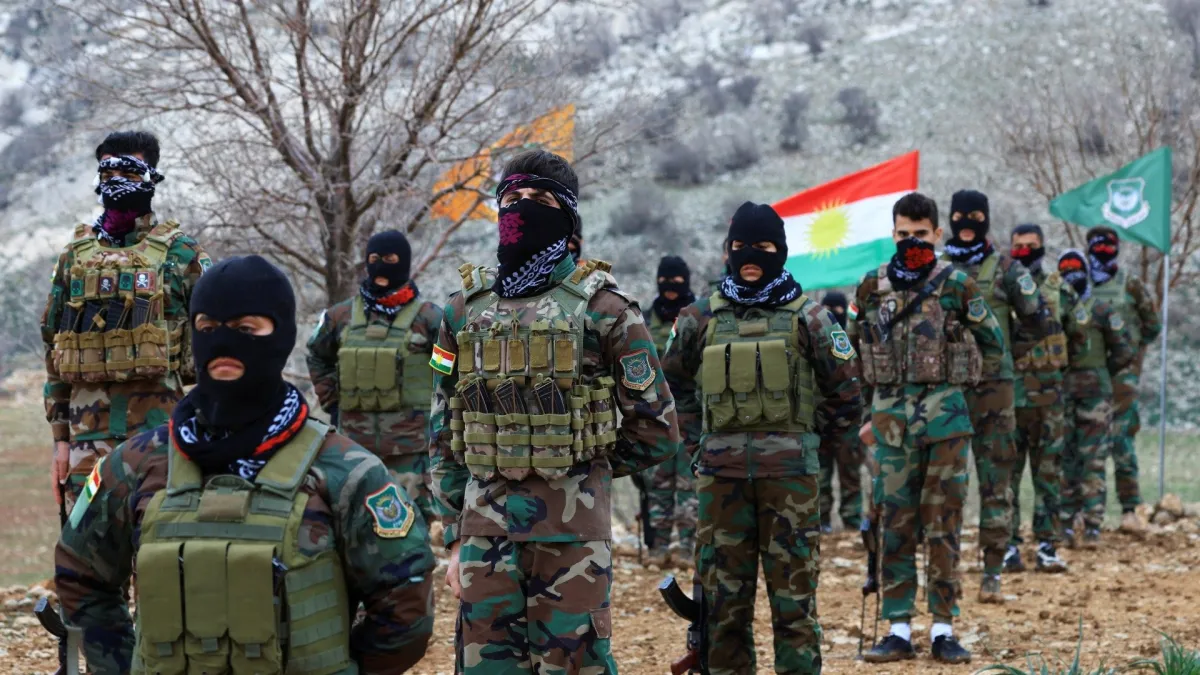
Iranian Kurds have returned to the spotlight amid growing speculation that their regions could become a new front in the ongoing war against Tehran.
As the United States and Israel continue military strikes on targets inside Iran, attention has begun shifting to the Kurdish areas in the country’s west, amid unconfirmed reports that Kurdish factions are preparing to confront the Iranian regime with U.S. backing.
Speculation gained momentum after U.S. President Donald Trump expressed support for any attacks the Kurds might launch against Iran, comments that were interpreted as a potential precursor to a scenario involving internal opposition alongside military strikes.
Amid this escalation, Kurdish regions have emerged again as one of Iran’s most sensitive vulnerabilities, given a long history of tension between Kurds and the central government, and the presence of armed parties and organizations based in neighboring Iraq’s Kurdistan Region.
During the first five days of the conflict, Israel reportedly intensified efforts to set conditions inside Iran for a Kurdish uprising. Alongside the assassinations of Tehran-based leaders, Israeli airstrikes targeted police centers and Revolutionary Guard positions in the country’s west, while U.S. strikes focused on missile launch sites, airports, warships, and other strategic targets, particularly in the south.
The Situation of Kurds in Iran
Kurds make up roughly 10 percent of Iran’s 90 million population, according to the World Bank’s latest estimates from 2024.
They are concentrated in the northwestern provinces, stretching from the Turkish border to the Iran-Iraq frontier. Key areas include West Azerbaijan Province, with its capital at Urmia on the border with Turkey; Kurdistan Province, with its capital at Sanandaj adjacent to Iraq’s Sulaymaniyah Governorate; and Kermanshah near Iraq’s Diyala Province.
Most Iranian Kurds are Sunni, particularly in West Azerbaijan and Kurdistan provinces, while the majority in Kermanshah are Shia. There are also communities of Sufis and Jews.
Kurds accuse Iran’s religious regime of persecuting them for three main reasons: their ethnic difference from the Persian majority, their religious differences, and their demands for autonomy. Iran denies these accusations.
Iranian Kurds have several nationalist parties, some with armed wings primarily based in neighboring Iraq, specifically in the Kurdistan Region. The oldest of these is the Iranian Kurdistan Democratic Party, founded in 1945. It is part of a coalition of six Iranian Kurdish parties opposing the regime, which announced its formation last week in a statement issued from Iraq’s Kurdistan Region.
On Wednesday, the party urged “all Iranian soldiers and personnel, especially in Kurdistan” to vacate their bases and withdraw support from the regime’s “armed and repressive forces” coinciding with the U.S.-Israeli offensive against Iran.
The coalition also includes the Kurdistan Freedom Party, the Kurdistan Struggle Organization in Iran, the Komala Party of the Toilers of Kurdistan, and the Kurdistan Free Life Party.
Representatives of the Iranian Kurdish parties in the coalition denied on Wednesday the rapidly circulating rumors of any mobilization from Iraq. Those reports prompted what Iranian state media described as a preemptive strike that destroyed targets in Iraq’s Kurdistan Region.
Among the Iranian Kurdish parties, only the Kurdistan Free Life Party (PJAK) is believed to have significant armaments, largely due to its ties with the Kurdistan Workers’ Party (PKK), the militant group based in majority-Kurdish areas of southeastern Turkey and northern Syria and Iraq.
In a statement on Wednesday, PJAK called on Kurds inside Iran to “prepare for the consequences of war and the Islamic Republic’s policies” and to “avoid military and security centers of the regime.”
A History of Conflict
After Iran’s 1979 Islamic Revolution, Iranian Kurds launched a separatist movement that ultimately failed.
Persecution of Kurds protesting government policies intensified from 2000 onward, particularly under President Mahmoud Ahmadinejad, according to the Iran Human Rights Documentation Center.
Following the disputed 2009 presidential elections, Iranian security forces targeted Kurdish activists. The U.S. State Department reported that more than 22 Kurds were sentenced to death in 2012 on political and security-related charges.
In recent years, especially since 2022, tensions and repression against Iranian Kurds have surged, notably following protests triggered by the death of Mahsa Amini, a young Kurdish woman, while in police custody.
Kurdish regions in Iran became flashpoints during anti-government protests that began in late December 2025, which resulted in thousands of deaths by January 2026.