
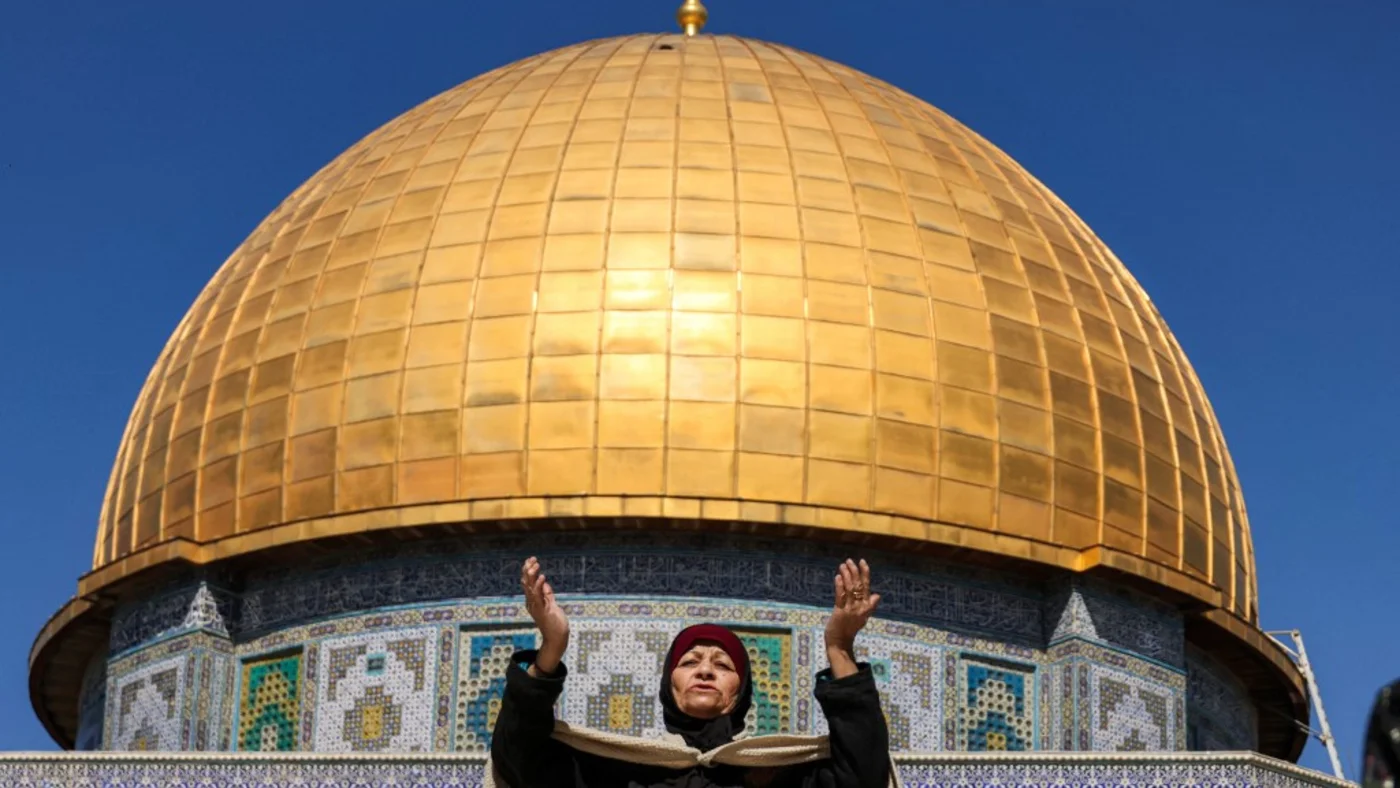
Within hours of the launch of the US-Israeli assault on Iran last weekend, both the Ibrahimi Mosque in Hebron and Al-Aqsa Mosque in occupied East Jerusalem were shut down. Israeli occupation forces expelled worshippers and justified the closures under the pretext of wartime “preventive measures”.
There are no bomb shelters in Palestinian homes in the occupied West Bank and East Jerusalem, nor are there public shelters. Among Palestinians in 1948 territories, around half of the population has no place to seek refuge from air attacks, according to figures from Israel’s own state comptroller.
Preventing worshippers from reaching the mosques, and instead confining them to their homes, markets, streets or workplaces, does not make them any safer. Amid the genocidal war in Gaza, the idea that Israeli authorities are concerned for the safety of any Palestinian is not merely laughable; it is stomach-turning.
The targeting of mosques through such measures stems, rather, from a vision of religious replacement espoused by Israel’s Zionist government and the Zionist right more broadly. Religious Zionists, who have become the dominant current in Israeli society, call the Al-Aqsa complex Temple Mount.
Adherents performs a mental act of erasure upon hearing this term. The same applies to the Ibrahimi Mosque, which the Zionist right regards as the Cave of the Patriarchs.
Israel’s imposition of emergency measures to close the mosques thus aims to achieve two objectives. The first is to entrench Israel’s claimed sovereignty over these sites, marginalising Islamic administrators as Israeli forces dictate the terms of accessibility.
In each case, the Islamic waqf is reduced to the position of a spectator; a passive recipient of whatever measures are imposed by Israel.
The second objective is to isolate the mosques, closing them to worshippers during the holy month of Ramadan, as a live rehearsal for the possibility of sealing them off and seizing them at any other time.
Stringent regulations
The gravity of these closures becomes clear when placed in the proper context, including Israel’s historical attempts to control access to Al-Aqsa Mosque. Over the past decade, Israel has worked tirelessly to strip the waqf of its authority to open and close the mosque.
There have been several key moments in this ongoing drive for control. In 2017, after three Palestinians fatally attacked five Israelis at the Lion’s Gate entrance to the complex, Israel shuttered the mosque and added metal detectors at the entrance. Mass popular resistance ultimately forced Israel to reverse the decision to install the equipment.
A few years later, in 2020, Al-Aqsa was again closed amid stringent regulations across Israel during the Covid-19 pandemic – even though the complex is a vast open space, where social distancing could easily have been enforced. It did not reopen for two months, remaining closed during Ramadan.
And then in June 2025, during the 12-day war between Israel and Iran, Israeli authorities again forced the mosque’s closure for the duration of the conflict.
The sweeping closures announced just days ago come on the back of these precedents. It is as though authority over the mosques is becoming the undisputed prerogative of the occupying government.
At the same time, Israel has been expanding and normalising its aggression against Al-Aqsa during Ramadan. From a month of heightened sensitivity, it has become a month for testing the machinery of elimination. What can be imposed during Ramadan opens the door to far more afterwards.
There have also been repeated calls by Israeli rabbis and activists to conduct ritual animal slaughter at Al-Aqsa Mosque to mark Passover, another move aimed at destroying the status quo, under which the holy site is meant to be reserved exclusively for Muslim prayer.
Escalating aggression
Israel’s aggression has escalated further during the current month of Ramadan, as Israeli authorities have reportedly barred some Al-Aqsa guards from covering their shifts, while also halting the entry of necessary supplies.
At the outset of Ramadan, Israel approved a plan to limit entry to 10,000 Palestinian worshippers for Friday prayers throughout the holy month under a “security” pretext; entry was limited to men aged 55 and over, women 50 and over, and children under 12 accompanied by a relative.
The lead-up to the holy month also saw escalating incursions into Al-Aqsa, culminating in the arrest of an imam and an Israeli police raid during evening prayers on the first night of Ramadan.
At the same time, we are witnessing a renewed Zionist push for spatial division. Even before the mosque’s closure, Israeli authorities reportedly stormed waqf sites and prevented the reinstallation of locks, focusing especially on the Dar al-Hadith al-Sharif building north of the Bab al-Rahma prayer area. A previous attempt by the Israeli occupation to sever this area from the mosque led to a 2019 wave of unrest.
Now, in addition to bans on worship and threats against Muslims attempting to practice their faith, proposed legislative changes could ultimately give Israel’s rabbinical establishment more control over Al-Aqsa Mosque.
Police harassment of worshippers is deepening. Armed patrols march next to prayer rows, arresting, searching and assaulting Muslims as a matter of routine. Settlers openly incite against Al-Aqsa and call for it to be permanently closed to those practising the Islamic faith.
Shutting the mosque under the pretext of war is in fact the culmination of a series of Judaising measures. It is the product of a full alignment between settlers and their government, not the outcome of any alleged safety concerns. It was a premeditated objective to be executed at the outset of the assault on Iran.
Closing Al-Aqsa is thus an act of war carried out with soft tools, and it must be confronted and defeated by all possible means.