
Growing concern over informal security commitments has renewed debate about congressional authority, arms exports, military deployments, and whether executive agreements increasingly expose the United States to regional conflicts without democratic oversight.
A Vote Shaped by War
This week, Democrats won both the House and the Senate in a major blue wave, after a campaign fought during a war most Americans oppose. The war with Iran is the bill for a decade of blank checks written in the Middle East. The newly-elected Congress should stop writing them.
President Donald Trump, in his second inaugural address delivered in January 2025, promised to measure his success by “the wars we never get into.” Five months later, however, American bombers joined a 12-day war that Israel had launched against Iran. Eight months after that, on February 28, 2026, the United States and Israel started a new one together that remains unresolved.
Nor is it over: Washington and Jerusalem have reportedly prepared another round of strikes for after this week’s midterms, with Trump telling Fox News that “they will have to do something large,” adding that it could involve a “heavy hit.”
The founders asked, at minimum, that Congress choose the nation’s wars openly. Nowhere has that principle been abandoned more completely than in the Middle East.
The problem is not one president. Washington’s Middle East commitments, formal and especially informal, fail a basic cost-benefit test no matter who sits in the Oval Office. They let partners set American risk, and they enrich a state-brokered arms trade rather than the American public. The Constitution already supplies the fix: yesterday’s elected Congress must wield its war and purse powers to cap those executive commitments.
Promises and Contradictions
In the 2024 election, Trump did not stumble into the restraint vote. He courted it. In 2016, he called the Iraq War “a big fat mistake,” and in his 2019 State of the Union, he declared that “great nations do not fight endless wars.” Voters who had buried sons and daughters from Fallujah to Kandahar heard a promise.
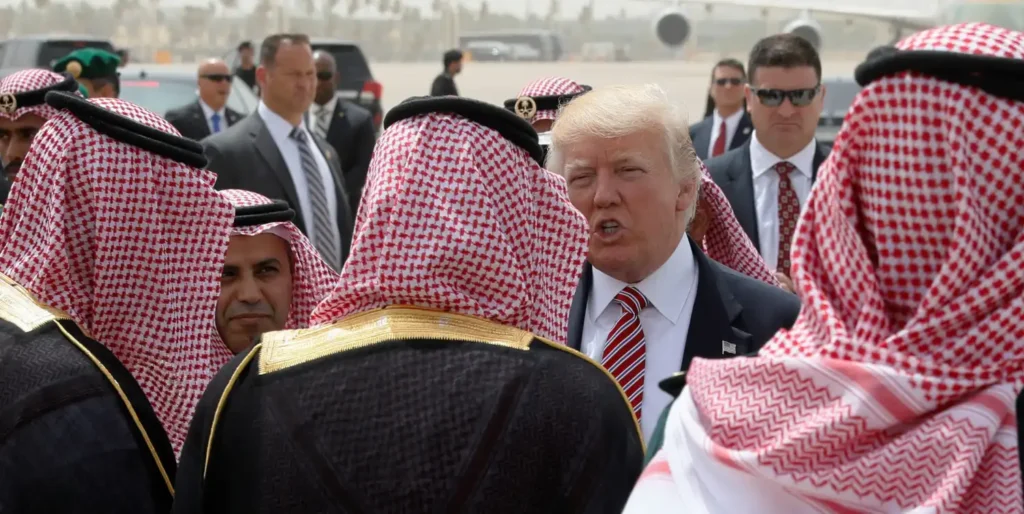
The record since has contradicted it. In May 2025, the White House announced a Saudi arms package worth nearly $142 billion. That autumn brought a security guarantee for Qatar and a defense agreement with Riyadh. Then came February 2026, and a war whose stated aims ran from Iran’s missiles and navy to its proxy network and, by Trump’s own words, its government.
The public largely agrees that the war was not their idea. A Reuters/Ipsos poll found that only 37 percent of Americans approve of the war and 59 percent disapprove, including about one in five Republicans. But this isn’t one president’s inconsistency that a successor could fix. The deeper problem lies in how Washington makes commitments in the region.
Gulf Arms Sales and Informal Commitments
Every security guarantee lets a partner shape American risk. Informal ones are more dangerous because no one ever votes on them.
The distinction matters. A formal commitment is a treaty with defined triggers that the Senate must ratify. An informal commitment is everything else: arms sales, basing rights, joint operations, political signaling, and, importantly, executive pledges. The United States has no mutual defense treaty with Israel or any Gulf monarchy. Yet informal ties have created obligations in practice that were never consented to in law.
The record bears this out. American forces shot down Iranian missiles and drones aimed at Israel in April and October 2024, and again in June 2025, though no treaty required it. Regional basing turned American troops into targets: three soldiers were killed at Tower 22 in Jordan in January 2024, and, since February, Iran has struck US facilities in Bahrain, Jordan, Kuwait, Qatar, and the United Arab Emirates. Forces sent to reassure partners in peacetime become hostages to their conflicts in wartime.
Moral hazard completes the trap: a partner, sure of American backing, takes risks it would never take alone. Saudi Arabia’s war in Yemen, fought with American refueling and intelligence, helped harden the Houthi movement now firing on Riyadh and the Red Sea almost daily. In June 2025, Israel struck Iran while Washington was still negotiating with Tehran; within nine days, American bombers had followed.
Israel’s September 2025 strike on Doha shows the whole cycle. Washington extracted only an apology from the partner that fired, then extended a new guarantee to the partner that was hit, through an executive order treating any armed attack on Qatar as a threat to the United States. Iran hit Al Udeid that June. One partner’s gamble produced a new American obligation to another, which then came under fire. At no step was Congress asked if it approved.

The Arms Trade Connection
The objection is not to trade agreements, or to friendship with these states. It is about who decides when a partner’s war becomes America’s, a choice the founders gave explicitly to Congress.
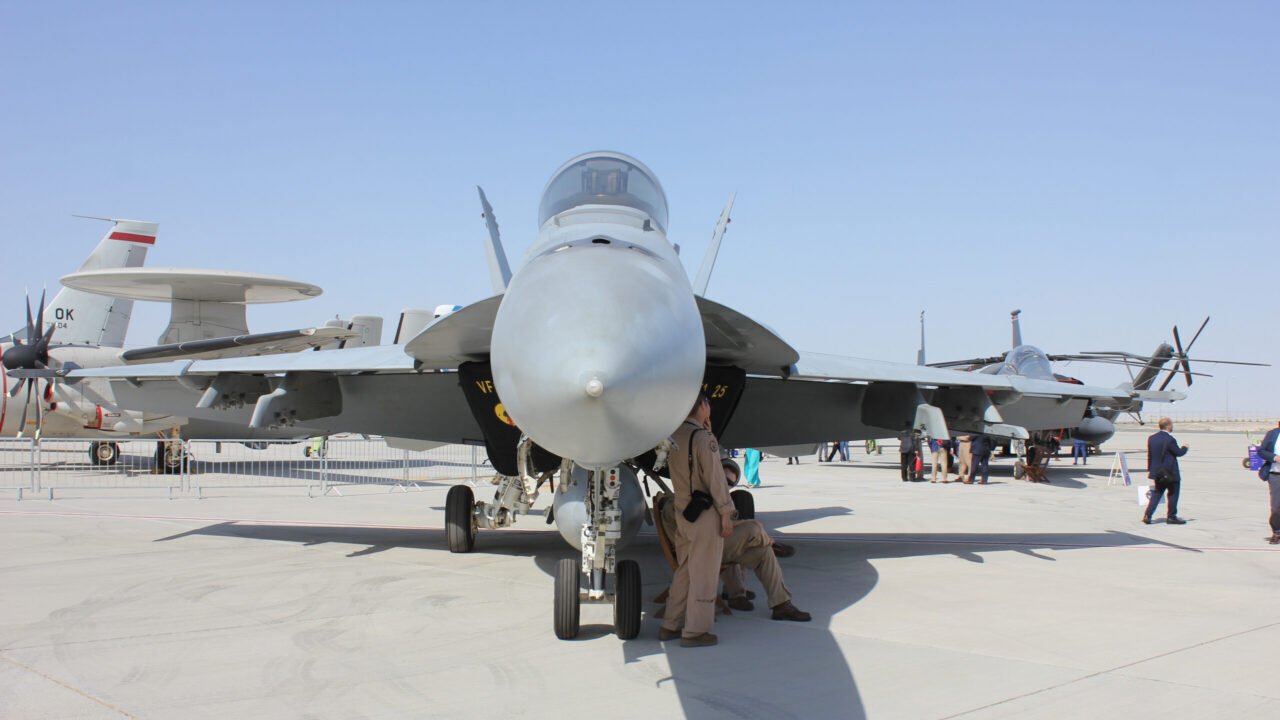
Arms sales serve to maintain informal alliances while largely sidestepping Congress. In 2025, government-to-government sales alone topped $100 billion a year. A major sale of jets, air defenses, or tanks brings American training, parts, and contractors for 30 to 40 years, and because the buyer depends on Washington to keep its forces running, Washington is drawn into whatever those forces do.
Congress’s only formal check, a joint resolution of disapproval under the Arms Export Control Act, has never succeeded, and an emergency declaration can override even the informal holds that once slowed sales. Nor are these commitments sold as commitments: the White House billed its 2025 Saudi agreement, with F-35s and nearly 300 tanks, as an America First win for American jobs.
US military bases work in a similar way. The Al Udeid in Qatar, Camp Arifjan in Kuwait, and Al Dhafra in the UAE rest on executive agreements the Pentagon negotiated. Congress funds the troops stationed there but never voted on the commitment they carry.
Gulf Arms Sales Need Oversight
If the executive branch builds these informal commitments, only Congress can deconstruct them. The Constitution gives it the power to declare war and the power of the purse, and the Congress elected on November 3 must use both.
Congress can act when it chooses to. In 2019, it passed a war powers resolution on Yemen and voted to block arms sales to Saudi Arabia and the UAE, though Trump vetoed both. Last December, it repealed the 1991 and 2002 Iraq war authorizations, and this year, the House has passed Iran war powers resolutions three times, most recently 220 to 204.
In June, Congress passed its first concurrent resolution telling a president to end a military action since the War Powers Act of 1973. That form, instead of a joint resolution like the one Trump vetoed on Yemen in 2019, spared it a presidential veto. Trump dismissed it as “meaningless,” and the White House has effectively ignored it, arguing that the War Powers Act itself is unconstitutional. In September, the Senate fell only one vote short of passing another.
After this week’s election results, this could and should be the moment such votes start to mean something. With Democrats set to hold both chambers in January, September’s one-vote gap should close, and a binding war powers resolution should reach the president’s desk.
To make that shift last, January’s Congress must look beyond this war. Politico reports that Democrats plan to use war powers votes, oversight hearings, and appropriations measures to press Trump to quit it. But that targets one president’s war, not the commitments behind it. A former Kamala Harris advisor already expects a Democratic White House to inherit “a total mess” on Iran in 2029, and given the party’s own long-standing hawks, no one can be sure that a president would use those commitments any more sparingly. Congress should therefore start by rewriting the laws that let presidents act first and inform Congress later.
It should amend the War Powers Act and the Arms Export Control Act so military operations and major sales to non-treaty partners require Congress’s approval, rather than proceeding unless Congress can pass a near-impossible, veto-proof joint resolution of disapproval. The War Powers Resolution should also define “hostilities” and automatically cut off funds for any operation Congress has not authorized beyond the 60-day limit.
Additionally, it should require congressional approval for new or renewed Gulf basing deals and for ongoing executive security pledges, starting with the Qatar order and the Saudi agreement, which should lapse without it. Because resolutions can be ignored and reforms vetoed, Congress should attach these changes to appropriations and defense authorization bills, the must-pass legislation a president cannot easily refuse. In the meantime, it should force a vote on every major Gulf sale and tie sustainment to one condition: no partner can drag Washington into its wars if it is not thoroughly in American interest, as defined by the representatives of the American people.
Reclaiming war powers is also one of the few causes that can still unite a bipartisan grouping, and the polls show that coalition reaches well beyond Congress. Democrats will soon have the gavels and should use them, but they should not treat their new majorities as a reason to go at it alone. A joint resolution, or better, reform that can survive a veto, will need Republican votes.
With new strikes reportedly waiting until after this week’s election, the question of who decides when Americans fight is on the ballot. Delaying new strikes until after the election would suggest that the White House knew voters would object, which is exactly why Congress must decide.
Why US Restraint in the Middle East Isn’t Weakness
Israel and the Gulf states deliver real American interests: energy stability, counterterrorism intelligence, and deterrence of Iran. The counterargument to congressional action on this issue would let China fill the vacuum in the Middle East.
The benefits of US ties in the region are real, but the informal military guarantees that purportedly secure them are not part of that. The United States is a net petroleum exporter, and Iran is currently weaker than at any point since 1979, according to White House intelligence. Its remaining power to hurt Americans lies in troops within its reach and in the Strait of Hormuz, which it closed only once the war began.
The price shock came from the war, not from weak deterrence. Gas rose from under $3 a gallon before the war to more than $4.27 by late October, and in one survey, 81 percent of respondents agreed the conflict had raised the cost of living. Americans are paying for this war twice, first through their taxes and again through higher prices.
Nor are US Middle East partners helpless. Saudi Arabia signed a defense pact with Pakistan in 2025 and widened it to Turkey this August in the Mecca Joint Defence Agreement, a step Trump himself welcomed. Between these pacts and the Abraham Accords, the region is building its own security. American intelligence sharing and open commerce would keep most of the value of engagement without guarantees that have proven so costly.
As for the vacuum, Beijing has shown no wish to fill it. China wants Gulf oil and markets, not responsibility for Gulf wars, and it is content to let Washington police the sea lanes that carry its imports. Guarantees also buy less loyalty than assumed: Riyadh let Beijing broker its 2023 détente with Tehran while still under the American umbrella. And presence has its own price. After the Gaza war began, American favorability in Arab states dropped sharply within weeks, while China, untied to the region’s wars, gained support. American restraint would not hand China the region; it would stop handing China free wins.

Reclaiming Constitutional Authority
The danger to American power is not retreat, but the habit of treating every partner’s problem as America’s own. Trump’s last-minute announcement that $4 billion in annual American aid to Israel next year would be a good first step in breaking that habit. But it came on election day, from a president with a history of empty campaign promises, so it remains to be seen whether he will follow through. Even if he does, aid to Israel is far from the only commitment the United States has in the region.
Rational congressional judgment is not isolationism either; it is the founders’ balanced view of executive power. The question for the next Congress is whether it will reclaim its constitutional judgment powers or keep letting others decide how American taxes are spent, for what cause, or worse, when Americans should die. They should judge the party by whether it demands a vote on every one of these commitments, including when a Democrat next sits in the Oval Office.