
The Hormuz blockade has driven energy costs upward across Europe, Asia, and the Gulf. Growth forecasts fell, inflation rose, and industrial sectors faced shortages. Washington’s allies absorb the heaviest economic damage while the U.S. remains insulated.
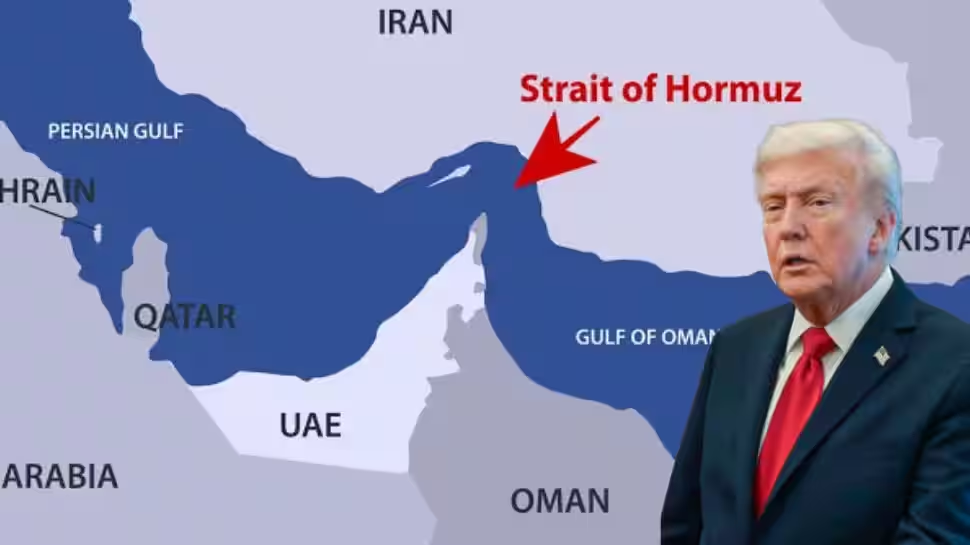
The closure of the Strait of Hormuz has transformed a military confrontation into an economic crisis that now spreads far beyond the combatants. The Hormuz blockade has trapped not only Iranian oil exports but also the assumptions underpinning U.S. security guarantees.
Washington’s allies across Europe and Asia face soaring energy costs, disrupted supply chains, and declining industrial output, all while the United States itself remains comparatively insulated due to domestic energy production. The blockade exposes a structural asymmetry: American power can withstand the shock, but the partners who host U.S. bases, align with U.S. policy, and depend on Gulf hydrocarbons cannot. European growth forecasts have fallen, Asian manufacturing hubs confront feedstock shortages, and Gulf states hosting American forces now absorb direct attacks on their infrastructure.
The Hormuz blockade therefore functions as an economic weapon with global reach, but its damage concentrates among friends rather than adversaries. The war’s failure to produce a quick victory has deepened the sense that the global economic order cannot be dictated solely by Western powers. The longer the closure persists, the harder it becomes for Washington’s allies to absorb the costs without questioning the strategic assumptions that placed them in harm’s way.
Hormuz blockade Hits European Allies
The crisis and blockade in the Strait of Hormuz have driven up energy costs, forcing the EU to lower its economic growth forecasts for 2026 and creating intense cost pressures across the continent. This new burden follows the energy disruption and public spending commitments associated with the Ukraine war.
The sudden surge in energy costs has raised expenses across industrial production and transportation. The interruption of traffic through the strait has exposed Europe to a serious risk of jet fuel and other refined fuel shortages. Higher energy bills and increased business expenses are squeezing household purchasing power and damaging consumer confidence.
European governments have introduced tax cuts and direct support packages, although their responses differ. The blockade has created a shared energy and supply chain shock, but its effects depend on each country’s industrial structure, import dependence, and capacity to absorb higher costs.
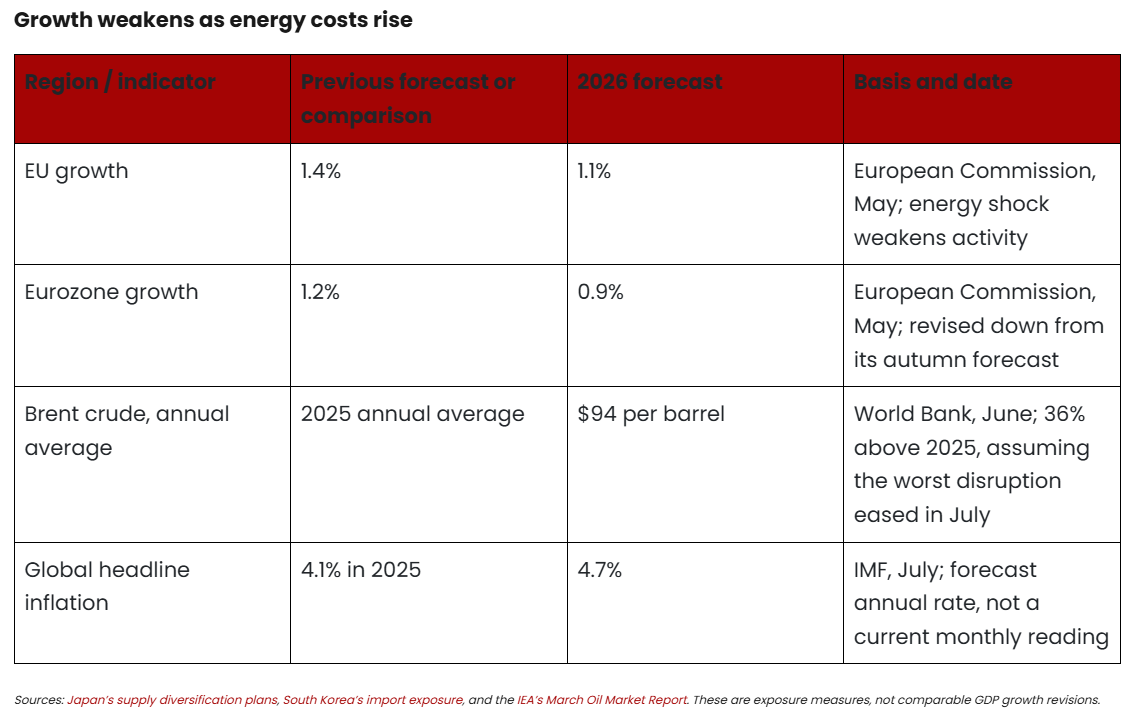
The European Commission’s May forecast lowered projected EU growth to 1.1 percent and eurozone growth to 0.9 percent. The World Bank’s June assessment likewise cut the global growth outlook, while the International Monetary Fund’s (IMF) July update raised its forecast for global inflation.
The figures come from different institutions and forecast rounds, but point to the same pressure: more expensive energy is weakening growth and complicating efforts to bring inflation down.
Growth weakens as energy costs rise
The EU’s industrial engines under strain
Germany, Europe’s largest economy, faces renewed pressure on manufacturing. The chemical, automotive, and heavy industrial sectors are vulnerable to high energy costs. More expensive crude oil and liquefied natural gas (LNG) feed into production costs, while disruption to Gulf supplies threatens the delivery of petrochemical feedstocks, packaging materials, and other industrial inputs.
France obtains about 70 percent of its electricity from 57 operable nuclear reactors, providing some protection against the shock. Its transportation sector and household spending remain exposed, however. Most cars, commercial vehicles, and ships still rely on petroleum fuels, and higher freight costs feed into the prices of finished goods, from food to furniture.
The threat of a jet fuel shortage is among aviation’s most serious concerns. Airlines have faced higher costs and flight reductions, even where physical fuel supplies have remained available. In May, the EU energy commissioner warned of longer-term supply risks, while saying there was no immediate shortage.
Paris has faced pressure to shield consumers, but fiscal constraints have limited its response. The French finance minister argued against broad tax reductions and favored temporary, targeted assistance. Yet the political problem remains as households expect protection while the government is trying to contain its deficit.
Italy, already burdened by high public debt, faces a similar dilemma. Supporting households and businesses costs money at a time when borrowing is becoming more expensive. Italian Prime Minister Giorgia Meloni has pressed for greater flexibility in EU fiscal rules, bringing the clash between energy relief and budget discipline into the open.
Britain’s island exposure
The blockade and the Iran war have delivered a twin shock to the UK economy through energy and trade. Although the UK obtains substantial oil and gas supplies domestically and from Norway, its costs remain tied to international markets. Buying from a different producer does not insulate a country from a global price increase.
London’s concern is the risk of renewed inflation alongside weak growth. The latest available ONS figures put annual consumer price inflation at 2.9 percent in July, up from 2.6 percent in June. Food and non-alcoholic beverage inflation stood at 1.3 percent. The increase in headline inflation adds to pressure on households already facing high living costs.
The Bank of England’s July policy statement warned that inflation was expected to rise “as the effects of higher energy prices continue to pass through.” Bringing it under control risks putting further pressure on an already weak economy.
Higher oil prices have also increased the pressure on aviation. Major hubs such as Heathrow and Gatwick depend on reliable fuel supplies, leaving them exposed to prolonged disruption in the Gulf. The UK government’s published guidance said airlines were not experiencing a jet fuel shortage when it issued its assessment, while contingency measures sought to reduce the risk of last-minute cancellations.
As an island country, Britain is heavily dependent on maritime transportation for consumer goods and industrial inputs. Where Asia–Europe services avoid the Red Sea and sail around the Cape of Good Hope, longer journeys add freight costs and delay deliveries. These diversions compound the Hormuz shock, although they concern a separate passage and do not provide an escape route for vessels trapped inside the Persian Gulf.
Britain’s military commitments create additional demands. London and Paris have led multinational planning for a mission to protect navigation through Hormuz once conditions permit. Protecting trade routes requires ships, personnel, and sustained funding, adding to the obligations of a state already trying to reconcile defense spending with pressure on public services.
Asia bears the supply shock
That is the situation in the west. In the east, the dependence on Gulf energy is even more direct. East and South Asia are among the regions most exposed to the crisis, and hopes that diplomacy would quickly restore normal traffic have repeatedly run ahead of events.
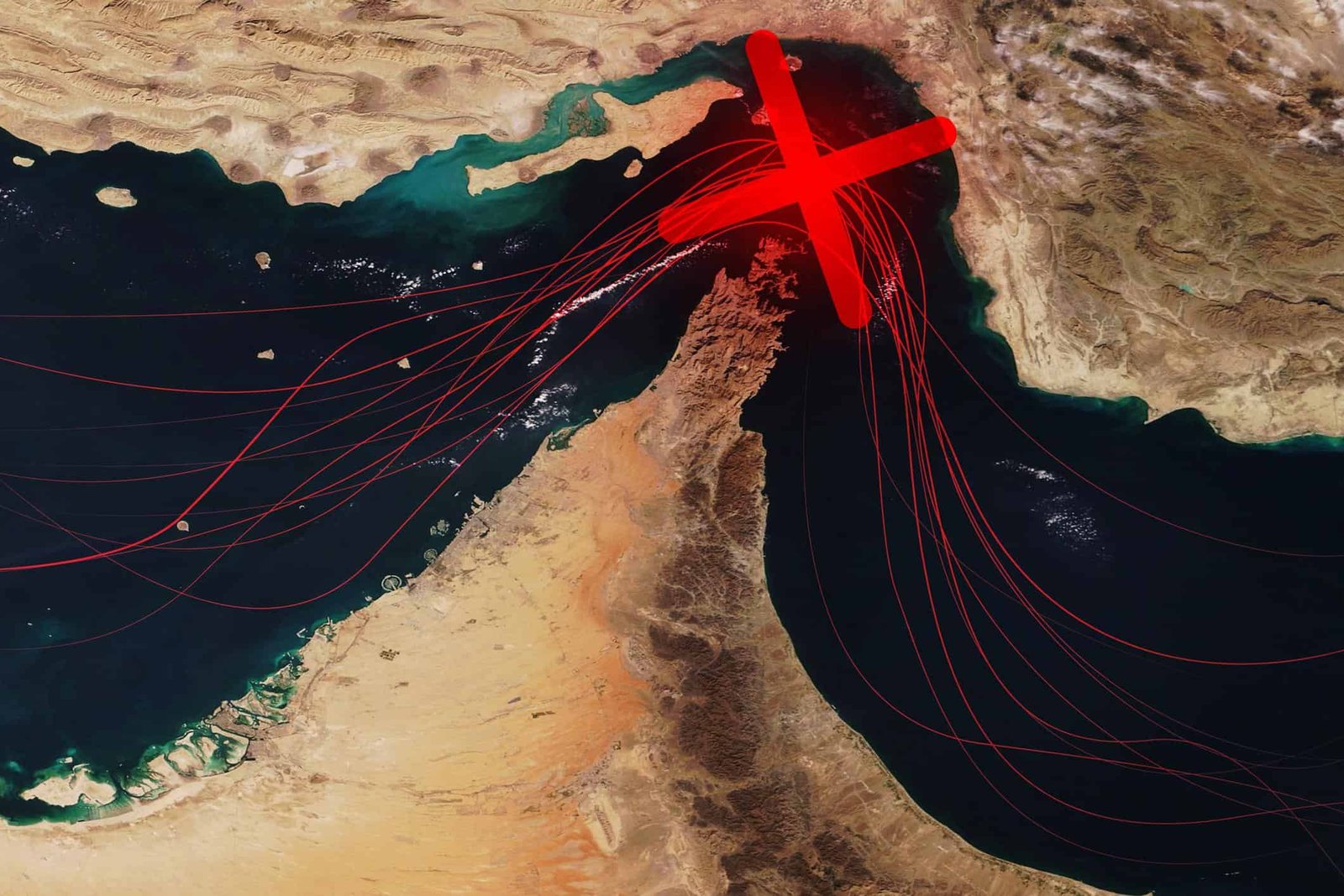
The effective closure of the strait has struck at a supply route serving the industrial centers of Asia. The US Energy Information Administration (EIA) estimates that 84 percent of the crude oil and condensate, and 83 percent of the LNG, passing through Hormuz in 2024 went to Asian markets.
China, India, Japan, and South Korea are major buyers, although they enter the crisis with different reserves, domestic energy resources, and options for replacing interrupted supplies. Their exposure cannot be measured by import volumes alone. The ability to pay for alternatives and move them to consumers also matters.
Indian farmers face a mounting bill
India imports about 60 percent of its liquefied petroleum gas (LPG) needs, with Gulf cargoes central to that supply. The disruption has created price pressure from cooking gas cylinders to industrial fuel. According to the Centre for Research on Energy and Clean Air (CREA), India’s LPG import bill for March–August was approximately $4.7 billion, including an estimated $1.1 billion in additional crisis-related costs.
Total LPG imports fell 49 percent in March compared with the average of the corresponding month in the previous two years. The US share of imports rose to 32 percent in April, replacing part of the lost Gulf supply. The six-month cost estimate combines reported trade data with estimates for later months.
New Delhi also turned back toward Russian oil as Gulf supplies became less reliable. Energy security has forced India to weigh western pressure against the immediate needs of its refineries, businesses, and households.
Fertilizer has delivered another blow. The World Bank’s April commodity forecast projected a 60 percent rise in urea prices for 2026. In a country where agriculture supports a large share of the population, costlier fertilizer and disrupted feedstock supplies increase pressure before the planting season and raise the cost of shielding farmers.
Agriculture, livestock, forestry, and fishing grew by 3.6 percent in April–June 2026, down from 4.4 percent a year earlier.
While rainfall, harvest conditions, and domestic demand also shape agricultural growth, disrupted supplies and higher fertilizer costs add to farmers’ difficulties. Shielding them from those costs through subsidies puts further strain on the government’s budget.
CREA estimates India’s net additional fossil fuel cost at $14.4 billion, equivalent to 0.38 percent of GDP. An additional bill of that size draws resources away from other spending, even before the wider costs of interrupted production are counted.
In April, the Reserve Bank of India expected growth of 6.9 percent in 2026–27, against an estimated 7.6 percent in the preceding financial year. The projected slowdown leaves New Delhi facing weaker momentum while it tries to contain the cost of supporting consumers and producers.
Dependence carries a freight premium
High dependence on Gulf oil has made insurance another source of pressure. Early in the conflict, reported war-risk premiums rose from about 0.25 percent of a vessel’s value to 1–1.5 percent, a four- to sixfold increase. Rates have fluctuated with the fighting and ceasefires rather than remaining at one fixed crisis level.
Replacing Gulf cargoes with supplies from more distant producers increases shipping distances, fuel consumption, and demand for tankers. Rerouting around Africa can avoid the Red Sea, but neither the Cape nor Suez bypasses Hormuz for cargo still inside the Persian Gulf. Export pipelines leading to terminals outside the strait offer a limited alternative.
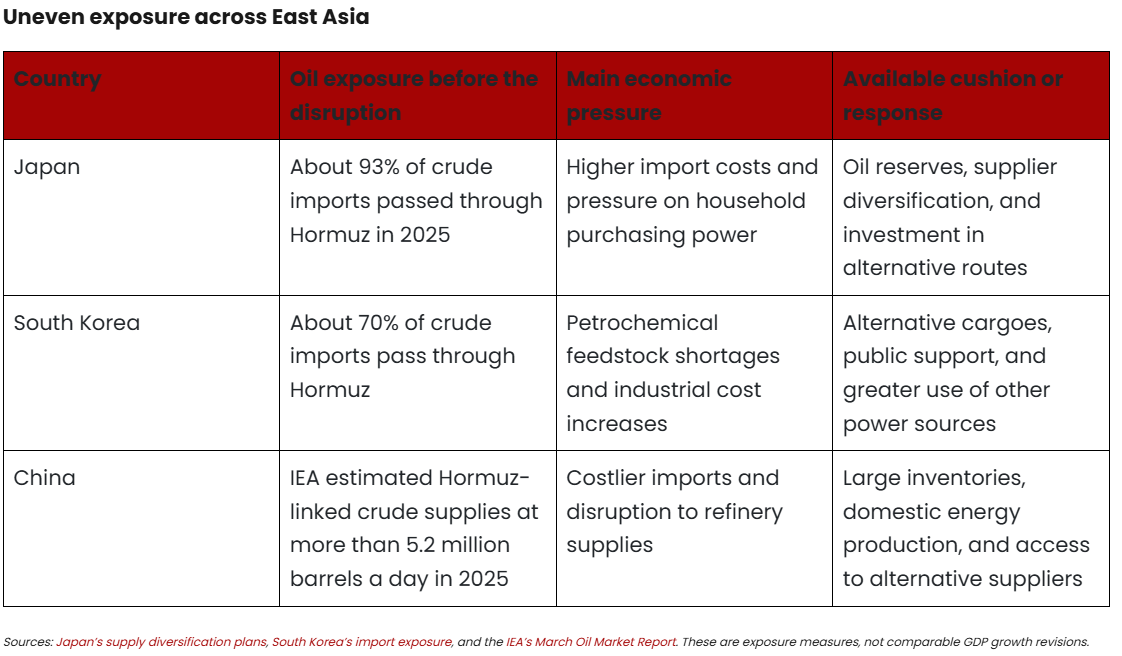
Uneven exposure across East Asia
Japan’s expensive dependence
Japan entered the crisis with an aging population, labor shortages, a very large public debt burden, and the legacy of decades of weak demand and deflation. The Hormuz shock has added an external, supply-side increase in costs at a time when inflation has already replaced deflation as an immediate policy concern.
For a country obtaining more than 90 percent of its crude imports through this route before the war, the disruption directly raises the cost of key production inputs and threatens purchasing power. A weak yen compounds the problem as importers must find more yen to pay bills denominated in dollars, even before any increase in the dollar price of oil.
To address inflationary pressures, the Bank of Japan raised its policy rate by 25 basis points in June, bringing it to one percent. The increase extended its tightening cycle, raising borrowing costs as households and businesses were also confronting more expensive imports.
Japan and the US subsequently launched a rare joint currency intervention to prop up the yen, but the relief was short-lived. The currency resumed its slide as higher US interest rates continued to favor the dollar.
Alarm bells continue to ring across the Japanese economy. A further rate increase was under discussion ahead of the September meeting, while Tokyo has sought to diversify oil supplies and support routes that bypass Hormuz. The need for alternatives has become more urgent, even though building them will take time.
South Korean industry cuts back
South Korea obtains about 70 percent of its oil and 20 percent of its LNG from West Asia. The crisis has therefore struck directly at manufacturing and chemicals, where energy and petroleum-derived feedstocks are essential to production.
Petrochemicals, plastics, and other energy-intensive industries face higher costs and pressure to reduce capacity. Naphtha shortages are especially serious because the material is used to make products that feed into automotive manufacturing, electronics, packaging, and construction. A shortage at this stage can spread through industries far removed from oil extraction.
The government has sought to cushion the shock through public support and measures to secure supplies. In late March, it proposed a 26.2 trillion won supplementary budget to assist households and businesses. Such intervention shifts part of the immediate burden to the public finances, even when it prevents larger losses elsewhere.
Southeast Asia’s energy paradox
Southeast Asian industry also depends on Gulf crude oil, LNG, and petrochemical inputs. Higher energy costs and interrupted supplies place factories and employment at risk across the Association of Southeast Asian Nations (ASEAN), although the severity varies substantially between countries and industries.
The Philippines faces an additional exposure through approximately 2.4 million Filipinos working in West Asia. Their safety, employment, and ability to send money home are all vulnerable to a prolonged conflict.
Malaysia and Indonesia, two major Southeast Asian economies, face an energy paradox. Both produce oil and gas and can benefit from higher commodity prices, yet domestic production does not eliminate dependence on imported fuels, international prices, or costly consumer subsidies.
Both governments have maintained subsidized fuel prices while introducing purchase limits. Higher export earnings can provide a cushion, but the cost of protecting households rises too. The balance depends on the fuels each country produces, imports, and subsidizes. Gains for an exporter or a state energy company can coexist with growing pressure on the households and industries buying its fuel.
Hormuz blockade Erodes Gulf Security
Then there is West Asia itself, where the war began. The US-Israeli assault on Iran in late February and the subsequent disruption of Hormuz have exposed Washington’s Gulf allies to crises on several fronts. Attacks on energy facilities and civilian infrastructure have brought the economic consequences of war directly into states that host US military forces.
Forecasts have deteriorated sharply, but the damage is uneven. The IMF’s April projections put Qatar’s contraction at 8.6 percent, Kuwait’s at 0.6 percent, and Bahrain’s at 0.5 percent. The disruption has continued well beyond those April forecasts.
Qatar faces particularly severe damage to its LNG-dependent economy. By late August, Oxford Economics was warning of a contraction approaching 30 percent, given damage at Ras Laffan. The deterioration since the spring outlook reflects the scale of the damage to facilities on which Qatar’s export earnings depend.
Kuwait’s lack of a maritime outlet outside Hormuz leaves its exports acutely exposed. Bahrain, already heavily indebted, faces additional financing pressure; its credit default swap prices had risen almost 40 percent by late August. The cost of insuring government debt offers another measure of the uncertainty now surrounding the region.
Riyadh cushions its losses, Dubai loses ground
Saudi Arabia and the UAE have more scope to soften the shock, although neither has escaped it. The IMF’s April forecast still projected 3.1 percent growth for each, despite cutting Saudi Arabia’s outlook by 1.4 percentage points and the UAE’s by 1.9 points. Their alternative export routes provide some protection, but leave much of the wider economy exposed.
Saudi Arabia’s East–West Pipeline has allowed it to export some oil through the Red Sea, bypassing Hormuz. Higher oil prices have also partly offset lower volumes. The kingdom’s experience shows why damage to production and changes in revenue do not always move together.
Even so, the economic losses are substantial. Saudi oil activity fell 24.7 percent in the second quarter, while overall GDP contracted 4.8 percent year on year. Its budget deficit was approximately $9.1 billion, despite the benefit of higher petroleum revenues.
The UAE, particularly Dubai and Abu Dhabi, has suffered through its role as a global logistics, tourism, and financial center. According to JPMorgan estimates reported in late August, Dubai property sales had fallen 70–80 percent, while UAE stocks were down around 14 percent during the conflict.
Regional airspace closures initially forced major airlines to suspend or sharply reduce operations. Emirates reported restoring 96 percent of its global network by 4 May. Reopening routes nevertheless leaves airlines exposed to higher fuel costs and renewed security interruptions.
Abu Dhabi has also used the Habshan–Fujairah Pipeline to maintain some oil exports through the Gulf of Oman. Like the Saudi route, it provides a valuable outlet, but cannot replace every shipment or restore the confidence on which the wider economy depends.
The cost reaches the household
The crisis extends beyond oil revenues and financial markets into everyday life. The vulnerability of desalination plants is especially serious in states where drinking water depends overwhelmingly on energy-intensive coastal facilities. An attack on a plant, its power supply, or its distribution network threatens an essential service with few immediate substitutes.
Supply chain interruptions also raise the cost of importing food and other necessities. Even where government intervention or existing stocks prevent shortages, replacing cargoes and maintaining supplies carries an additional expense. Those costs must be absorbed by importers, households, or the state.
Repairing the damage across Iran and the Arab states of the Persian Gulf could cost $34–58 billion, according to Rystad Energy’s April assessment. Beyond oil and gas facilities, the bill extends to factories, power stations, and the desalination plants on which much of the region depends for drinking water.
Arms spending presses on development
The Hormuz blockade and damage to oil facilities, water systems, and civilian infrastructure are forcing Washington’s Gulf allies to reassess their security arrangements. Hosting US forces has not insulated them from the war’s economic consequences, while repairing essential infrastructure creates obligations that will outlast any ceasefire.
Defense spending now competes with reconstruction, public support, and long-term development. Infrastructure investment has not stopped: Gulf states are also accelerating plans for ports and pipelines that reduce dependence on Hormuz. But the need to finance alternative routes is itself part of the price of the war.
Billions that could improve public services and living standards risk being absorbed by arms purchases and the repair of what has been destroyed. The longer this continues, the more Washington’s allies will be required to spend simply to preserve the security and prosperity that their alliance was supposed to guarantee.