
House rejection of Iran strike authority exposes Trump’s waning congressional control. Republican defections, eroding poll numbers, and a pivot to domestic grievances confirm that striking out on Iran defines his current political crisis.
Legislative rebellion on Capitol Hill suggests the president’s once-iron grip on foreign policy is fracturing. Striking Out on Iran has become a tangible risk after the House defied Trump on fresh military authorization. Yet the true story of Striking Out on Iran may be less about Tehran and more about Trump’s collapsing domestic authority.
Striking Out on Iran Vote Defeat
On Wednesday, the House of Representatives voted to block President Donald Trump from carrying out fresh strikes on Iran by a 215-208 vote—an embarrassing setback for the president, who saw four Republicans defect. It comes on the heels of several other defeats, including the Senate’s refusal to authorize either Trump’s proposed slush fund for January 6 malefactors or his opulent ballroom. What did pass the House was a bill authorizing fresh funds for Ukraine, the embattled country that Trump, who dispatched a special delegation to the St. Petersburg International Economic Forum, regards with no little venom. Has the tide turned against Trump?
Why GOP Is Striking Out on Iran Too
The very measures that Trump has taken recently to fortify his hold on the GOP may have undermined it. He endorsed the rivals of Senators Bill Cassidy and John Cornyn, but the effect has been to liberate them—and offer a potent reminder to other Republicans that loyalty with Trump is a one-way street. He now confronts an increasingly refractory Republican Congress, one that is calculating that fidelity to Trump may be a potent recipe for electoral defeat in the midterm November elections.
A Fox News poll, for example, indicates that not only is Trump’s standing eroding in states such as Ohio, but that Democratic challenger Sherrod Brown leads incumbent Sen. Jon Husted by eight points. Should the GOP lose the Senate as well as the House to the Democrats, it would be an epochal defeat for Trump.
The Reluctance Behind Striking Out on Iran
For all the nascent attempts of some in the GOP to divorce themselves from the Iran war, the funny thing is that Trump himself appears to display little avidity for renewed hostilities. Even as Iran takes potshots at Kuwait and other Gulf countries, the president is striking a blasé attitude. The Strait of Hormuz remains bottlenecked, and gas prices continue to rise; Trump’s foray into the Middle East threatens not only higher gas prices in America, but calamity for the world economy.
In his press conference on Wednesday, however, Trump indicated that the ceasefire was doing well, indicating that he had a more elastic definition of what constituted one “in that part of the world.” Presumably this would come as news to Kuwait, whose airport was bombed by Iran earlier in the day.
Striking Out on Iran Means Attacking Home
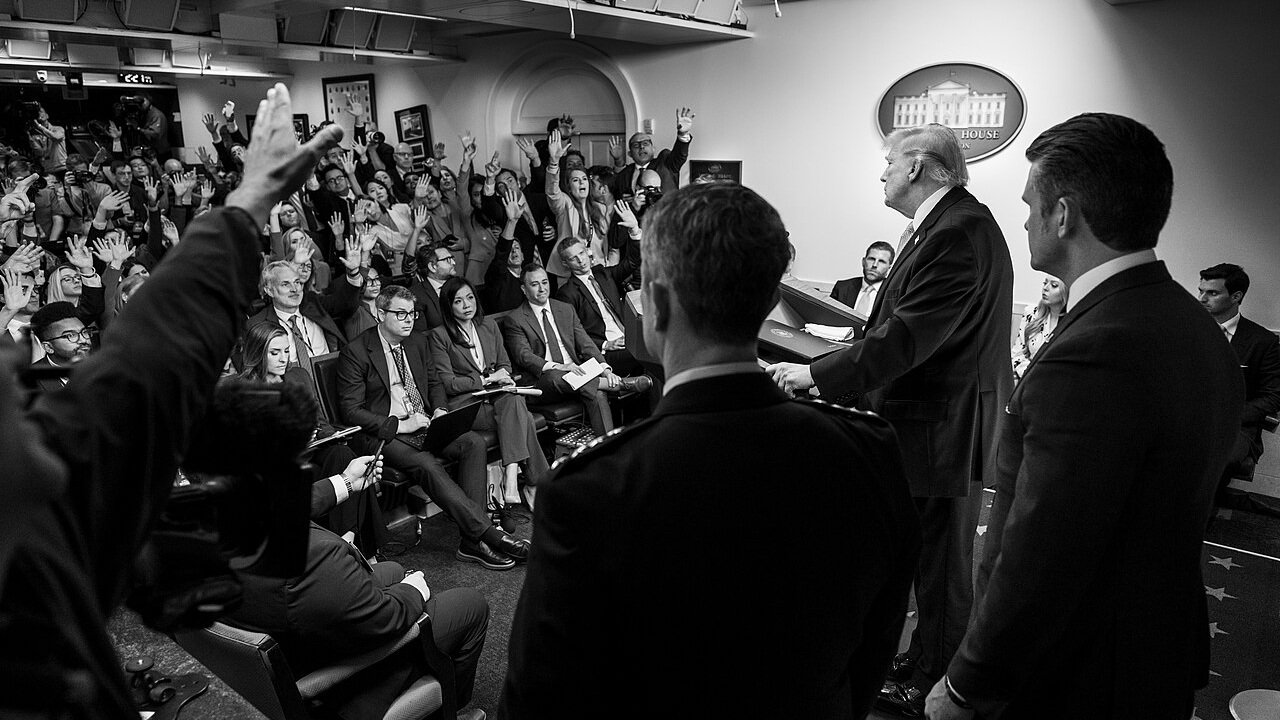
Trump reserved his true fire for the “radical left judges” who he claimed had “destroyed” the lives of his supporters, which was why he remained enamored of his proposed “weaponization” fund. (The Washington Post has revealed that Trump’s efforts to bolster the January 6 crowd have included hiring one Elias Irizarry to serve in the Pentagon’s Special Operations and Low Intensity Conflict office.
Video footage shows that on January 6 Irizarry clambered into the US Capitol while holding a metal pole.) At the news conference, Trump also denounced CNN’s Kaitlan Collins before she even had an opportunity to pose a question, declaring “I never see a smile on her face. I see her standing there with hatred in her eyes, like, she has hatred because we have borders, because we have a strong military, because we cut our taxes, because we do things that everybody wanted and then we win our election in a massive landslide.”
Trump Is Truly Striking Out on Iran
As he confronts the unpalatable choice of upping the ante in Iran or sidling away, Trump is more than likely to focus his attacks, as far as possible, on his real and perceived domestic adversaries. How effective they will be is another matter. The nimbus of power and resolve that previously surrounded him has begun to erode as his war effort falters and as he is about to become an octogenarian president. Trump, one could even say, is striking out.