
Israeli spy networks exploit telemedicine, aid coercion, and travel vulnerabilities to penetrate Palestinian, Lebanese, and Iranian resistance movements. Strict post-breach protocols and travel suspensions aim to limit damage, but paralysis often persists.
The operational resilience of Palestinian and Lebanese resistance movements has long depended on their ability to shield internal archives from outside scrutiny. Yet Israel’s decades-long campaign of penetration, recruitment, and assassination has repeatedly forced those movements to confront breaches that cannot be acknowledged publicly without compounding the damage. Israeli spy networks have evolved from relying on face-to-face handlers to exploiting telemedicine, scholarship programs, medical travel, and diaspora access, widening the attack surface far beyond traditional agents of influence.
The result is a security environment in which a single compromised cadre can abort an operation, poison trust among commanders, and paralyze an entire organization for years. Recent conflicts in Gaza, Lebanon, and Iran have exposed the depth of these vulnerabilities, as Israel’s ability to map both operational methods and human weaknesses has outpaced the resistance’s capacity to impose counterintelligence discipline.
Accounts from Lebanese and Palestinian security sources describe strict travel protocols, post-breach suspensions, and the painful recognition that recruitment often succeeds not through money alone but through the private story a target wishes to believe about himself. Israeli spy networks thus represent a threat that operates below the threshold of conventional war, yet they shape battlefields before the first shot is fired. Understanding how these networks function—and why they have proven so difficult to uproot—is essential for any serious assessment of asymmetric conflict in the region.
How Israeli Spy Networks Operate
Every resistance movement has sensitive files it cannot open to the public. Palestinian and Lebanese archives are filled with accounts of agents, failed operations, and breaches whose full circumstances may never be disclosed. Other secrets died with the people who carried them, leaving black boxes scattered across Syria, Iraq, and beyond.
Some details are withheld to spare organizations embarrassment, while others could compromise methods, expose surviving networks, or show the enemy how a breach was uncovered. Public disclosure also risks turning an isolated case of collaboration into evidence of wider decay within the resistance.
Secrets the resistance cannot publish
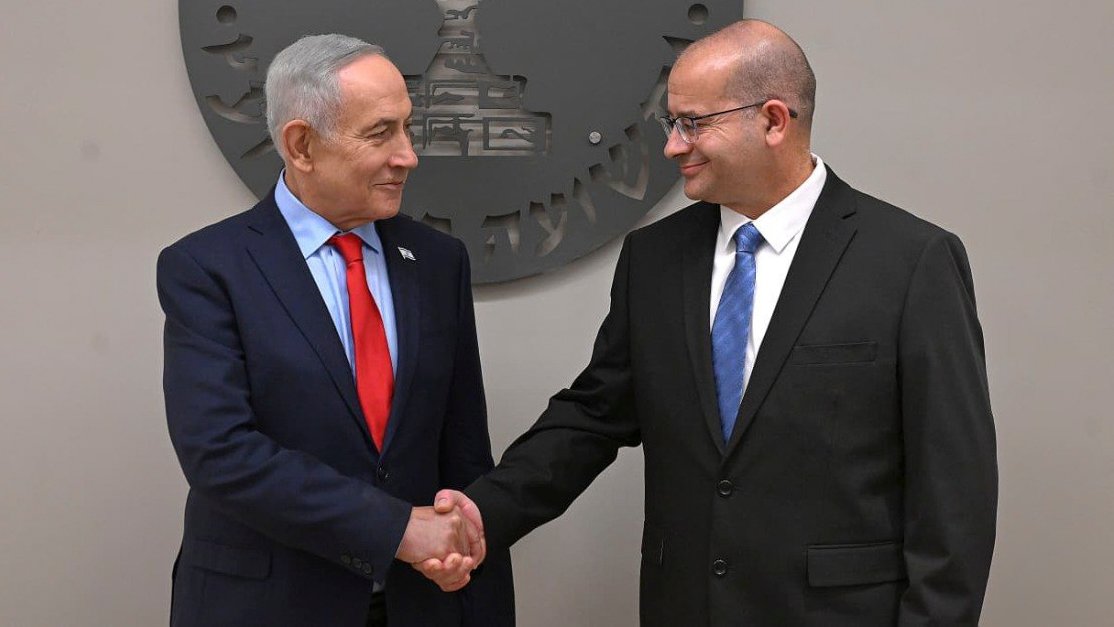
Facing fewer restraints, retired Israeli officials publish memoirs, former operatives brief journalists, and the details of old assassinations become material for books and television. Former Mossad director Yossi Cohen’s 2025 memoir, “The Sword of Freedom,” is one recent example. Ronen Bergman’s “Rise and Kill First” drew on roughly a thousand interviews and thousands of documents to reconstruct Israel’s long assassination campaign.
Personal ambition, political rivalry, and institutional score-settling shape these accounts as much as the historical record. One former Mossad chief reportedly supplied analysts and writers with extensive details of past operations to settle political scores with Israeli Prime Minister Benjamin Netanyahu, with some of that material finding its way into Bergman’s book. Israel’s freedom to publish also reflects a deeper confidence that its enemies may learn the method yet still lack the reach to answer it.
Other books in this field have a more overtly propagandistic purpose. Some appear designed to lead the resistance toward a particular version of events and close a sensitive file before the full picture emerges, especially when the operation is recent.
Yet these accounts can still yield useful fragments. The index to Bergman’s book, for example, names Noam Erez as the Israeli operational official responsible for Imad Mughniyeh’s assassination. Elsewhere, it claims that Yahya Ayyash met Hezbollah leaders in Marj al-Zuhur, despite Ayyash never having been among the Palestinians deported there in 1992.
Such discrepancies may result from poor sourcing or deliberate misdirection, but either way they show why Israeli accounts must be read for what they reveal inadvertently as much as for what they claim outright.
The resistance therefore needs its own record, even if names and countries must be withheld, to understand what each penetration changed, how it survived, and which defensive measures worked. Such protection and prevention belong to the practice of resistance as surely as the operations conducted in public view.
Recruitment without a handler
Israel’s recruitment methods have changed over more than eight decades. Agents were cultivated before the occupation of Palestine, but the communications revolution of the past thirty years has widened the number of possible entry points.
A recruiter no longer needs repeated face-to-face meetings. Financial distress, private correspondence, medical records, travel histories, and intimate relationships can be mapped from a distance before the target realizes that an approach has begun.
Recent wars have added harsher forms of coercion. In Gaza, Israel has sought to turn entire families into local auxiliaries by tying survival, aid, or permission to remain in place to cooperation. In September 2025, The Cradle reported that members of the Dughmush and Bakr families were killed after rejecting approaches from the Shin Bet.
Arabic reporting, citing the EuroMed Human Rights Monitor and family representatives, described offers of money, weapons, and protection in return for forming armed groups modeled on Yasser Abu Shabab’s militia.
Marwan Bakr, the family’s ‘mukhtar,’ said the occupation army offered to let them remain in exchange for cooperation, but they refused: “We will not be tools in the hands of those who kill us.” Nizar Doghmush, head of his family council, likewise believed that “death is easier than the stigma of betrayal.” These individual positions form the nucleus of collective steadfastness, but every refusal has a price.
The approaches to the two families form part of Israel’s wider effort to construct armed Palestinian alternatives to Hamas and place aid routes under their control. Its proxy strategy in Gaza turns existing clan disputes, criminal networks, and political rivalries into instruments of occupation. Elsewhere, the same logic allows Tel Aviv to encourage a local killing without exposing the outside hand that selected the target.
In Iran, access was pursued through a different route. On 26 June 2025, an X account identifying itself as Mossad Farsi advertised a telemedicine service for Iranians through WhatsApp, Telegram, and Signal.
The post offered Persian-speaking specialists in cardiology, diabetes, infectious disease, oncology, gynecology, and psychology, and advised prospective users to connect through a VPN. Israeli media treated the service as a Mossad initiative, although the agency declined to confirm the account when asked by Israel Hayom.
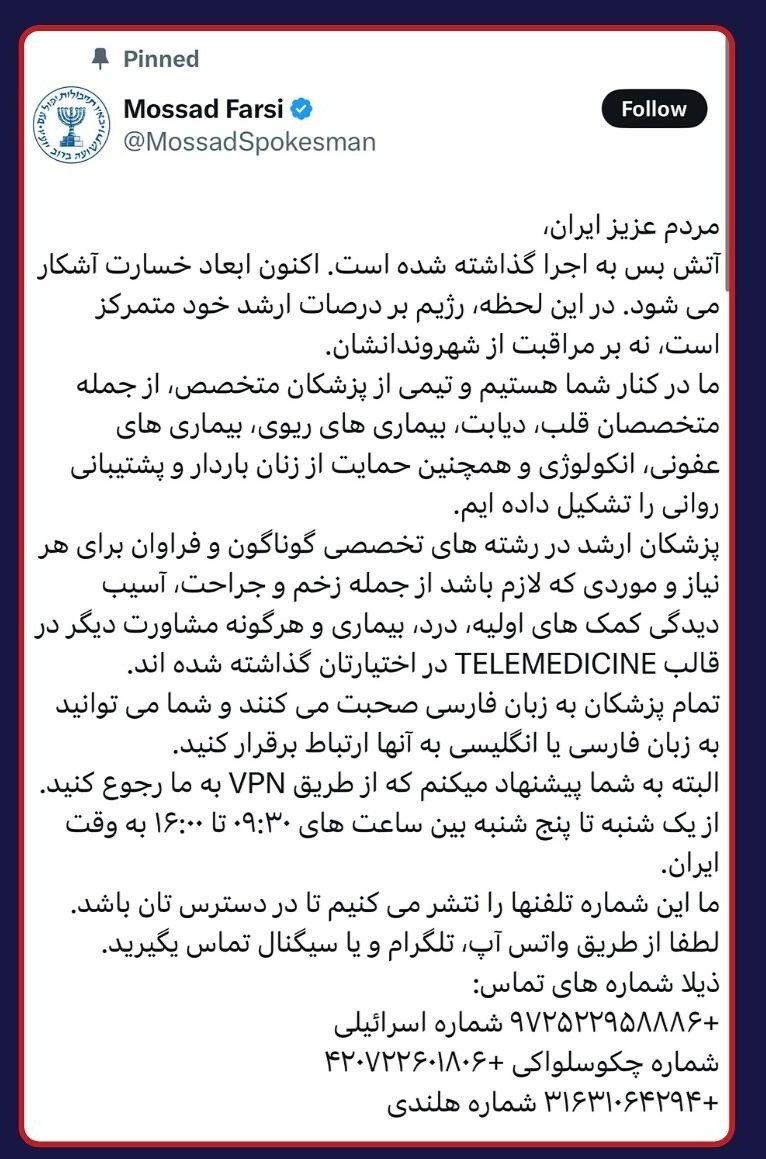
Whether the account was officially run by Mossad matters less than the opening it created. A medical consultation can yield names, locations, family ties, health records, personal vulnerabilities, and a private line of communication.
The offer also served Israeli propaganda by presenting an enemy intelligence service as more attentive to Iranian citizens than their own government, while quietly probing loyalties and building access.
Scholarships, exchange programs, professional conferences, cafes, and diaspora associations can serve the same purpose. Students in sensitive technical fields are especially valuable because recruitment abroad is harder to detect once they return home. The method need not begin with an explicit request to spy. Access is built gradually through favors, status, travel opportunities, and proximity to people with money or influence.
Protocols written after the breach
Speaking to The Cradle, a Lebanese security source describes the problem bluntly:
“Someone recruited abroad is far more difficult to detect. The resistance therefore has strict protocols. For example, entering the embassies of certain countries, or even passing through those countries in transit, is sufficient grounds for suspension or dismissal.”
The source adds:
“If a cadre travels without permission, even to a country that is neither hostile nor suspicious, the minimum decision is to suspend that person for years. That is enough time for the handler to lose any hope of benefiting from the cadre if he has been recruited.”
Not every organization adopted such rules early enough. A Palestinian source points to the abduction of a mid-ranking cadre in an Asian country. Local authorities freed him before he was killed, but not before he surrendered the information he held. The source reveals:
“As a result of this incident, a decision was taken to prevent even those who had resigned from their duties from traveling until three years after the date of resignation. During this period, the direct superior must ensure that all relevant arrangements are changed immediately if any cadre travels or suddenly disappears.”
Beyond money, blackmail, or ideology, some captured agents have described a need to feel important, a desire for foreign citizenship, or the attraction of access to influential people. Recruitment often succeeds when an intelligence service identifies the private story a target wants to believe about himself, long before it assigns him a mission.
The scale of the danger is visible in Lebanon, where the Internal Security Forces and Hezbollah have repeatedly uncovered Israeli networks spanning sects and nationalities. In 2022, authorities announced the dismantling of what was described as the largest Israeli spy network discovered in the country.
Iran’s arrests after the June 2025 war likewise showed how recruitment can spread across logistics, transport, communications, and ordinary civilian work rather than remain confined to officials with obvious access.
Medical Travel as a Trap
Medical travel creates a particularly difficult exposure because patients and relatives must surrender documents, diagnoses, contact details, and travel plans to hospitals, charities, insurers, visa offices, and intermediaries.
Although most of those bodies are legitimate, a hostile service needs to compromise only one link in the chain to identify a vulnerable person or begin an approach that appears unrelated to politics. The danger grows when urgent treatment abroad leaves the patient dependent on whoever can accelerate an appointment, secure a visa, or cover the bill.
The 2024 Israeli war on Lebanon and Israel’s 2025 attack on Iran exposed security failures that public rhetoric could no longer cover. A resistance movement can compensate for weaknesses while the enemy remains uncertain about its capabilities.
Once Israel has mapped both, speeches carry little weight. By then, the battlefield has already been shaped by what was surrendered behind the lines.
When Israeli Spy Networks Destroy Operations
The most destructive agent does more than pass names or coordinates. Advance warning can allow Israel to abort an operation, redirect a target, or let the plan proceed far enough to turn it into a trap. The result is not measured only in casualties. A failed operation can provoke paralysis, internal accusations, and years of fear among cadres who no longer know which part of the chain was compromised.
Israeli officials and aligned journalists claim in their own defense that for many years they had no significant agent within Hamas’s senior military leadership. This, they say, is why Operation Al-Aqsa Flood proceeded without warning from “golden information” or a “high-level agent.”
Israel’s search for such sources is as old as the organizations it targeted. From the first operations of the Palestine Liberation Organization (PLO), agents reached positions of consequence and, according to Palestinian accounts, sometimes entered command rooms.
Egypt and Syria faced the same effort. The conflicting literature surrounding the October 1973 war still shows how difficult it can be to separate a genuine human source from an ignored warning, a political cover story, or retrospective mythmaking.
Hamas may still have been penetrated despite Israel’s failure to obtain strategic warning. The Cradle has documented a case involving access to the movement before Operation Al-Aqsa Flood, while the surprise achieved on 7 October suggests that any source was too low, excluded from the operation, or unable to transmit what mattered. Israel’s later success in Lebanon and Iran only sharpens the contrast.
Resistance sources in Lebanon and Palestine attribute several failed or compromised operations to internal breaches, including the 2005 Ghajar operation and the first Zikim naval assault in 2014. The Zikim raid itself is established, and footage later showed Qassam fighters reaching an Israeli military position. The claim that an agent sabotaged its first phase, however, is not supported by a public record and should remain attributed to the source.
Similar caution is needed over a source’s claim that more than 30 attempts to retaliate for the 2008 assassination of Mughniyeh were disrupted, and over accounts of an agent known only as ‘N.N.’ who allegedly remained inside a Gaza armed wing for 25 years.
Another Palestinian account involves a former female prisoner who had been sent on a bombing mission more than 15 years before her release. Days before she left prison, she says, Israel assassinated the commander who had dispatched her.
His killing ensured that the two could never compare what they knew or identify the suspected agent between them. Whether by design or consequence, the episode reflects a familiar intelligence method in which the only people capable of assembling the full picture are prevented from meeting.
A Masterstroke Worth a Thousand Blows
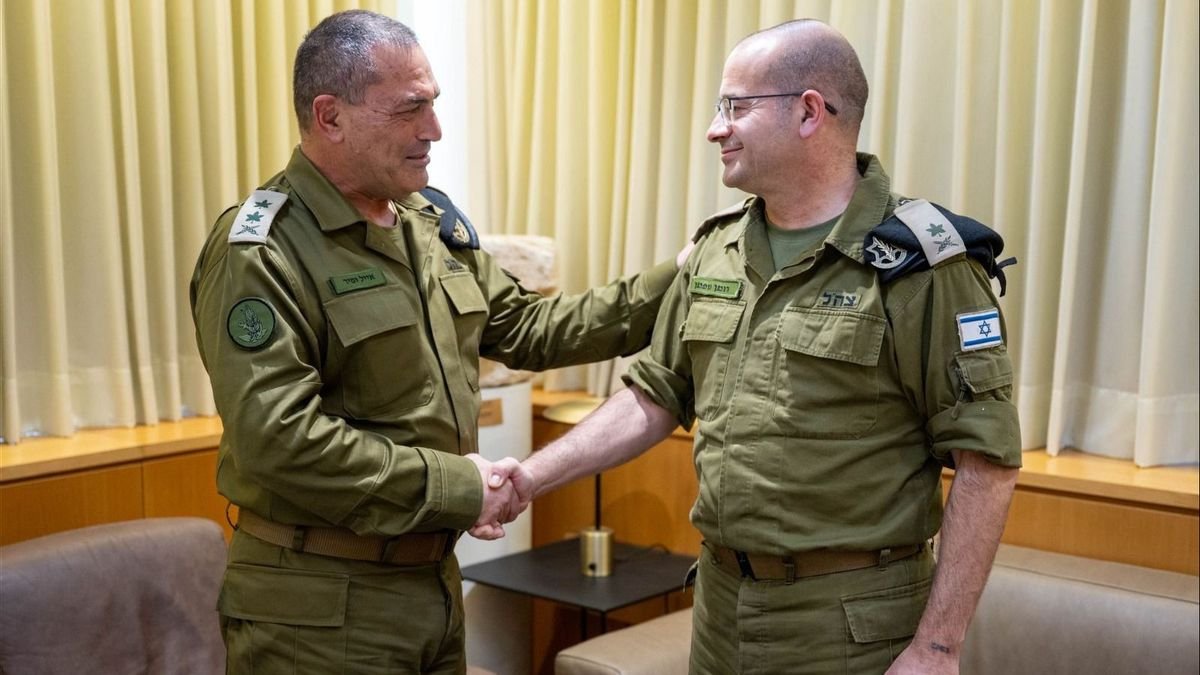
A retired security source offers a more verifiable pattern from the occupied West Bank. Between 2017 and 2019, he says, Israel allowed a developing armed structure to expand while monitoring meetings abroad.
Arrests came only after members returned to their cities and the financing and weapons-transfer chains had been exposed. “One rotten tomato can spoil many others,” the source says.
At the time, the Israelis allowed the structure to develop and monitored every meeting held abroad. They waited until everyone returned to and settled in their cities, then waited further until the financing and weapons-transfer cells still operating inside the territories were exposed, before carrying out a major arrest operation.
The same source concludes:
“A shock of this kind causes organizational paralysis and mutual recriminations, and an organization cannot recover from it easily or quickly. It also creates frustration and fear among cadres on the ground, a reality that may take years of effort or a generational change to overcome. A masterstroke is worth a thousand ordinary blows. This explains why the West Bank did not rise up in the opening days of Al-Aqsa Flood and has not done so to this day.”
An Israeli penetration can survive the arrest of the agent who enabled it, leaving commanders to question compromised plans, exposed routes, and even one another. By then, the occupation has already planted suspicion where trust once held the organization together.