
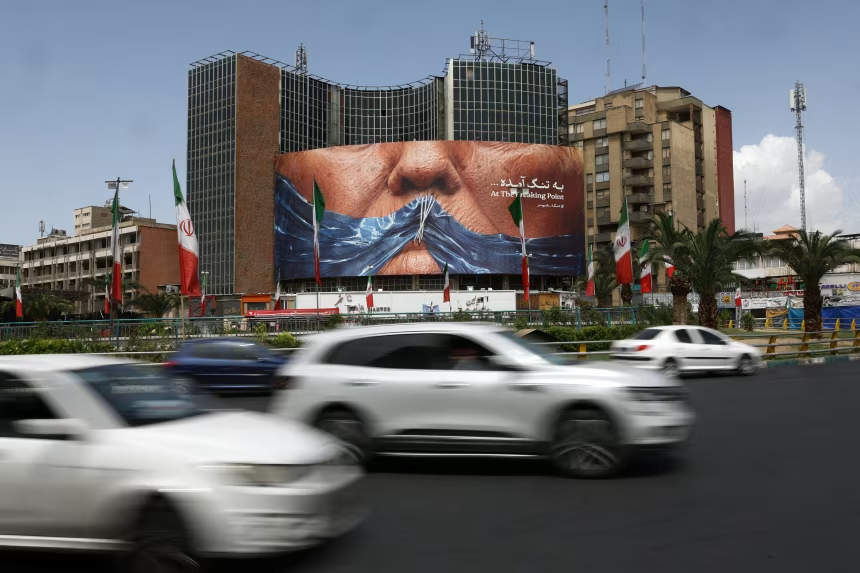
Iran has de facto closed the Strait of Hormuz; the US blockades Iranian ports. Neither side will blink first. Concession risks regional power shifts; military action is uncertain. The world faces a protracted stalemate.
The current Strait of Hormuz crisis has reached a pivotal stalemate that threatens the core of global energy security. As Washington and Tehran engage in a severe test of wills, the Strait of Hormuz crisis forces a decisive choice between economic endurance and military escalation. Resolving this urgent Strait of Hormuz crisis is now the primary strategic challenge for international maritime stability.
Strait of Hormuz crisis and the Kennedy reflection
In the darkest days of the Cuban Missile Crisis, President John F. Kennedy privately reflected on the central question before him: Who blinks first? For days, Washington and Moscow sat locked in a test of wills — each side convinced time and pressure favored them, each side wary that backing down could invite greater danger later.
That same logic now hangs over the Strait of Hormuz.
Iran has effectively shut the strait to normal commercial transit, declaring that ships must pass through its waters and pay a transit fee. The United States, in turn, has blocked Iran’s ports — telling Tehran that if the world cannot use the strait as before, then Iran cannot use it either.
The result is a stalemate, one with no immediate off-ramps and a handful of options that range from bad to worse.
Option 1 for the Strait of Hormuz crisis
The default outcome is that both sides settle in, believing time is on their side. Iranian leaders project themselves as prepared to push their country to the brink of economic collapse if necessary for the survival of the revolutionary system.
There is truth to this view. Iran’s leaders are ideological — committed to expelling American influence from the Middle East and confronting Israel — and many have personally endured worse, including the brutal Iran-Iraq war of the 1980s.
But even the most hardened systems have a breaking point, and the blockade on Iran’s ports will compound over time. Even before this crisis began, Iran was suffering from roughly 60 percent inflation and a historic economic crisis. Those conditions helped drive Iranians into the streets earlier this year in protests the regime ultimately suppressed by force. None of those grievances have disappeared.
President Donald Trump is also projecting readiness to settle in, saying he feels “no pressure” over the situation. He is right that the US economy has shown resilience, and as the world’s largest oil producer, the United States is more insulated than in past decades from the shocks of a Middle East crisis.
But energy trades in a global market, and with roughly 20 percent of global oil supplies that once moved through the strait now disrupted or diverted, pressure on the global economy will also compound over time — and eventually reach American shores. Tehran believes Trump will not be able to withstand that pressure indefinitely, particularly heading toward the midterm elections. So, both sides believe the other will blink first, which means neither may blink at all.
Option 2 and diplomatic concessions in the Strait of Hormuz crisis
Breakthrough diplomacy rarely comes from banging the table harder than a counterpart. Breakthroughs require compromises, and compromises require concessions. Right now, neither Iran nor the US appears prepared to make them. Both are focused on breaking the other’s will, rather than breaking through to a deal.
For Iran, that means refusing to back away from its assertion of sovereignty over the strait and its demand that commercial traffic pass through Iranian-controlled waterways and pay a toll. Tehran has fired missiles and drones at ships failing to comply with this new reality.
This assertion of control over an international strait violates longstanding principles of freedom of navigation. The US could lead in building an international diplomatic and military coalition to reject Iran’s claims. But as of now, Washington has not done so, and Iran has demonstrated both the capability and willingness to enforce its demands.
The US could ultimately concede the principle in the interest of relieving pressure on the global economy. Trump has previously suggested the strait is less central to American interests, but such a concession would alter the region’s balance of power in Iran’s favor and raise profound questions about the future stability of other international waterways — including the Taiwan Strait, an international waterway that Beijing increasingly asserts as sovereign territory.
Option 3 and military action in the Strait of Hormuz crisis
The US could conclude that freedom of navigation through the strait is a non-negotiable core interest and move militarily to secure it outright.
Historically, the free flow of commerce through major waterways has been a foundational principle of American power. But a sustained operation to reopen or guarantee maritime access would likely be expensive and time-consuming even in the best-case scenario.
Recent efforts in the Red Sea demonstrated the challenge. Even successful naval coalitions proved more effective at defeating missiles and drones than at restoring commercial confidence among shipping companies.
The threat today is not primarily from mines in the water, but from drones and missiles that can be fired from hundreds of miles away. So long as Iran can launch attacks from positions deep inside its territory — including from the mountains overlooking the strait — the threat to commercial shipping will not recede.
A US military campaign to forcibly reopen the strait therefore remains an option, but its viability and outcome are uncertain. Iran could also retaliate with missile attacks against Gulf energy infrastructure, worsening the global economic shocks already underway.
A new normal following the Strait of Hormuz crisis
Against this backdrop, we should assume the strait may remain effectively closed for the foreseeable future — and that even if the immediate crisis subsides, presumptions about freedom of navigation through the strait may never fully return.
Many countries in the Gulf are already acting accordingly, accelerating plans for east-west infrastructure projects that bypass the strait altogether. Saudi Arabia’s east-west pipeline system has already proven strategically valuable, while Iraq is increasingly focused on routes that would move oil from the Gulf to the Mediterranean. The UAE’s Port of Fujairah, which bypasses the strait, is also likely to emerge as an even more important global energy hub.
This is the logical long-term response: reducing dependence on the strait and on Iran’s ability to hold the global economy hostage.
But infrastructure projects take years, not months. Until then, the world may remain trapped in what amounts to the Great Strait Stalemate.