

A strategic analysis of the unprecedented acceleration of West Bank settlement activity before Israel’s October 2026 elections, examining the institutional mechanisms, settler violence data, and political calculus driving territorial entrenchment.
The West Bank Settler Expansion unfolding in the run-up to Israel’s October 2026 election is not a random spike in violence but a tightly coordinated, institutionalized campaign to reshape the territorial map beyond the reach of any future political reversal. Data confirms that the current period has already surpassed all previous records, with the United Nations documenting over 1,330 attacks on Palestinians and their property in the first seven months of the year.
Behind these numbers lies a structural capture of the state: settler leaders now direct planning, land allocation, and civil administration in Area C, blurring the boundary between government policy and militant ideology. The establishment of the Settlement Directorate under Finance Minister Bezalel Smotrich, the legalization of more than a hundred outposts, and the proliferation of grazing outposts as a stealth annexation tool have transformed the pace of West Bank Settler Expansion into a sprint against the electoral clock.
More than 2,300 Palestinians have been forcibly displaced this year alone, as the mechanisms of coercion—violence, water denial, pastoral destruction—create an environment designed to empty communities without formal eviction orders. This calculated acceleration reveals a profound understanding among architects of the settlement project that the facts built today will far outlast any coalition arithmetic produced by the ballot box.
A Record Surge Before the Ballot
In the occupied West Bank, settler attacks are taking place at a record rate ahead of Israel’s October elections, the first national poll since the war on Gaza in 2023 triggered an explosion in settler expansion.
The surge in violence isn’t random. Analysts describe it as a race to lock in facts on the ground before the upcoming vote can change the balance of power, potentially away from ultra-right-wing parties that have enabled settlers to rapidly encroach on Palestinian land.
“The settlement movement has come to treat the elections as an opportunity to accelerate the implementation of its project,” Israeli affairs researcher Muhannad Mustafa told The New Arab.
“Because the maps drawn in the field often become more durable than the decisions made in the Knesset.”
The latest wave of violence began on 24 July in Tel, southwest of Nablus. Four Palestinians and two Israeli settlers were killed during a confrontation when armed settlers backed by Israel’s military raided the village. Dozens more Palestinians have been injured in ensuing settler attacks across the West Bank.
In response, the Israeli military announced it was preparing for extensive military operations, with some Israeli politicians calling for the scorched earth destruction tactics seen in Gaza.
For Israeli affairs researcher Esmat Mansour, what the West Bank is experiencing represents a clear shift “from a phase of violence as reaction to a phase of violence as a political tool”.
The current attacks, he said, are no longer carried out in revenge following a Palestinian military operation, as was the case in previous years. Instead, they have “become part of a broader strategic project seeking to impose control over the land and create facts on the ground that make any future Israeli withdrawal more difficult”.
West Bank Settler Expansion’s Electoral Clock
As Israel’s political class focuses on election maths, the map of the West Bank is shifting almost daily. Analysts link this to a deliberate strategy. They say Netanyahu’s government is using this period to expand settlements before October’s election, especially as polls currently have him losing.
Netanyahu’s coalition of Likud, ultra-Orthodox, and far-right parties is trailing in the polls. Surveys point to a clear defeat for him in the 27 October election – though Israel’s fractured politics mean the result is far from certain, and smaller parties could still decide who ends up in power.
The UN’s humanitarian affairs office (OCHA) has documented more than 1,330 settler attacks on Palestinians or their property from the start of 2026 through late July. That is more than six attacks a day – the highest rate since systematic monitoring began around two decades ago.
A government run by settlers
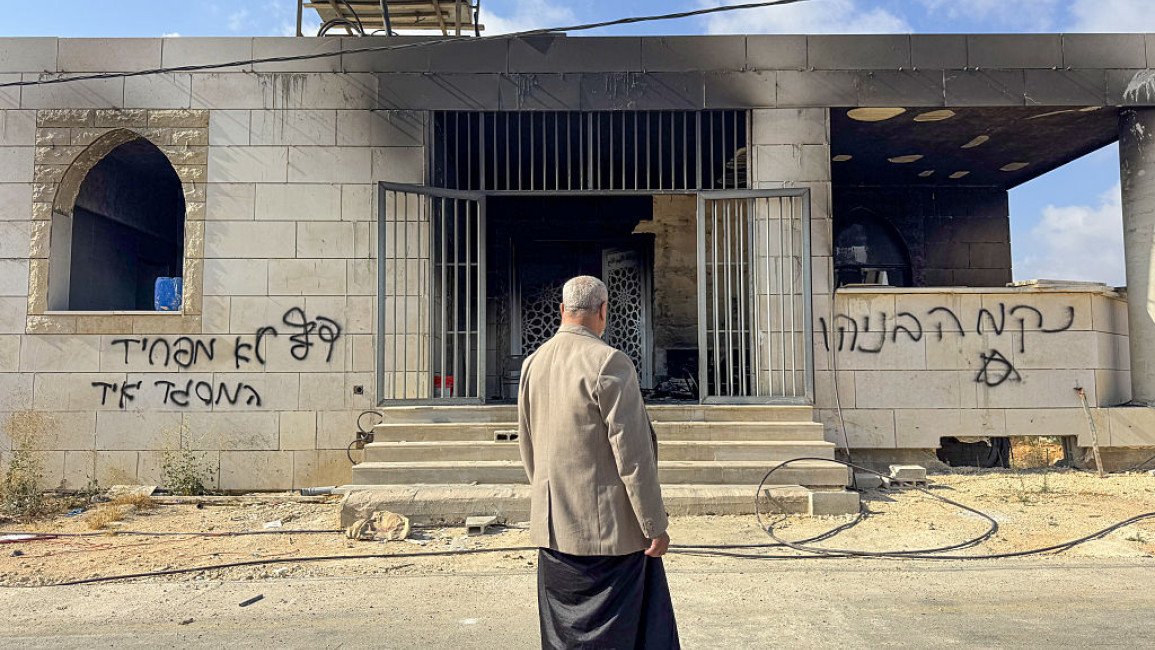
In recent years, Israel’s settlement movement has infiltrated the centres of decision-making.
“Settlers are no longer merely a pressure group,” political analyst and researcher Ehab Jabareen told The New Arab.
“Their representatives have become part of the government itself, granting the settlement movement unprecedented capacity to influence decisions on land, planning, and civil administration.”
Mansour makes a similar point: the entry of settler movement figures into decision-making centres within the Israeli government, he said, has directly reshaped events on the ground – whether through accelerating the legalisation of outposts, expanding settlements, or providing security protection for settlers.
“This has caused the boundaries between settler activity and state policy to blur,” Mansour said.
The Architects of Land Seizure
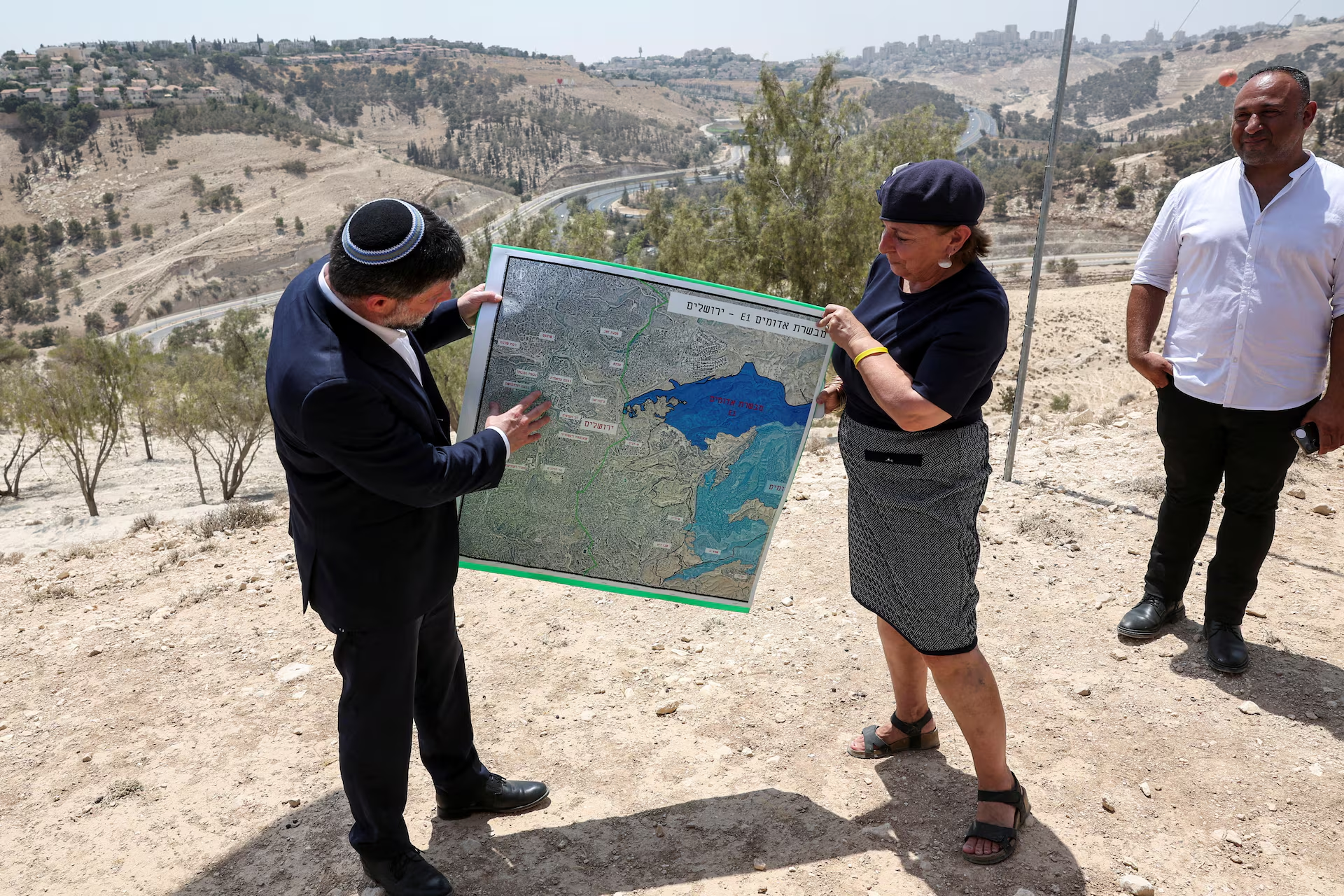
In late 2022, West Bank affairs were restructured. Finance Minister Bezalel Smotrich was given parallel powers inside the Defence Ministry. This included direct oversight of planning, construction, land, and civil administration in Area C, which represents about 60 percent of the West Bank.
In March 2023, Smotrich set up a new body: the Settlement Directorate, which took control of powers once held by the military’s Civil Administration. The far-right minister has recently pushed to make this directorate permanent, ahead of the October election, in case power shifts.
During this same period, Itamar Ben-Gvir, a far-right extremist who favours West Bank expansion, was appointed head of the Ministry of National Security and given expanded powers over policing in the West Bank.
That gives him direct authority over the police – the same police who investigate settler attacks – with researchers linking his role to rising impunity.
Since being in his post, Smotrich has also overseen the establishment of 160 agricultural outposts or farms, and has approved, legalised, or reestablished more than 104 settlements.
“Ministers like Smotrich and Ben-Gvir see the West Bank as a project – one that must be locked in, demographically and geographically,” Jabareen said. “That explains the accelerating settlement expansion, the legalisation of outposts, and tighter restrictions on Palestinian construction.”
Displacement by a Thousand Cuts
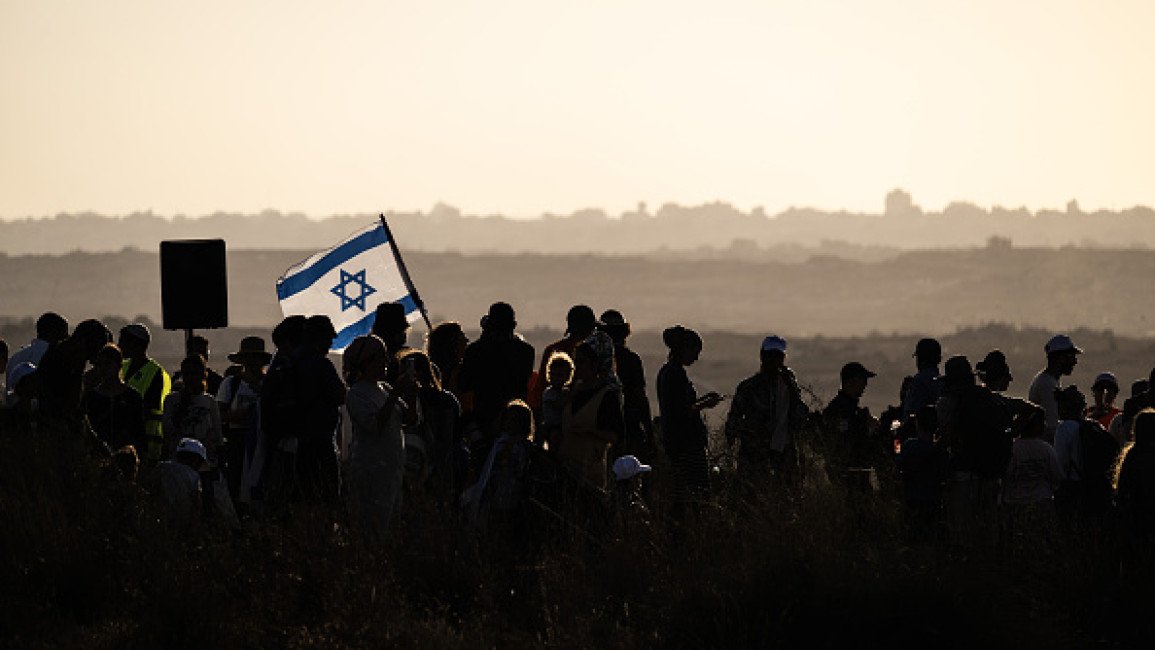
According to the UN, more than 2,300 Palestinians were forced from their homes during 2026 because of settler attacks and related restrictions. Since 2023, the number of displaced Palestinians has passed 6,200 – including thousands of children – after more than a hundred Palestinian communities were emptied, fully or partially.
International institutions see these numbers as a sign of what they call a “coercive environment,” conditions that push people to leave without any formal eviction order.
Marzouq al-Halabi, a Palestinian writer and analyst, points to a deeper shift in the relationship between the settler movement and Israeli government.
“The settlers’ ideological project has merged with state institutions. Their shift from defending existing settlements to proactively seizing control of their surroundings – through grazing outposts and water sources – confirms that the goal is to redraw the entire map,” he said.
Writer and political analyst Ahmad Rafiq Awad also sees a tangible change in the army’s role, with Israel shifting from “managing the conflict” to “resolving it”. This happens through the gradual control of land, not a formal annexation announcement.
He pointed to four key areas: the Jordan Valley, southern Hebron, east Ramallah, and southern Nablus.
“There, daily attacks combine with settlement growth, bypass roads, and control of water sources. Together, they push Palestinians out,” Awad told The New Arab. “These attacks are not limited to a few spots. They have reached about 250 Palestinian communities. Most sit in Area C.”
From tents and caravans to settlements
Alongside traditional settlements, a new model has emerged: the grazing outpost. It often starts small – a tent, a mobile home, a handful of sheep. Then, it expands.
Grazing outposts are now one of the most effective tools for seizing land in the West Bank because they allow settlers to take initial control of large areas without any formal government decision.
UN figures show that 18 Palestinians have so far been killed in settler attacks from the start of 2026 through 20 July. That already exceeds the total number of deaths for all of last year.
The Human Cost of West Bank Settler Expansion
Jerusalem affairs researcher Ziad Abhais says the attacks target not only the land but the Palestinian social fabric in rural areas, especially smaller villages and farming communities.
He describes it as a slow, grinding pressure: cutting off water, attacking livestock, burning crops, and assaulting homes. “The aim is to make staying harder than leaving. This policy empties the land of Palestinians, while letting Israel expand control without a direct fight with the international community,” he said.
Since January 2026, settler-related attacks have injured about 880 Palestinians – 720 of them directly by settlers – making up 56% of all Palestinian injuries recorded in the West Bank this year.
UN reports document dozens of incidents where Israeli soldiers were present during attacks, or accompanied settlers during them. In other cases, Israeli forces used force against Palestinians who tried to fight off attackers or protect their property.
Can Facts on the Ground Be Reversed?
Over time, settler violence has taken the shape of a deliberate strategy to lock in permanent realities on the ground.
Every attack that blocks a farmer from his land, every outpost that takes over a pasture, every settlement road that cuts through the hills only adds to a growing system of control.
And each development also shrinks the space left for any future political settlement. Even if the next Israeli election produces a less hardline coalition, today’s facts on the ground may prove hard, if not impossible, to reverse.