
Iran’s leadership is grappling with its most existential crisis since the 1979 Iranian Revolution as the US-Israeli war on the country escalates.
In power since 1989, the killing of 86-year-old Supreme Leader Ali Khamenei in a joint US-Israeli airstrike marked a turning point, forcing the regime to select a new leader amid a widening conflict.
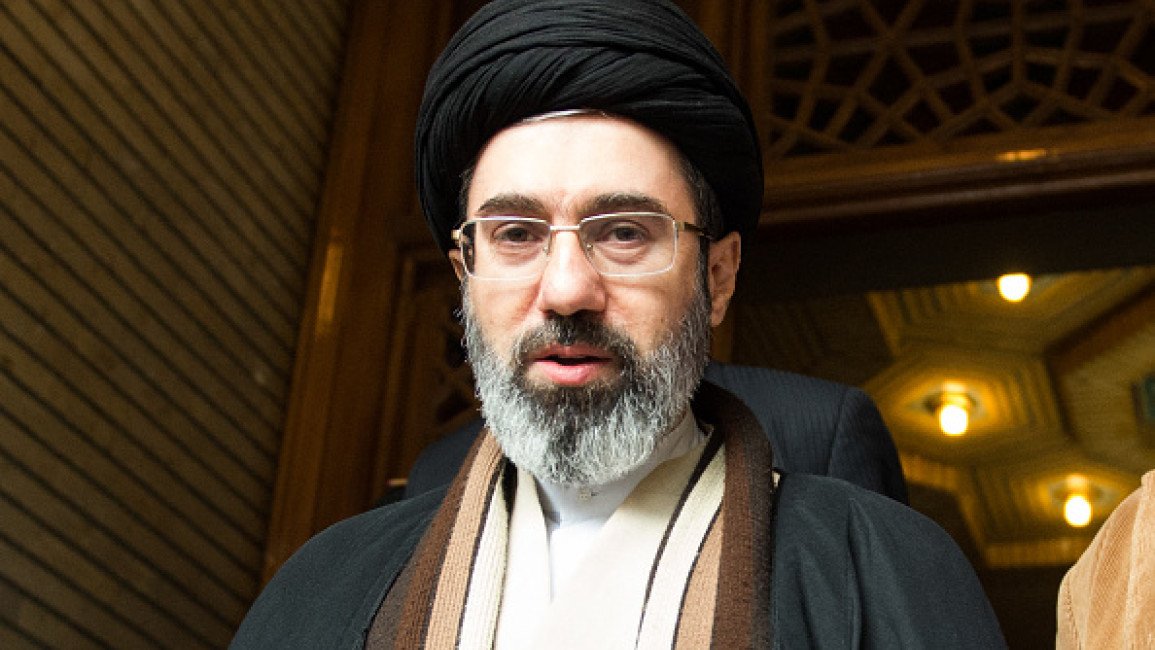
On Sunday, the 88-member Assembly of Experts announced that it had selected 56-year-old Mojtaba Khamenei, the second-oldest son of the late Ali Khamenei, as his father’s replacement.
By choosing one Khamenei to succeed another, the Islamic Republic is projecting continuity, reinforcing its authority, and presenting political stability in the face of external military aggression.
A quiet but powerful figure
The US-Israeli war launched on Iran on 28 February has seen Tehran retaliate by targeting Israel, US bases in the region, and Gulf states, sending shockwaves through global energy markets.
The war has been further complicated by Iran’s allies joining the fight, with Hezbollah in Lebanon launching cross-border attacks on Israeli forces and Iran-aligned militias in Iraq targeting US military positions, further regionalising the conflict.
Israel and the US administration under Donald Trump have targeted Iran’s top leadership, including the Supreme Leader, to ramp up pressure on the regime. As of yet, however, it hasn’t collapsed, showing that Iran’s system can withstand severe shocks.
Now, with Mojtaba Khamenei installed as the new Supreme Leader, Iran’s political establishment is expected to move quickly to project unity against external threats and avoid potential unrest. But it remains to be seen what kind of Iran will emerge from the war under his leadership, should the political system survive.
Before he was appointed, Trump called the potential appointment of Mojtaba Khamenei “unacceptable” and said he himself needed to be involved in choosing Iran’s next leader. He later warned that anyone selected without US approval would “not last long.”
Israel, meanwhile, had already threatened to target Khamenei’s successor even before Iran’s recent announcement.
The rise of Mojtaba Khamenei as the Supreme Leader comes not only amid external threats but also amid uncertainty surrounding his leadership style.
Mojtaba has long been a quiet but powerful figure in Iran’s political landscape, with his rise to power coming despite the regime’s official stance against hereditary rule.
He is said to have built influence behind the scenes, working in his father’s office and strengthening ties with the Islamic Revolutionary Guard Corps (IRGC) and Basij forces, rather than through formal government roles. Critics associate him with election interference and harsh crackdowns on dissent, such as during the disputed 2009 presidential vote.
Reza H. Akbari, Middle East and North Africa Program Manager at the Institute for War and Peace Reporting, told The New Arab that Mojtaba’s connections are mostly with peers “from the same generation,” who “have risen together within the system, share networks and interactions, and align politically, including on the country’s security outlook”.
Given his deep ties with the IRGC, Iran’s leadership under Mojtaba Khamenei is expected to renew a hardline and defiant stance amid the war.
The IRGC takes centre stage
Ali Alfoneh, senior fellow at the Arab Gulf States Institute, told TNA that the IRGC will also benefit “from the fact that the introverted Mojtaba Khamenei has few real allies within the regime and would therefore be heavily dependent on IRGC support for his rule”.
Because Iran’s Supreme Leader has traditionally deep ties to the IRGC, this relationship will likely reinforce itself, making the IRGC a key source of Mojtaba’s political influence, even under extreme pressure from US and Israeli airstrikes.
Iran’s hardline stance was also reflected in internal political tensions that emerged during the first week of the conflict.
On 7 March, Iran’s President Masoud Pezeshkian, part of the Interim Leadership Council after Ali Khamenei’s death, announced that Iranian forces would halt attacks on neighbouring countries and respond only to strikes from their territory.
He apologised to the affected Gulf states, blaming disorganisation in the armed forces after the killings of senior commanders and the Supreme Leader. Hardliners swiftly rejected the remarks.
Parliament speaker Mohammad Bagher Ghalibaf warned on X that “as long as the presence of US bases in the region continues, the countries will not enjoy peace”. Pezeshkian later withdrew his apology, and attacks continued.
Signs of hardliner dominance in Iran can be seen both on the frontline and in political decision-making.
In a military context, Iran is adopting a decentralised asymmetric strategy against the US and Israel, embodied in a “decentralised mosaic defence” doctrine that empowers regional commanders to act independently if central communications fail, while also reinforcing a hardline posture against foreign aggression.
“The goal is twofold,” Arman Mahmoudian, a research fellow at the University of South Florida’s Global and National Security Institute, told TNA. “First, to inflict pain and economic pressure on the US, its allies, and the rest of the world,” and second, “to exhaust US munition stockpiles,” since many Arab states use the same Patriot system as the US.
Meanwhile, in the political context, the appointment of a new supreme leader is crucial both for maintaining elite cohesion and for recalibrating internal power after the shockwaves of the war, to secure the continuity of the system that Ali Khamenei built over 36 years of his rule.
The Assembly of Experts that elected Mojtaba is chosen by popular vote, although candidates are vetted by the Guardian Council. The body’s most recent elections in 2024 were dominated by hardline conservatives, signalling a further consolidation of their power.
Eric Lob, assistant professor of Politics at Florida International University, told TNA that the composition of institutions like the parliament and Assembly of Experts is deliberately stacked with hardliners, reflecting Ali Khamenei’s awareness of his advancing age, weakening health, or potential threats to his life.
“The way the institutional landscape is currently configured leans in favour of hardliners – those who oppose domestic openings for activists and political, economic, and social change, and who are not congenial to US, Western, or Israeli interests,” he said.
While political factions – largely divided between principalists and reformists – may temporarily ease rivalries during the war, Sina Azodi, director of the Middle East Studies Program at George Washington University, told TNA that competition is likely to soon increase.
Even after a new Supreme Leader is chosen, he is still new to the role and, “being, in a way, socialised into the position,” factions – including the IRGC – will continue vying to expand their influence over him.
Other political figures who may gain influence during this war include former IRGC members Ghalibaf and Ahmad Vahidi, the IRGC’s new commander, and Ali Larijani. The latter, in particular, is seen as one of the Islamic Republic’s most powerful executive figures, serving as secretary of the Supreme National Security Council and expanding his influence behind the scenes.
If the Islamic Republic under Mojtaba Khameni survives the war, what Iran will look like remains uncertain.
In the past two years, Iran has been weakened regionally. Its main proxy, Hezbollah, was severely debilitated after its war with Israel in Lebanon. Syria, meanwhile, is no longer under its influence following the fall of Bashar Al-Assad’s regime.
Iran itself was weakened after the June 12-day war with the US and Israel, and internally is facing a multilayered crisis that includes economic instability, energy shortages, and environmental challenges. More recently, it lost even more legitimacy among large swaths of its population following one of the bloodiest crackdowns on protests in January.
It is unclear what Mojtaba’s domestic policy might be, but internally, his appointment is expected to consolidate power and assert control over the system.
Akbari explained that Mojtaba Khamenei might be able to secure support and lead a faction of younger IRGC officers, but he would struggle to gain popular backing within the country.
“He could probably maintain the regime’s base, but he won’t be able to expand it within society,” he said.
Externally, the new leadership may continue the legacy of Ali Khamenei by taking a confrontational stance against Israel and the US.
Should the current political system survive the war, analysts expect Iran could move toward a more entrenched security state, with the further consolidation of security institutions where hardline factions tighten their hold on power and further narrow political space.
“That all depends on how the conflict is ended, and if the Islamic theocracy survives it,” Trita Parsi, co-founder and executive vice president of the Quincy Institute, told TNA.
“The highest likelihood is that hardline factions rise in influence and that the political space in Iran further contracts.”