
Trump’s “friends-and-family” diplomacy—exemplified by Witkoff and Kushner—prioritizes personal networks over expertise, pressing weaker parties first. In Gaza and Ukraine, this risks unsustainable deals built on commercial opportunities for insiders. Europe must leverage its own relationships.
Trump’s family and friends are trying—but failing—to broker peace in Gaza, Ukraine and beyond. The network they are building blends diplomacy with profit. Europe needs to find a way to shape the terms.
US president Donald Trump’s almost exclusive reliance on friends and family as envoys to broker difficult foreign policy deals poses systemic risks for Europe.
The Trump envoys typically plug into a network of rich and royal friends whose interests rarely align with Europe’s. Most operate outside European institutions and leverage, and are largely insulated from public scrutiny, with their wealth rooted in the (usually American) private sector or monarchical states.
This private-actor style of diplomacy has now revealed its more dangerous and illuminating consequences in Iran. Reports suggest that White House envoys Steve Witkoff and Jared Kushner—meeting with Iranian negotiators in Geneva on the same day they conducted Ukraine-related diplomacy—did not fully grasp the mechanics of the Iran nuclear issue. They also reportedly conducted the now-failed negotiations without nuclear experts at their side.
While it is still too early for any visible ceasefire efforts to emerge in Iran, this commentary examines how the same diplomatic approach has shaped peace processes on two other fronts: Gaza and Ukraine. Written from the standpoint of practitioners, it offers suggestions for how European leaders can use both their leverage and the predictable tendencies of these envoys to advance European interests and broader peace and security, while confronting the systemic challenge these informal networks present.
Emerging patterns
Peace talks on Gaza and Ukraine have been led by the same two American non-governmental envoys, both businessmen operating with little support from career officials or subject-matter experts. Their approach follows a pattern as recognisable as the signature rhythm of a Morse code operator:
Pressing the weaker party first: The US envoys’ proposals typically start from the goals of the more powerful parties—here, Russia and Israel. This approach seems to reflect a philosophy of “might is right” when it comes to deal-making.
Deferring hard issues: The envoys tend to focus on the headline deal. Issues that could delay a signing ceremony are deferred as much as possible. “Momentum” is invoked to justify leaving hard questions—such as those involving territory, security or local participation—for later, even as the parties use these issues to foil progress.
Implementing agreements through personal networks: Negotiations often introduce issues important to the envoys and their networks, especially commercial projects like resorts in Gaza and critical minerals or a free economic zone in Ukraine. These initiatives could be helpful if the wider peace initiative is managed well, but they seem to reflect the negotiators’ comfort with these ventures rather than the underlying conflict dynamics.
Below, we examine each of these aspects—how they shape negotiations, where they introduce risks and what openings they may create for Europe. The task for Europe is not merely to criticise this style of diplomacy, but to use its shortcomings to reshape these processes and advance its own interests.
Pressing the weaker party first
The initial American offers on both Gaza and Ukraine contain the same problematic core: they begin by pressing the weaker side to give up territory, sacrifice sovereignty, make economic concessions or accept governing roles based on the demands of the stronger side.
In successful negotiations in which some of the authors of this piece have been involved, the logic has typically run in the opposite direction. Talks begin either from the weaker side’s position or from those not owned by either side. In our experience, the side that believes it is winning tends to interpret concessions from the weaker party as signs of weakness, creating a dynamic that encourages the stronger party to seek complete victory.
This is visible in the Ukraine process: Moscow reacts to each new US proposal with a demand to return to what it sees as the starting point, a vague (and never publicly clarified) understanding from the August 2025 Trump–Putin Alaska summit: that Ukraine should cede more of its land to Russia and accept Moscow’s de facto veto over its sovereignty as part of any solution.
Besides the obvious injustice, the problem with this approach is that once the weaker side rearms or regroups, its grievances over the coerced peace will fuel further conflict. This is already evident in Ukraine, which retains the capacity and willpower to continue fighting. Palestinians can be expected to do the same, as they have over recent decades; the October7th 2023 attacks occurred after years of a suffocating Israeli siege of Gaza.
In Gaza, having secured initial aims such as the release of the remaining hostages—a humanitarian achievement and critical to Israeli buy-in—the mediators now find themselves with Israel mounting daily attacks and blocking desperately needed humanitarian inflows, while Hamas refuses to totally lay down its arms.
Lessons for Europe: Pressure Russia, work with the GCC
Europe has had some moderate success in disrupting this dynamic.
On Ukraine, Europe can greatly increase the costs on Russia and thus change its negotiating position, though it has so far used that leverage only partially. Europe’s control of sea lanes that allow Russian energy exports to reach global markets remains a key tool that should be used further. Routine inspections of shadow-fleet ships for regulatory and environmental reasons would likely reduce Russian oil movements in the north, which account for over half of the country’s exports. This approach would not require unanimity among EU states, so it is an ideal avenue for more assertive action.
Russia’s immobilised sovereign assets remain another underused source of leverage. If implemented, US envoys would be compelled to engage with the new reality, creating opportunities for European involvement even at the cost of American irritation.
On Gaza, Europeans have cooperated closely with Gulf Cooperation Council (GCC) states—who hold far more influence in Washington on Middle East issues—to temper Trump’s support for maximalist Israeli goals. While the ceasefire and subsequent negotiations remain hugely problematic, engaged Europeans like France, working closely with the GCC, have at least managed to move Trump away from initial talk of the expulsion of Palestinians from Gaza and toward at least a theoretical acceptance of the need for a full Israeli withdrawal and a new path to Palestinian statehood.
That shift will not necessarily translate into meaningful US pressure on Israel to implement these broader terms, especially with an Israeli government that appears ideologically opposed to the creation of a Palestinian state. This is where Europe, by continuing to work closely with key Arab Gulf states and coordinating political and economic leverage toward both the US and the actors on the ground, can be crucial.
Deferring hard issues
Deferring tough issues risks unravelling any deal.
In Gaza, no credible force exists to enforce the ceasefire, protect both Israelis and Palestinian civilians, prevent new escalation and lay the groundwork for reconstruction and an eventual full Israeli withdrawal. Countries hesitate to send troops for an international security presence precisely because there is no concrete plan to address the political underpinnings of the conflict, thereby incentivising combatants to position themselves for the next fight.
In Ukraine, Moscow has little incentive to stop the fighting now and instead appears content to continue the war of attrition in hopes of extracting even more concessions from Kyiv. Russia has sustained extraordinarily heavy losses—more than 1,000 soldiers a day—while continuing to attack Ukraine’s civilian and economic infrastructure. Yet it has neither taken the territory it seeks nor broken Ukraine’s will to fight. Russia’s hope is that it can win at the negotiating table what it cannot secure on the battlefield. The US fuels this hope by suggesting Ukraine cede various territories and, critically, by remaining vague about what security assurances a post-war Ukraine would receive. The 2026 attacks on Iran—which raised oil prices and strained air defence assets Ukraine relies on—may deepen Russia’s belief that it can outlast Western resolve and capacity to support Kyiv.
Lessons for Europe: Focus on security
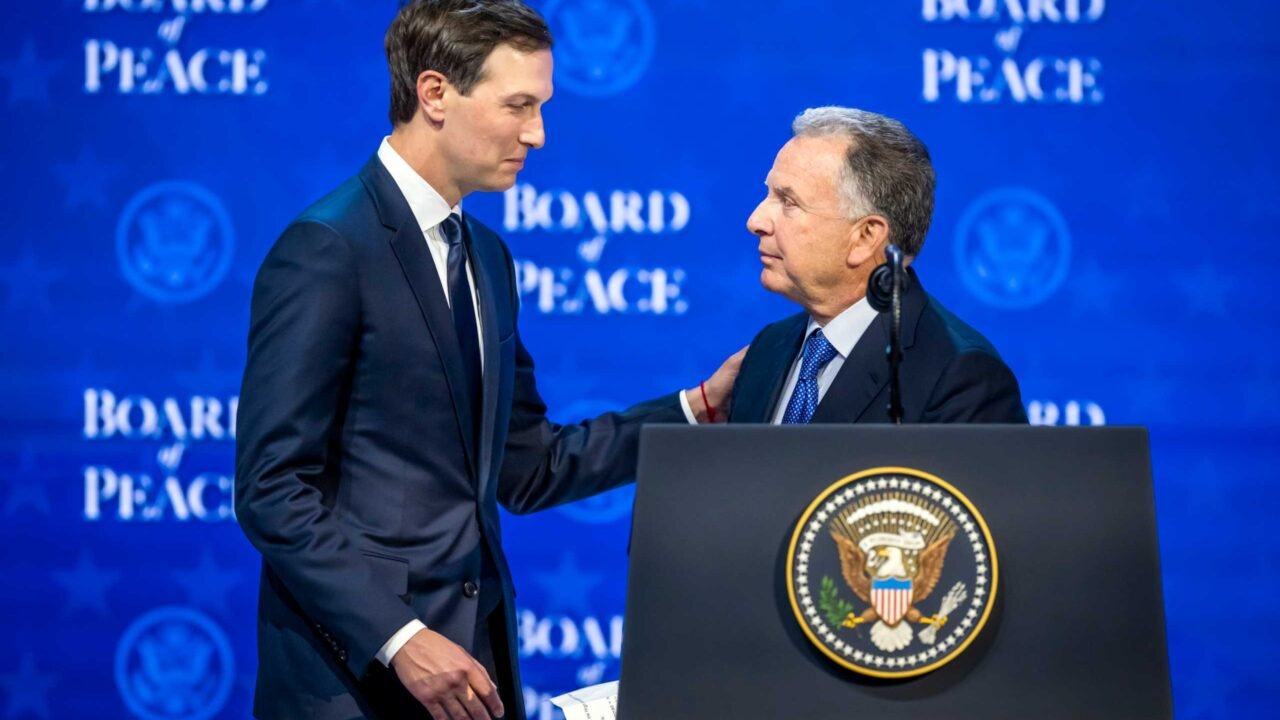
On Gaza, Europe’s unique set of relationships in the region—and a shared interest with the Arab Gulf in seeing a Palestinian state and sustainable peace—should anchor a common approach toward the US. Staying outside of the US-led Board of Peace (BoP) or only joining as observers (as many European states eventually did) is the right call. It preserves European independence and a degree of external leverage, including the ability to act with the GCC states who do sit on the BoP.
Regarding Ukraine, the January 2026 Paris announcement on security assurances shows sustained European engagement. It gave substance to the vague commitments of America’s November 2025 28-point plan, which largely ignored questions about Ukraine’s future security and deterrence of Russia. A European coalition of states is now translating those pledges into concrete force planning: What capabilities and in what quantities does Ukraine need to defend itself? What does Europe need to ensure timely reinforcement in the event of future Russian aggression? And how should Ukraine be brought into the EU? Any ceasefire offer should take all these questions into account if it is to align with Europe’s security interests.
In both Gaza and Ukraine, Europe should present its positions as practical steps to make peace, which is Trump’s desired win. Recent European diplomacy on Ukraine and Greenland shows leaders know how to combine clear red lines with flattery to avoid confrontation. Even if the Gaza ceasefire collapses or a final peace is not reached in Ukraine, European proposals can still be valuable. In Ukraine, for example, planning credible post-ceasefire security arrangements can strengthen Kyiv’s defences while the fighting continues.
In Gaza, Europe’s leverage is economic. As Israel’s largest trading partner, the EU could have punched much harder. Had the bloc been united in using this leverage, it would have been taken much more seriously in both Washington and Tel Aviv. This is a role that Europeans need to now assert, not only with Israel but also with Palestinians, with whom they should deploy economic support to press necessary reforms. Used together, these tools could help push the parties towards a viable political track, without which the security needs of both Gaza and Israel will remain unmet.
Implementing agreements through personal networks
In both Ukraine and Gaza, the US envoys make use of relationships developed outside diplomacy, such as ties to Mohamed bin Zayed, the president of the United Arab Emirates, or the Russian envoy Kirill Dmitriev, as well as bankers and investors. The centring of commercial opportunities in their peace proposals—such as Jared Kushner’s Davos presentation of gleaming skyscrapers in Gaza, or the critical minerals and investment deals outlined in the November 28-point plan—creates a role for these individuals in the negotiations.
The problem is that these commercial opportunities come at the expense of factors that make peace sustainable.
The Gaza BoP approved by the UN Security Council echoes the form of post-conflict bodies from Clinton-Blair days, as in Bosnia-Herzegovina, Kosovo and East Timor (the global BoP, which the US administration bolted onto that structure weeks later, is a much different beast). However, the Gaza BoP’s criteria for participation effectively blocks credible local leaders, hollowing out legitimate Palestinian ownership that will be needed to sustain the project, risking the entire enterprise from the get-go.
Gaza needs economic opportunity and reconstruction, but that will only contribute to peace if the Palestinians are allowed to shape its form and share its benefits. Currently, the Gaza BoP’s commercial agenda is at core a real estate project (marina, beachfront towers and a special economic zone) that will primarily serve the interests of Israel and foreign corporations, one of whose executives now sits on the BoP. Palestinians would largely be pushed away from their homes into newly planned communities, symbolised by the proposed “new Rafah”. Israeli security control would extend over the entire project.
Meanwhile, early costs—for planning, site clearance and maintaining the Palestinian population offsite—could also be borne by public funds from the World Bank and potentially European institutions, such as the European Investment Bank.
The vision is one of Gaza rebuilt as a landscape of trade zones, data centres and glittering resorts, without any meaningful, representative political life for Palestinians. Around the US president, powerful actors pass around slides of beachfront commercial developments that bear little relation to realities on the ground, with rights to build and profit from them granted through a forum he controls.
Even if the peace process fails, those involved with the commercial prospects early can still profit. Investment managers and consultants will reap fees, property developers will borrow money against concessions, possibly from opaque lenders, then sell the rights. The prospect of congressional scrutiny in America, European review of the concessions, and a likely future Democratic administration in Washington will only accelerate a scramble to clinch deals and cash out before peace in Gaza has a chance.
Similar ideas are percolating in Ukraine. Washington and Moscow have floated proposals to unlock immobilised Russian assets (most of which are held in the EU) and channel them into US-led investments in potentially lucrative mineral deposits. The idea of a free economic zone built in the ruins of the Donbas, or of Ukraine’s mineral wealth being exported under the control of US-chosen companies, may sound tempting in some business quarters. But they are detached from the reality of a country emerging from war, whose immediate priorities will be reconstruction and economic recovery. They are unlikely to be sustainable as either businesses or peace projects.