
Vatanka analyzes the psychological and political fallout of the 2026 war’s fifth week. He details how the explicit denial of “regime change” has alienated the Iranian diaspora while failing to reassure allies. The report highlights the “Venn diagram” of U.S. inconsistency—claiming military dominance while simultaneously refusing responsibility for the economic security of the Strait of Hormuz.
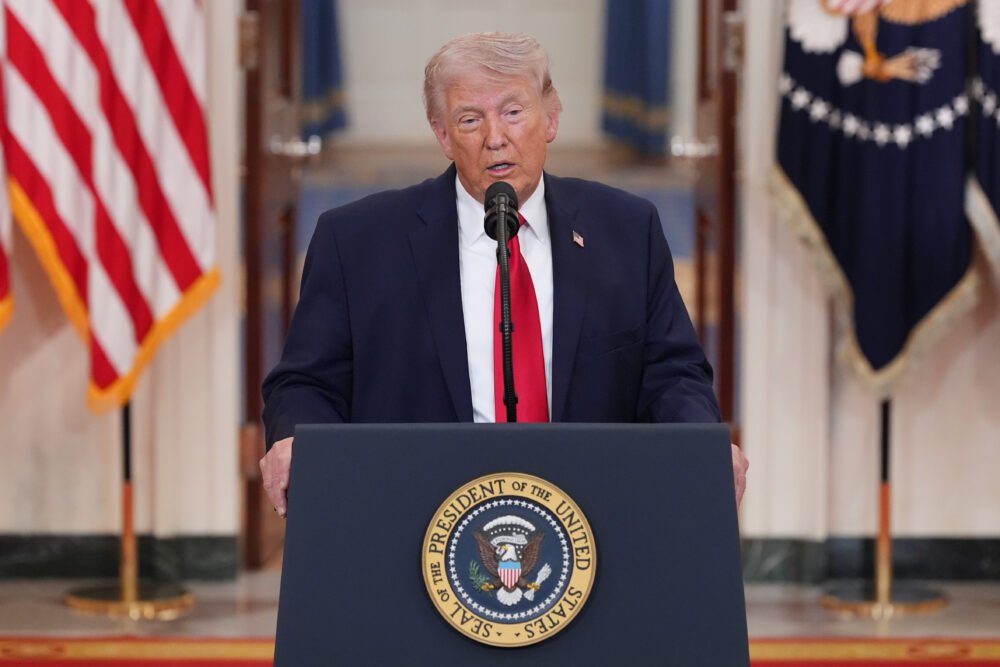
Iran’s leadership did not take long to respond to President Donald Trump’s latest address on the war. Regime-linked media dismissed the April 1 White House speech as a repetition of earlier claims, while officials and commentators close to the Iranian government framed it as further evidence that Washington remains uncertain about its own course. Also notable was how widely the speech seemed to unsettle other audiences. In parts of the Iranian diaspora opposition, it appeared to narrow whatever limited space had existed for viewing the United States’ actions as aligned with Iranian aspirations. Among allies, including partners in Europe, Asia, and the Gulf, his remarks are bound to raise fresh questions about American war aims. And in global markets, the immediate reaction — rising oil prices and declining stock markets — suggested that investors heard not clarity but continued uncertainty. In the battle over messaging, Trump’s ambiguity is giving Iran’s narrative the edge.
Trump: We Are Winning and Our Objectives Are Achieved
At the center of the speech was a familiar set of claims. Trump asserted that US forces had achieved rapid and decisive successes, that Iran’s military capabilities had been severely degraded, and that Washington was close to completing its strategic objectives. He also reiterated that the United States would not allow Iran to acquire nuclear weapons and portrayed the war as a necessary move to prevent that outcome. He raised the possibility of a negotiated end to the conflict but also warned that Washington would carry out “extremely hard” strikes against Iran over the next two to three weeks, without explaining the gap between assertions of near-success and promises of additional force. None of these arguments were new. What was new was the tension between these claims and other elements of his own message.
A similar tension was evident in Trump’s description of the political goals of the war. He insisted that “regime change was never our objective.” Yet earlier rhetoric had at least implied the possibility of political transformation inside Iran. The shift in tone may reflect a recalibration in Washington. But it also raises a broader question: If the United States is not seeking to alter the political structure of the Islamic Republic, then what is the intended objective of sustained military pressure? Is the goal deterrence, containment, or something else entirely?
The discussion of the Strait of Hormuz further illustrated this pattern. Trump suggested that the waterway would “naturally” reopen once the conflict subsided, and indicated that countries dependent on Persian Gulf energy flows should take the lead in securing it. At the same time, he emphasized that the United States does not rely on Middle Eastern oil and would not need to in the future. These statements may reflect a domestic political argument about American energy independence. But they also carry implications for allies and partners that do depend on the stability of that key waterway. If Washington is both the principal military actor in the conflict and yet reluctant to assume responsibility for securing its most critical economic consequence, then the broader strategic framework becomes difficult to interpret.
Iran: The US Is Wavering and Weak, Like Trump
Throughout the speech, Trump appeared to move between different conceptions of the war without fully reconciling them. These ambiguities were not lost on observers outside the United States, contributing to a more cautious and, in some cases, uneasy posture. Allies are calibrating their positions and realigning their priorities. In some cases, they have even directly called out the inconsistencies in the US position. Markets are responding to uncertainty about the duration and scope of the conflict. And Iran’s leadership is using the ambiguity to strengthen its own narrative of resilience.
Since the conflict began, the Islamic Republic has sought to present itself as capable of absorbing external pressure while maintaining institutional continuity. The leadership has emphasized rapid replacement of senior figures, the continued functioning of state structures, and the ability to retaliate across multiple domains. In this context, Trump’s address — particularly its mixture of confident claims and unresolved questions — has been used to reinforce the argument that the United States has not achieved decisive results.
This line of interpretation is clear not only in official statements but also in commentary from those close to the regime. Some outlets portrayed the speech as disconnected from battlefield realities. Others argued that references to negotiation reflect a US desire to manage or limit the conflict rather than conclude it on clear terms. Former Foreign Minister Mohammad Javad Zarif, responding to Trump’s language about returning Iran to the “Stone Age,” described the address as “22 minutes of nonsense with zero content,” adding that such rhetoric reveals more about the speaker than about Iran itself.
At the same time, the address may have had unintended effects beyond providing material for the regime’s immediate messaging needs. By explicitly stating that regime change is not an objective and by emphasizing that the US “doesn’t need” Iran’s resources, Trump clarified the limits of Washington’s ambitions. For some Iranian audiences, including those critical of the Islamic Republic, this is likely to be interpreted as a signal that the US is not pursuing a broader political transformation. In a conflict where narratives matter as much as capabilities, that perception carries weight.
Trump’s Ambiguity Allows Iran to Shape the Narrative
The issue is not simply whether Trump’s claims are accurate or overstated. It is that the speech reflects a deeper absence of strategic coherence. Throughout the conflict, the Trump administration has not consistently articulated a stable set of objectives or a clear pathway to achieving them. Instead, it has alternated between different messages — near-victory, imminent escalation, possible negotiation — without fully integrating them into a single framework. This has left multiple audiences, both inside and outside the region, with the same basic question, which President Masoud Pezeshkian posed bluntly in an open letter to the American public: “Exactly which of the American people’s interests are truly being served by this war?”
Iranian officials have increasingly framed the war not as a conflict involving the Iranian or even the American people, but as a war driven by narrower interests — whether as a favor to Israel’s leadership, a product of Washington’s security establishment, or an extension of economic interests tied to the global arms and energy industries.
Such statements are, of course, politically charged and deeply contested. But they are not insignificant. They speak to a broader contest over the meaning of the war.
By failing to define its purpose in a way that resonates beyond immediate military objectives, Washington risks reinforcing the very argument it seeks to undermine. The Islamic Republic has long relied on the claim that external pressure is not about reform, rights, or regional stability, but about power, control, and coercion. In the absence of a clearly articulated alternative, that claim gains traction.
Trump’s speech was intended to project control over a war entering its second month. Instead, it underscored how much remains undefined. And in that ambiguity — between declared success and continued escalation, between denial of regime change and absence of political end state — the United States has left space for its adversary to shape the narrative of the conflict in ways that may prove as consequential as events on the battlefield itself.