
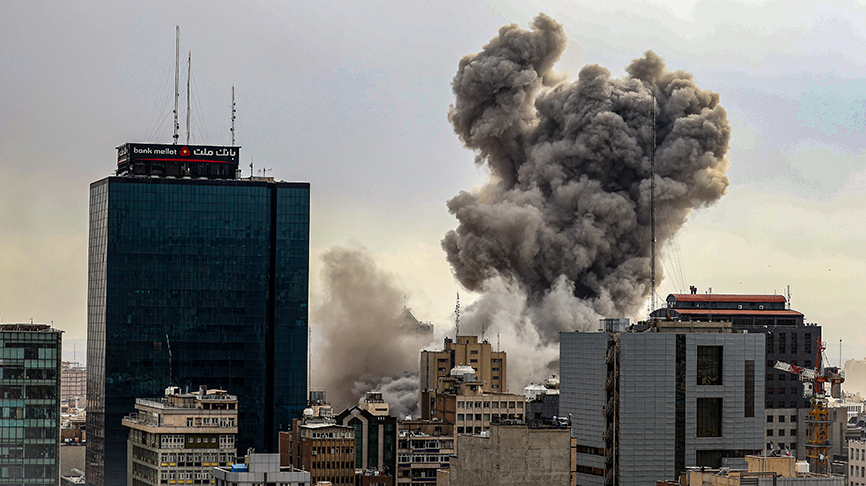
The systematic degradation of Iran’s defense-industrial complex and the killing of Ali Khamenei have not produced the anticipated internal uprising. Instead, the conflict has hardened the regime’s ideological core, severely damaged the economic viability of Gulf partners, and incentivized a potential nuclear breakout as a final survival mechanism.
It is plausible that all three combatants will simultaneously claim victory while ending up strategically worse off.
The war that started on 28 February 2026 pitting the United States and Israel against Iran is many things, including a reflection of the decades-long failure of global diplomacy adequately to restrain the Islamic Republic; the logical culmination of the predictable chain of events started on 7 October 2023; a manifestation of the inability of the Middle Eastern security system to constrain and integrate revisionist powers; and evidence of a crumbling international order.
Above all, it is the clash of Iran’s ideological and strategic delusions, Israeli Prime Minister Benjamin Netanyahu’s unhinged obsession with security and US President Donald Trump’s opportunistic, high-risk improvisation. This quintessential war of choice is the fifth major shock to the region since 1979, following the Iranian Revolution, the Iran–Iraq War, the first Gulf War and the US invasion of Iraq. It began to reverberate regionally and globally within hours. Within a day, it became clear that it would have a long tail, throwing the Middle East into a new era of conflict and transformation.
The road to war
War with Iran has loomed on the horizon since the inception of the Islamic Republic. Its revisionist ambitions and belligerent ways have alienated many around the world. It has few friends, but maintains a strong, righteous belief in its anti-imperialist, Islamist outlook. In the region, it has spread influence through militias and the transfer of military technology. Its nuclear programme, combined with the regime’s inflammatory ideology, made the future threat unacceptable to the US and Israel even as many others thought it was manageable through diplomacy and containment. Fundamentally, the existence of a regional adversary frustrated Washington and Tel Aviv.
The war is a logical continuation of the June 2025 12-day war in which Israel, followed by the US, took out much of Iran’s nuclear assets and air defences. Trump declared the obliteration of the nuclear programme, but the outcome was strategically inconclusive. The diplomatic dance that followed was doomed: Iran would not have offered nuclear capitulation and the US had nothing to offer except not attacking. Above all, Israel was eager to strike, confident this time that the US would join from day one. Trump dithered a little, but was effectively cornered by his own impulses and decisions, his advisers and a determined Netanyahu.
The war began with the Israeli Air Force’s spectacular decapitation of Iran’s government by lethally targeting supreme leader Ayatollah Ali Khamenei and several dozen of his top commanders. The joint US–Israeli campaign has been systematic and relentless. Having established air superiority, the two militaries have applied high-end firepower, intelligence assets and precision-targeting capabilities to effectively erase Iran’s conventional capabilities and defence-industrial base, as well as its energy facilities and civilian infrastructure.
What determined the timing of the opening salvo was more opportunity than imminent threat. The US administration issued a torrent of often contradictory justifications, inconsistent timelines and optimistic assessments that could not hide its lack of planning and strategy, and misalignment of ends and means.
Having purportedly ‘obliterated’ the nuclear programme in June 2025, Trump claimed that Iran was merely weeks from a completed nuclear device. Having also told Iranian protesters that ‘help was on the way’, Trump mused that he would look for an alternative from within a regime that had just massacred thousands of them. Having promised to return Iran to glory, he considered, then dismissed, arming and deploying Kurdish militiamen and royalist activists, and alluded to altering Iran’s borders. As his defence officials listed their operational achievements, Trump appeared increasingly frustrated that he could not replicate in Iran the expeditious decapitation of the Maduro regime in Venezuela. After calling for unconditional surrender, but faced with the possibility of a long, messy conflict, Trump suggested that the job was almost done and that the campaign would end in a matter of days.
In contrast, the Israeli government has remained disciplined. Its multi-week campaign is unambiguously aimed at destroying all the pillars of Iranian power and ostensibly creating the conditions for internally led regime change, however unlikely. The immediate challenge for Israel is to keep Trump on board for an unlimited campaign; the longer-term one is to avoid blame should the campaign end in strategic failure.
Indeed, while both sides stress their operational alignment and prowess, the United States’ ultimate objectives differ from Israel’s. Bolstered by wide support among its Jewish citizens, Israel prioritises the destruction of the Islamic Republic, even at the risk of the collapse of the Iranian state or comprehensive chaos. Concerned about sea lanes, global economic stability and its reputation with its Middle Eastern partners, the US is in a more precarious position, compounded by significant domestic opposition to a war Trump had promised never to start.
The US is compelled to contemplate its failures. As this essay went to press, the hoped-for capitulation and uprising have not materialised. America has been accused of mounting a weak defence of the Gulf states owing to lack of preparation and prioritising Israel. The Strait of Hormuz faces severe maritime disruption because Washington underestimated the threat.
Iran’s resilience and troubled future
The Islamic Republic faces its stiffest existential challenge since 1979. The war is as much the consequence of its violent ideological rejection of the US and Israel as its own strategic miscalculations. Its nuclear programme and related diplomacy prompted an attack rather than preventing it. Its network of partners in the Middle East, arrayed to deter and punish, started the cycle of wars, failed to perform and precipitously lost its strategic value. Iran’s missiles and drones inflicted pain, but not enough to force a change in Israel’s and the United States’ appetites for risk. China and Russia, for their part, saw themselves merely as Iran’s defence partners, not its strategic allies.
Even so, the Iranian system survived the initial shock and retaliated within an hour, demonstrating operational readiness and flexibility. Unable to defend itself, it chose to impose high costs on its neighbours not just out of anger, but also for strategic effect and tactical convenience. It could absorb considerably more pain than America’s friends in the Middle East, and calculated that threatening their viability and confidence would compel them to push for the war’s termination. However ruthless, illegal and counterproductive in the medium term, it is a realistic strategy for surviving and restoring a degree of deterrence. Iran’s military has significantly damaged up to 17 US military installations in the Middle East, including advanced systems. In doing so, it has reminded the Gulf Arab states of the limits of American military power.
Iran’s system has proven more resilient and tolerant of pain than Trump and his advisers expected. There were no defections or popular uprisings in the first two weeks, and a new supreme leader was elected. Mojtaba Khamenei, the son of Ali, is more radical and less skilled than his father, but he is surrounded by experienced politicians with deep ties inside the elite Islamic Revolutionary Guard Corps (IRGC). He may look at his father’s legacy critically: while a domestic tyrant, Ali was widely seen as cautious abroad and, especially by hardliners, as self-consciously restrained since the 2020 assassination of Qasem Soleimani, the famed commander of the Quds Force, and having miscalculated by staying under the nuclear threshold. If he survives, Mojtaba may accelerate Iran’s nuclear breakout.
That said, Iran is undeniably weakened, the damage to its command structure, military capabilities and infrastructure immense. It will not be able to project sustained power in the region as it has in the past 20 years. It cannot re-emerge as a conventional power in the next decade. The IRGC will be busy securing the home front and the periphery, and thus unable to spread influence abroad. By striking its neighbours, Iran has guaranteed the Arab world’s lasting distrust. Already isolated and struggling commercially, it will not easily replace the few Gulf Arab states it had as economic partners before the war. Additional sanctions on and interdiction of oil exports would be crippling.
Shock to the Gulf states
The Gulf states have been the primary targets of Iran’s wrath. More than 80% of all projectiles fired by Iran in the first ten days of the war were directed at the Gulf states: 44% against the United Arab Emirates (UAE), 24% against Kuwait and 10% against Bahrain. It has targeted their critical infrastructure, including water-desalination plants and energy facilities, as well as ports, airports, hotels and residential areas. The scope and relentlessness of the attacks have produced genuine political and psychological consternation across the Gulf Arab states. They have built economic models based on the expectation of security and insulation against geopolitical disorder to reassure expatriates, investors and tourists. Iran is shaking the very confidence that has allowed them economic success.
Never shy of denouncing Iran’s ambitions and threats, they had settled for an uncomfortable accommodation with Tehran starting in 2021. Iran’s weakening after the 2025 12-day war even made them supportive of a limited nuclear deal, which several had resisted in 2015 when Iran was ascendant. Diplomacy, they hoped, would shield them against Iran’s fury. They also thought they had enough capital and access at the Trump White House, especially after Trump’s celebrated visit in May 2025, to make a convincing case against war. The Gulf states’ opposition to the war stemmed from legitimate worries about their exposure, the United States’ capacity to defend them, the risks of protracted instability in Iran and the perils of an unconstrained Israel. In the event, their influence could not overcome Israel’s determination.
The war has validated all of these concerns. Iranian missiles and drones have paralysed every aspect of life in the Gulf, hit critical infrastructure and disrupted maritime traffic. America proved unable to defend the Gulf states as well as they expected. The ever-changing US war aims raised concerns about Iran’s future, with regime survival and instability likely outcomes. US bases, which they hosted to secure US protection, ended up inviting attacks. The UAE and Bahrain, the two Gulf signatories of normalisation agreements with Israel, watched as Israel, an initiator of the war, was afforded more cover than they were.
A range of outcomes are possible, but none include a clear-cut American victory. Ironically, it is more plausible that all three combatants will simultaneously claim victory while ending up strategically worse off.
The end of the high-intensity phase of the conflict will likely be determined less by purely military factors than by Trump’s mood or attention span, Netanyahu’s political needs, petrol prices and global economic effects. Iran will want to be the last one to fire. For all the damage it has suffered, the Iranian regime could still emerge not as a winner, but as a defiant survivor that withstood the war machines of global and regional military superpowers. Should Iran dash for the nuclear bomb, the war will have caused exactly what it was meant to avoid.
Middle Eastern states must now contain a weakened, militarised, angry Iranian regime willing to disrupt their geo-economic and geopolitical relationships. This may sound like a repeat of Iraq in 1991, but the US was then on the ascent militarily and diplomatically, enjoyed broad international support and had made a strong legal case for war. It has none of these advantages now. Realistically, the price Iran may exact for the difficulties it has endured includes human misery, instability, migration, terrorism and nuclear proliferation.