
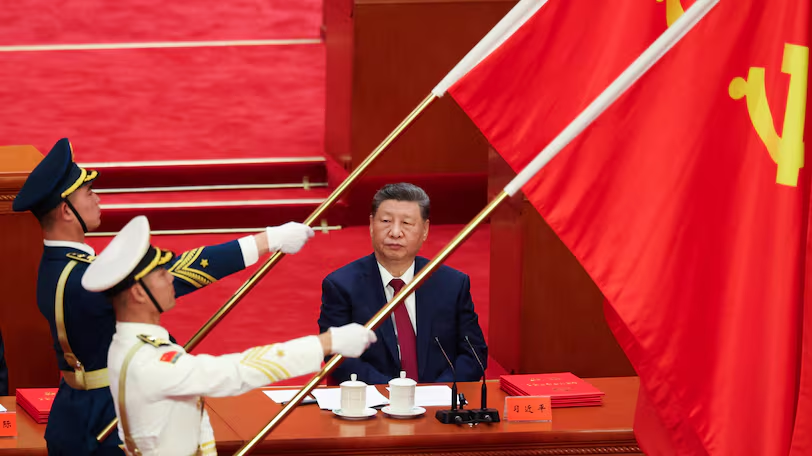
Public opinion surveys track a pronounced drop in international trust toward the United States, allowing China to expand its diplomatic influence. Through non-coercive regional mediation and massive development partnerships, Beijing presents a stable alternative to unpredictable Western governance
Recent international polling reveals a stark decline in confidence toward traditional Western centers of power. As traditional alliances show deep fatigue, America’s global leadership is becoming an open competition where previous assumptions no longer hold true. Washington can no longer take its dominance for granted, creating a rare window for alternative powers to claim America’s global leadership through steady diplomatic engagement.
America’s global leadership trust fractures
It was a line in a recent news report that jumped out at me. In Australia, “the levels of trust in either the US or China to ‘act responsibly’ in the world are now almost evenly matched”.
The figures came from an annual poll conducted by the Lowy Institute in Sydney. This year’s survey also found that 61 per cent of Australians see China more as an economic partner than a security threat – an 11-point increase on last year.
In one sense this seems remarkable. It was only a few years ago that relations between the two countries were in the deep freeze, with Beijing imposing punitive tariffs and bans on a range of goods from Australia, including beef, barley, wine, coal, timber, cotton and lobsters, amid a row over the origins of the Covid-19 virus.
But the turnaround fits a wider pattern.
Why America’s global leadership changes
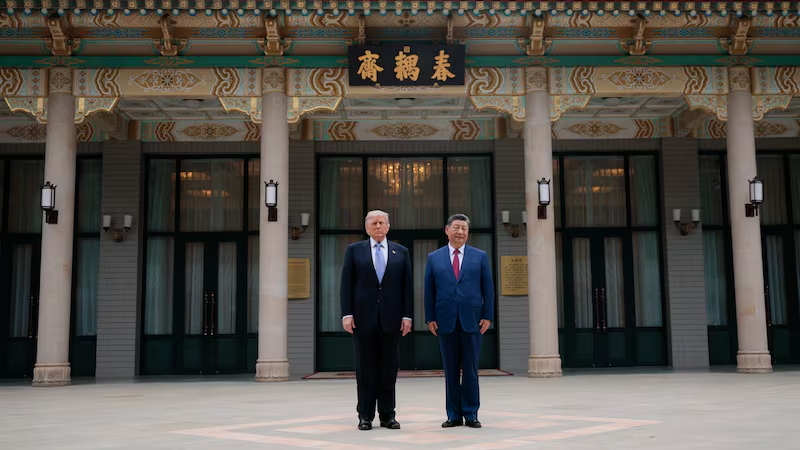
In March, a Politico poll found that in Germany, France, the UK and Canada – all American allies, like Australia – sizeable majorities said that it was better to rely on China than the US under President Donald Trump. In April, the polling firm Gallup released the findings of surveys it took in 130 countries over the course of last year – before the onset of the Iran war – and found that while 36 per cent approved of China’s leadership, only 31 per cent did so of the US leadership.
To be fair, neither figure is very high, but as the firm noted: “China’s five-percentage-point advantage over the US is the widest Gallup has recorded in China’s favour in nearly 20 years.” And the countries where China had the highest net approval ratings were not just close friends and trade partners like Russia and Pakistan: the state with the second-highest net approvals was Singapore, hailed by the Library of Congress as “a stalwart US partner in both trade and security co-operation, and … an advocate of a strong US role in the Indo-Pacific”.
This is not just a function of the US appearing to act in an unpredictable and erratic manner under Mr Trump. China’s top leadership has been stable, and President Xi Jinping has long stressed the need to abide by international law.
Seeking new America’s global leadership
Of course, some states do have serious disagreements with Beijing, particularly the Philippines over the South China Sea, where disputes over the ownership of shoals and outcrops have led to confrontations. But many countries see China as a useful and reliable partner; indeed, in the developing world, it is often the indispensable partner when it comes to proceeding with much-needed infrastructure projects.
There are now increasing calls for China to become more involved in international diplomacy.
Beijing won plaudits for brokering a rapprochement between Saudi Arabia and Iran in 2023, and for its more recent role in discreetly supporting the process that led to the US-Iran framework agreement (although the deal appears to be in danger of being ripped up). This very week, Norway has asked China to use its influence to help bring about negotiations and a ceasefire in Ukraine.
I have long heard friends in the peacebuilding and mediation sphere saying that they hope China could take a bigger role in contributing to new and more durable settlements in the Middle East, and the necessity for it to be involved in creating new international mechanisms to solve maritime disputes.
America’s global leadership demands stability
There may be several reasons for hesitancy in Beijing. China still faces shrill accusations that it is trying to impose its governance system on other countries, never mind that this tiresome trope doesn’t appear to be supported by any evidence whatsoever. When, as just happened, it tests a new missile in the Pacific Ocean – which the US does quite regularly – American allies clutch their pearls and register “concern”.
Beijing will not want to get embroiled in situations that have the potential for military consequences, which is why it may not want to be a guarantor for, say, a new peace deal in the Middle East. There’s still a hint of the saying attributed to China’s late paramount leader Deng Xiaoping: “Hide your strength, bide your time.”
In fact, China has been involved in quite a lot of mediation work over the past few years – you just may not have heard about it – from brokering temporary agreements between the military and rebel groups in northern Myanmar, to holding a meeting last December to try to consolidate the ceasefire between Thailand and Cambodia, and hosting talks with Pakistani and Afghan representatives in Urumqi this April to explore a solution to the conflict that broke out last October.
How America’s global leadership operates
These meetings may not have received a lot of publicity, but a recent analysis by the Arab Gulf States Institute in Washington stated that Beijing excelled at “consensual facilitation”, where “there is no need for coercion to bring or keep parties at the table” – also described as the “power of not using power”. It then added, however: “Beijing does not believe in the use of overt coercion to bring or keep parties at the negotiating table when they do not want to be there” – and concluded that this “exposes Beijing’s limits”.
That sounds like a criticism, but I think most people would agree that we could do with a lot less coercive behaviour, and that bolstering a world that works together through consensus, rather than military powers making rash unilateral decisions, is much to be desired.
China has quietly been stepping up as a mediator. I know I am not alone in believing this is an instance in which Beijing no longer has to “bide its time”. There is a vacuum of trust in international diplomacy and space for a major player to fill that gap. A China, whose emphasis on peace, stability and international law is increasingly being appreciated globally, should not be shy about doing so.