
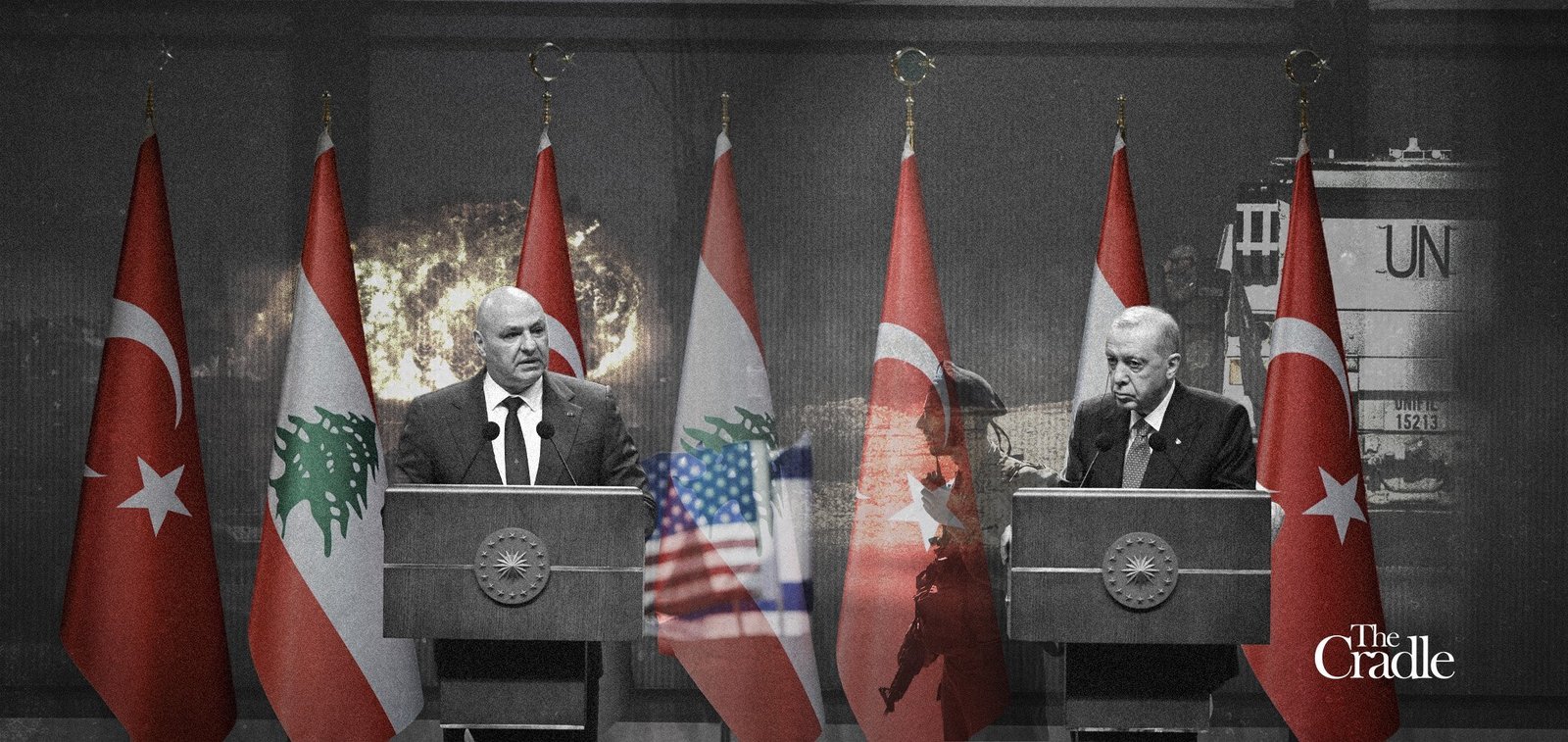
Lebanon drifts toward de facto partition as reconstruction is withheld from the south while the north turns toward Turkiye. Five tests will reveal whether a capable state emerges or temporary arrangements harden.
The Lebanese state is dissolving not through a declared partition but through the hardening of temporary arrangements that no government will map or acknowledge. Lebanon Partition is emerging from stalled diplomacy, reconstruction withheld from the south, and rival powers competing to define what remains. Turkey’s Blue Homeland doctrine treats maritime space as a sovereign extension of the mainland, requiring a functioning Lebanese state capable of signing agreements, licensing projects, and controlling territory.
Israel, by contrast, ties withdrawal to conditions Beirut cannot meet, ensuring paralysis that limits Ankara’s prospects far beyond the south. Three meetings in September—at Les Invalides in Paris, the State Department in Washington, and New York—exposed two strategic logics pursuing different Lebanons. Ankara needs a sovereign coast that can sign maritime agreements, while Athens, Riyadh, Paris, and Damascus also require a capable state, even for opposing purposes. The one mechanism operating on the ground is structured around Lebanon’s inability to become one. Lebanon Partition would deny Turkey the state it needs, yet prolonged paralysis could produce exactly that outcome, born from the erosion of the state on which Ankara’s strategy depends.
Lebanon Partition Emerges Through Stalled Diplomacy
Lebanon is drifting toward a partition that no government will declare or map. It is taking shape through stalled diplomacy and reconstruction withheld from the south, while rival powers compete to define the state that remains.
On 17 September, military officers and officials gathered at Les Invalides in Paris to consider how the Lebanese state could take control of the south as the UN Interim Force in Lebanon (UNIFIL) winds down. Turkiye and Cyprus sat at the same table, alongside Saudi Arabia and the US.
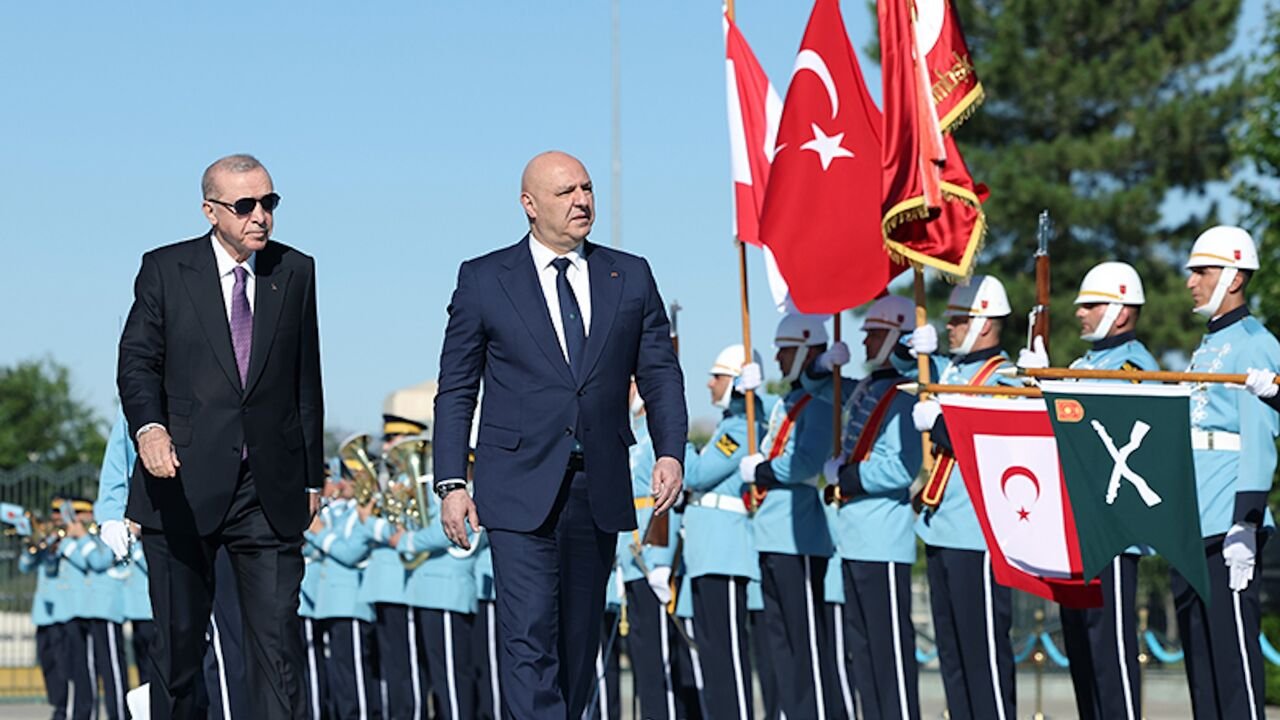
Two days earlier, the Lebanese and Israeli ambassadors had met at the US State Department after the next formal negotiating round was pushed to October. Four days later, Turkish President Recep Tayyip Erdogan received Lebanese Prime Minister Nawaf Salam for closed-door talks in New York.
Together, the three meetings expose more than a contest for influence over an exhausted country. Ankara and Tel Aviv are pursuing two different strategic logics, each of which requires a different Lebanon.
One needs a sovereign state capable of signing agreements, licensing projects, and controlling territory. The other ties withdrawal to conditions that the same battered state cannot meet. What is at stake, then, is the structure of Lebanon itself.
Ankara’s Blue Homeland Docks in Beirut
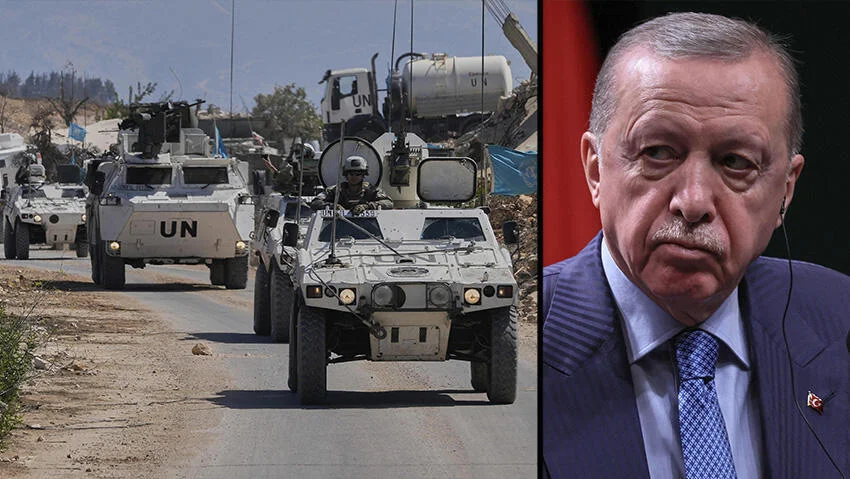
Turkiye’s “Blue Homeland” doctrine treats maritime space as a sovereign extension of the mainland, while Ankara’s rapid naval expansion gives that claim material weight. Any eastern Mediterranean settlement that excludes Turkiye is read as encirclement.
In June, Erdogan carried the same logic ashore when he declared that Turkiye’s security begins in “Aleppo, Damascus, and Beirut,” rather than at Hatay. Beirut had been placed inside a Turkish security perimeter.
Yet Ankara’s instruments in Lebanon still pass through the state. Only a sovereign government can sign a maritime delimitation agreement. The Turkish Cooperation and Coordination Agency’s (TIKA) work at Tripoli Port depends on official consent, while military training rests on a 2010 framework agreement. The revived Qlayaat Airport, whose first planned routes include Istanbul and Mersin, is being developed and licensed by the Lebanese state.
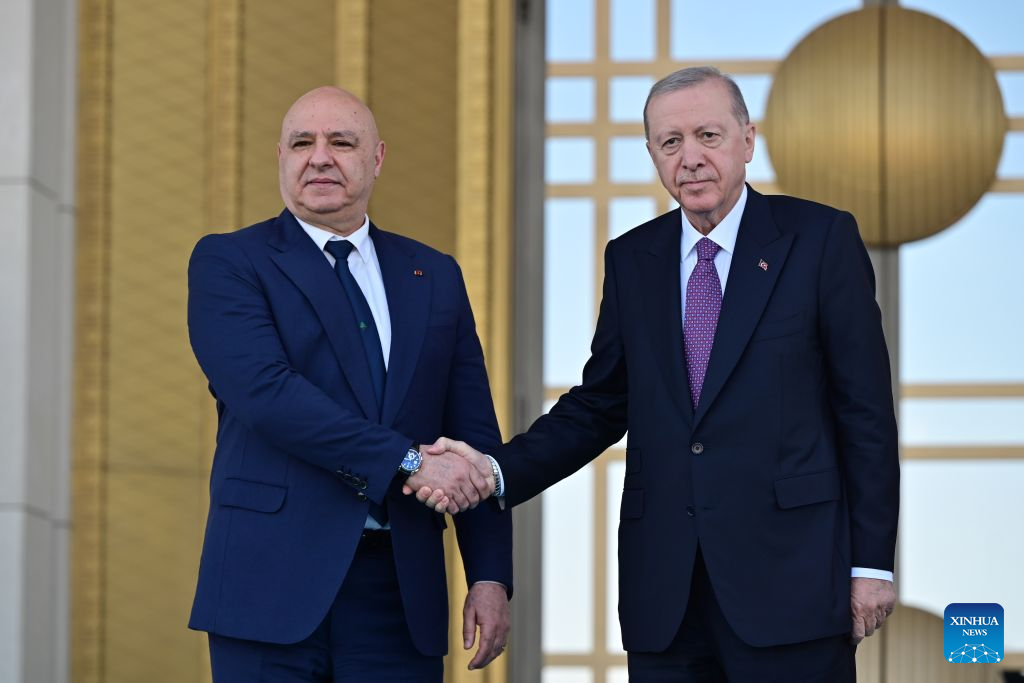
When Erdogan hosted Lebanese President Joseph Aoun in Ankara on 30 July, he said Turkiye wanted a place in “all initiatives” launched after UNIFIL’s withdrawal. Any such role would require Beirut’s invitation and some form of international cover. It would also face Israeli resistance, much as Ankara was shut out of the Gaza stabilization force.
The Turkish model departs sharply from the Iranian one. Tehran’s influence grew through the state’s vacancies. Ankara’s economic and diplomatic projects require functioning institutions because ports, airports, shipping routes, and maritime agreements cannot be secured through an unrecognized enclave.
The Cadre Waiting in the North
Below the state-to-state layer lies a social network built over years. Ankara has expedited Turkish citizenship for Lebanese of Turkish origin and members of the Turkmen communities of the north and Bekaa.
Semi-official figures cited by Carnegie put the number of citizenships granted by 2019 at more than 9,600, from nearly 18,000 applicants. Carnegie warned in late 2025 that this constituency could shape Sunni representation under Lebanon’s proportional electoral law.
It is reinforced by Ottoman restoration projects and the Mersin–Tripoli shipping route, which carries more than 100 truck drivers a week.
A second layer is harder to measure and should not be overstated. Religious currents with hardline roots have learned to advance through municipal politics, communal advocacy, and service provision. Around them sit civil associations trained in the language of governance and sustained by foreign funding.
Their coordination and ultimate sponsors remain unclear. Together, they form an ecosystem from which a governing cadre could emerge if Lebanon’s Sunni arena remains leaderless and the state continues to retreat.
The northwestern Syrian city of Idlib offers the nearest regional precedent. The so-called Syrian Salvation Government grew under Hayat Tahrir al-Sham (HTS) through local administrations, courts, and service institutions, while affiliated bodies extended their reach across fuel, communications, and transport.
Its senior officials and bureaucrats later moved into Damascus after December 2024. Idlib became an administrative laboratory, and its personnel were scaled up to the state. Northern Lebanon is nowhere near that point, but the political logic bears watching. Influence becomes power when the body providing services also acquires the authority to decide who may operate.
The comparison has limits, of course. Tripoli and Akkar retain an army, security services, municipalities, and a Sunni arena contested by Dar al-Fatwa, traditional political families, Gulf patrons, and local actors. Their mixed Christian and Alawite geography also resists easy replication.
There is no demonstrated canton project in the north. The sharper question is whether a locally rooted network is being prepared to move through municipalities and parliament toward executive power in Beirut.
Washington’s Machinery of Paralysis
The US–Israel–Lebanon trilateral framework signed on 26 June moves in the opposite direction. Washington describes a phased process in which the Lebanese army restores “effective sovereign authority over all Lebanese territory” as Israel gradually withdraws. It serves a goal Beirut has formally adopted: placing all weapons under state control.
The sequence, however, makes withdrawal contingent on verified disarmament. The army cannot forcibly disarm Hezbollah without risking civil conflict, and it cannot establish a new security order while Israeli troops occupy Lebanese territory and continue operating along its edges. Each side can therefore cite the other’s noncompliance, while Lebanon’s weakness supplies an open-ended rationale for Israel to remain.
The first pilot zone in Zawtar al-Gharbiyah exposed the trap. The plan called for clearance, third-party verification, maintenance, and reconstruction, later extending to Srifa and Froun. Progress stalled after the Rome round of negotiations between Beirut, Tel Aviv, and Washington in early August, as Israel demanded verification in the first areas before any expansion.
On 14 September, the Israeli Channel 14 accused the army of coordinating with Hezbollah inside the zones and quoted a political source declaring the mechanism a failure.
Two days later, Israeli Chief of Staff Eyal Zamir linked Hezbollah’s removal from south of the Litani to a dramatic improvement in Lebanese army performance. Each time Beirut comes close to meeting the terms, Tel Aviv raises the threshold for withdrawal.
The diplomatic track has been kept in the same state of suspension. The next formal round in Rome was delayed until October, when Israel holds elections. The ambassadors’ 15 September meeting in Washington kept a channel open but produced no announced decision. The framework continues to function administratively while the political bargain remains frozen.
By keeping the state weak, this paralysis also limits Ankara’s prospects far beyond the south. Israel has no need to compete with Turkiye directly in Tripoli if Lebanon remains unable to absorb the networks and investments Ankara is cultivating.
The struggle is over whether the Lebanese state can function at all. The buffer-zone drive in southern Lebanon follows the spatial logic Netanyahu laid out on 29 March when he boasted of “three security zones deep in enemy territory” in Lebanon, Gaza, and Syria.
Athens Enters the Anti-Turkish Arc
On 22 February, Netanyahu outlined what he called “a complete system, something like a sextet of alliances” spanning West Asia. He placed India, Greece, Cyprus, unnamed Arab and African states, and other Asian partners inside it, setting them against the “Shia axis,” weakened by Israeli strikes, and an “emerging radical Sunni axis.”
Greek Prime Minister Kyriakos Mitsotakis received Aoun in Athens on 31 August and described a strong state as the condition for a strong Lebanon. That same day, Greece and Israel signed a €3 billion (around $3.4 billion) deal for the Achilles Shield air defense system.
Athens presents itself as a historic friend of Lebanon and the Arab world while deepening a strategic military partnership with Israel. It also plans to place an EU–Lebanon partnership on the agenda during its EU presidency in the second half of 2027, as UNIFIL’s drawdown reaches its final stage.
Europe’s route into Beirut is thus passing through a capital Netanyahu has placed inside his proposed counteraxis. Whatever Athens intends, the arrangement presses against Ankara’s eastern Mediterranean strategy because the Greek–Turkish confrontation already runs through Cyprus, maritime borders, and control of the sea.
Partition by Timetable Hardens Division
The contradiction was built into the Paris meeting convened by France and Jordan through the Aqaba Process in preparation for an international conference supporting the Lebanese army and security forces.
Paris tied large-scale assistance to a credible deployment plan, while Lebanese commanders warned that the aid remained hostage to unresolved political conditions and that deployment could not be allowed to trigger an internal confrontation.
Riyadh has likewise dealt primarily with the state and its constitutional institutions since Aoun’s election, tying money to reform and the restriction of arms to state authority. The Mecca Joint Defense Agreement joining Saudi Arabia, Turkiye, and Pakistan has also reduced the old Saudi–Turkish logic of rivalry in Lebanon’s Sunni arena.
In an interview with Al-Mashhad, self-appointed Syrian President Ahmad al-Sharaa (the former Al-Qaeda chief known as Abu Mohammad al-Julani) argued that Lebanon needed a “third option instead of dividing between civil war or war with Israel.”
Ankara, Athens, Riyadh, Paris, and Damascus all require a capable Lebanese state, even when they want it for opposing purposes. The one mechanism already operating on the ground is structured around Lebanon’s inability to become one.
No outside power currently has the means to seize and administer Lebanon. Fragmentation would also deny Ankara what it seeks at sea, since a northern enclave cannot sign an internationally recognized maritime agreement. Yet a de facto division is already emerging, with each part of the country moving to a different timetable.
Reconstruction in the south is postponed until disarmament is verified after a war that destroyed scores of villages and made displacement increasingly permanent. The north turns economically toward Turkiye through Tripoli Port, the Mersin shipping line, and Qlayaat’s planned routes.
Beirut waits for Gulf and European money conditioned on reform. As Salam told parliament on 15 September, “There can be no sustainable reconstruction without funding, no funding without trust, and no trust without a capable state.”
If the state remains immobilized and reconstruction is rationed by geography, Ankara’s northern incubator could harden into an alternative center of power. The cadres it hoped to propel toward Beirut may instead find themselves administering the north by default. Prolonged paralysis would then produce the partition Turkiye seeks to avoid, born from the erosion of the state on which its strategy depends.
Lebanon Partition Denies Turkey Its State
Lebanon and Cyprus signed an exclusive economic zone agreement on 26 November 2025, prompting immediate rejection from Ankara and Northern Cyprus. The agreement treated the Republic of Cyprus as the island’s sole representative, while its Lebanese ratification remained politically contested.
UN Secretary-General Antonio Guterres said in July that another 5+1 meeting required more preparation, and by late September no date had been set. Any future formula granting Turkish Cypriots an effective say over exclusive economic zone decisions could reopen the legal and political basis of the Lebanese deal. Beirut’s share of Mediterranean gas may ultimately be shaped in Nicosia’s buffer zone as much as in Baabda.
The deeper Cypriot lesson is temporal. More than half a century without a settlement turned a provisional order into a permanent system of guarantors and buffer zones. Lebanon now faces a similar danger. UNIFIL’s mandate expires on 31 December 2026, but its withdrawal is expected to continue through September 2027. Beirut and its partners are still debating what, if anything, follows it.
Aoun has called preventing a vacuum the priority and has said that any replacement force should last only until the army can deploy. Lebanese military officials reject a monitoring mission empowered to dictate army operations, while Israeli elections make Tel Aviv’s consent to a new international force unlikely in the near term. The UN force sent to Cyprus as a temporary measure in 1964 remains on the island, a warning Lebanon can ill afford to ignore.
The battle after UNIFIL
Sharaa’s “third option” exists in theory and depends on the capable Lebanese state most regional actors claim to want. Ankara needs a sovereign coast that can sign maritime agreements. Athens wants a barrier to Turkish expansion. Riyadh will finance institutions more readily than factions, while Damascus cannot afford a fragmented neighbor that reproduces its own crisis.
Five tests will show whether that state is emerging. They are the October talks in Rome, the money committed at the international conference for the army, the composition of any post-UNIFIL presence and Turkiye’s place within it, the geography of reconstruction funds, and the appearance of any local authority in the north able to decide who may work there.
Lebanon’s next partition may require neither a foreign-brokered settlement nor new lines on a map. It will emerge if today’s supposedly temporary arrangements are allowed to harden into a permanent order. The country is already being divided by time.