
Iran successfully tested Hormuz as a strategic weapon during the war, imposing de facto control, informal tolls (up to $2 million per ship), and linking passage to unrelated fronts. The US cannot reopen the strait militarily. Tehran views this leverage as more valuable than its nuclear program and unlikely to relinquish without major economic incentives.
Iran has long seen the Strait of Hormuz as leverage, but this war has, for the first time, allowed it to test that power – and Tehran is unlikely to give it up.
The US and Iranian delegations failed to reach an agreement over the weekend following 21 hours of negotiations in Islamabad aimed at ending the war on Iran.
Together with Iran’s nuclear and ballistic missiles programme, the Pakistan-brokered talks, which followed a two-week ceasefire that began on 8 April, focused heavily on the status of the Strait of Hormuz.
Since the war began on 28 February, Iran has maintained de facto control over access to the Strait, turning it into the key flashpoint in a conflict that has engulfed the Middle East.
Under a ceasefire agreement, the US halted military strikes on Iran, while Tehran agreed to ensure safe passage for commercial vessels through the Strait of Hormuz.
President Donald Trump said the US had received a 10-point Iranian proposal to end the war, which includes mutual non-aggression, sanctions relief, war reparations, and Iranian control over passage through the Strait of Hormuz, among other provisions.
However, the strait has remained closed to most international shipping despite the ceasefire, with Iran linking any full reopening to the end of Israel’s war on Hezbollah in Lebanon, which it claims was included in the Pakistan-brokered ceasefire agreement, though the US and Israel dispute this.
Following negotiations, Trump on Sunday threatened to impose a naval blockade on the maritime passageway.
“Effective immediately, the United States Navy, the Finest in the World, will begin the process of BLOCKADING any and all Ships trying to enter, or leave, the Strait of Hormuz,” Trump said on Truth Social, adding that other countries would join and that Iran wouldn’t be allowed to profit from what he called “extortion”.
Meanwhile, on Saturday, US Central Command said it deployed two destroyers to help clear sea mines it said were previously laid by the Islamic Revolutionary Guard Corps. Iran reportedly warned an American destroyer in the passageway, and the IRGC Navy denied that US ships had passed through the strait.
By retaining control of the Strait of Hormuz and using it as a leverage, Iran is showing how that control can be turned into a powerful political and diplomatic lever in talks with the US, and why it has become a major obstacle to progress in negotiations.
Iran’s drone and missile attacks on civilian and energy infrastructure in neighbouring Gulf states were part of a strategy of economic attrition that drew in both the region and international markets.
But it was the disruption of trade through the Strait of Hormuz – through which vessels carry 20% of global oil and gas supplies – which has had the most global impact.
This triggered turmoil in global shipping and energy markets, with most tankers and commercial vessels delayed or forced to coordinate movements with Iranian authorities. War-risk insurance premiums jumped sharply, and Brent crude rose significantly.
The US tried to respond by deploying forces and building a maritime coalition to secure the waterway, while also considering limited ground operations to reopen the strait. Trump even threatened Iran with strikes on its energy infrastructure, claiming that “a whole civilisation will die” unless it was reopened.
Iran’s de facto control over traffic in the Strait of Hormuz has been a key lesson of the conflict, reinforcing how reluctant it may be to give up such leverage.
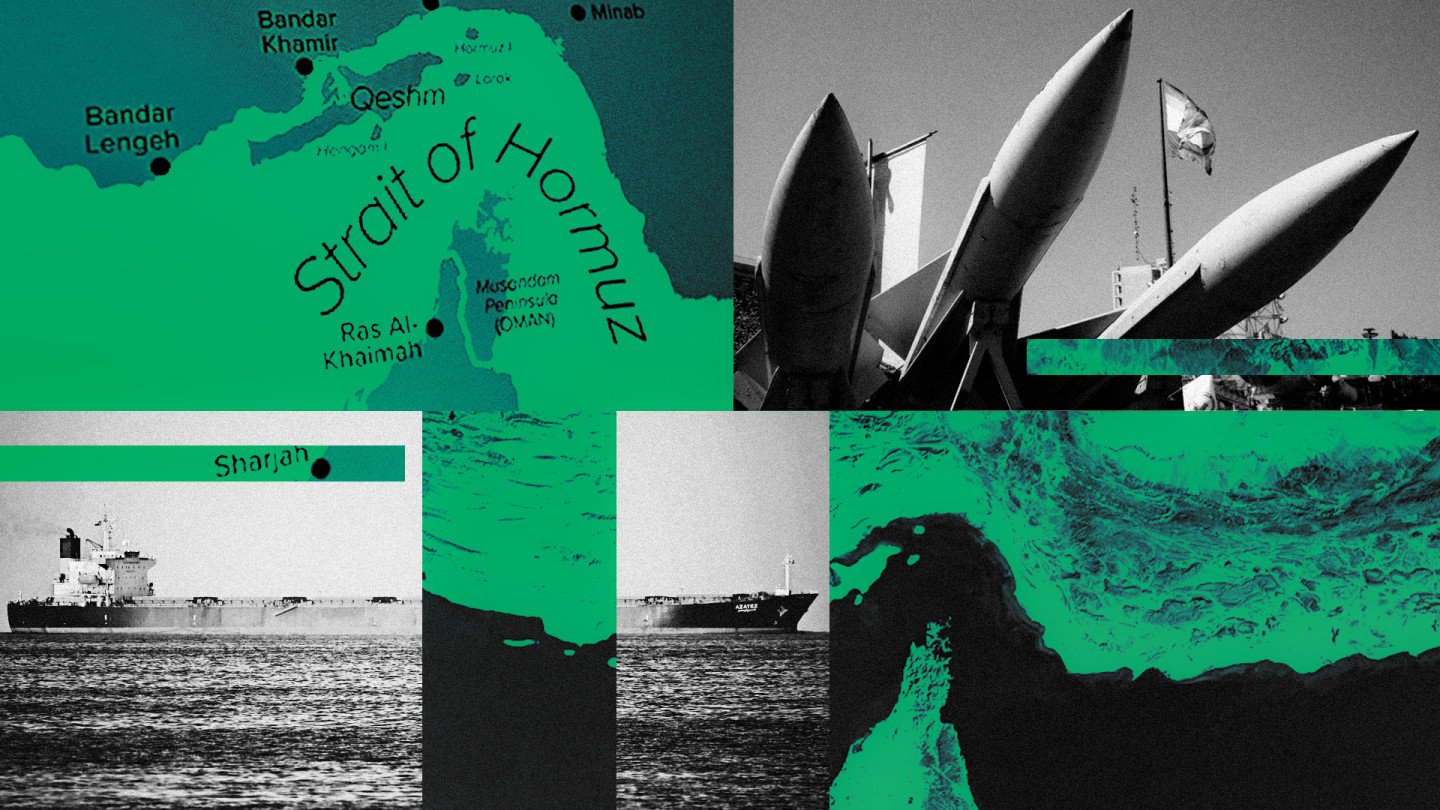
Stretching about 167 km between Iran and Oman, today, the Strait of Hormuz “probably has more value to the Iranians at the negotiation table than nuclear and military programs, and its proxy networks,” Reza H. Akbari, Middle East and North Africa Programme Manager at the Institute for War and Peace Reporting, told The New Arab.
“They’re using this as a strategic weapon to mobilise the conflict to impose costs and create divisions between regional neighbours and globally, which gives Iran a significant advantage,” he said.
The Strait of Hormuz is not only a strategic political asset, but also an economic lifeline.
Nearly 90% of Iran’s crude exports pass through the Strait of Hormuz, making it vital to a sanctions-hit economy already under severe strain. The war has further disrupted key industries, deepening the crisis.
Ali Vaez, Iran project director at the International Crisis Group (ICG), said Israel’s strikes on key export-generating industries, including steel, petrochemicals, and pharmaceuticals, have made postwar recovery significantly harder by reducing sources of hard currency.
“The calculus is that Iran would not be able, even if it survives this war, to survive the aftermath if it is not able to reconstruct, which requires a source of revenue,” he told TNA, adding that Iran views the Strait of Hormuz as a potential source of transit-fee income and a financial lifeline given low expectations of sanctions relief.
Iran is reportedly imposing informal transit fees on vessels, with some reports indicating charges of up to about $2 million per ship or amounts linked to cargo type, particularly oil shipments. Meanwhile, Iranian authorities have discussed tightening regulatory and security oversight of maritime traffic through parliamentary proposals.
Iran’s long-term strategy in the Strait of Hormuz balances political, military, and economic drivers, with a shifting emphasis based on threat perceptions.
Politically, Iran maintains a cautious, structural relationship with Oman, with which it shares the waters of the strait. Economically, Iran remains heavily dependent on the strait for trade, with tolls emerging as a minor tactical revenue addition, not a strategic shift.
Militarily, Iran is using the strait as a tool of deterrence, able to significantly disrupt navigation and reinforce its central role in regional security.
“Iran’s military strategy in the Strait of Hormuz was rather successful,” Abdolrasool Divsallar, professor at the Cattolica University of Milan, told TNA, adding that “the war effectively tested Iran’s strategy in a way that ultimately demonstrated its success”.
For centuries, the Strait of Hormuz has been one of the Persian Gulf’s most important maritime gateways, and a frequent flashpoint in regional power struggles.
The Portuguese seized control of it in the 16th century to dominate Gulf trade, before Shah Abbas I of the Safavid Empire, with help from the English East India Company, drove them out in 1622. More recently, during the Iran-Iraq War, both sides attacked oil shipping in the “Tanker War”.
Ali Alfoneh, a senior fellow at the Arab Gulf States Institute, explained that among Iran’s countermeasures, restricting passage through the Strait of Hormuz has proven the most effective, making it likely that Tehran will use this leverage to extract political concessions from the US and the broader international community.
However, “Iran must employ this tool judiciously to avoid provoking a unified global response against it,” he told TNA. “By conducting direct strikes against Iran, Israel and the US have broken a longstanding taboo,” prompting Iran to restrict passage through the Strait of Hormuz, leverage Washington can’t easily undo without risking a prolonged conflict.
Iran’s control of the strait is, however, increasing the risk of a global response and heightening tensions with Gulf states, which have been drawn into the conflict since the start of the war.
Alex Vatanka, senior fellow at the Middle East Institute, said that attempting to implement toll-based leverage over the strait risks alienating Gulf states, pushing them closer to Washington or Israel, while deepening regional tensions and triggering global backlash as “blackmail”.
“Iran could see [the Strait of Hormuz] as a card to play in a broader agreement with the US, moving towards economic normalcy, with sanctions lifted and becoming a regular state for investors,” he told TNA.
“That would bring far more long-term revenue than acting narrowly, as collecting from the Strait of Hormuz risks ‘thinking small’ and losing sight of the bigger potential.”
At the same time, Gulf countries may also face a security dilemma of their own, since they would remain dependent on US support but fear being left to manage Iran on their own if Washington’s role in the region weakens.
For now, the future of the Strait of Hormuz hinges on negotiations between the US and Iran, as the ceasefire clock ticks down and the risk of renewed strikes looms.
Iran has long seen the Strait of Hormuz as a source of leverage, but this war has, for the first time, allowed Tehran to test that power in practice, and it is unlikely to give it up.
This would most likely only happen if the Trump administration offered economic incentives, which it is unlikely to do, “so it either has to be a negotiated framework between Iran and the GCC, endorsed by the great powers, or it would become a source of tension,” Vaez added.
How Iran uses this leverage, and what Washington does next, will now be key to shaping the next phase of a conflict that has shaken both the Middle East and the global economy.