
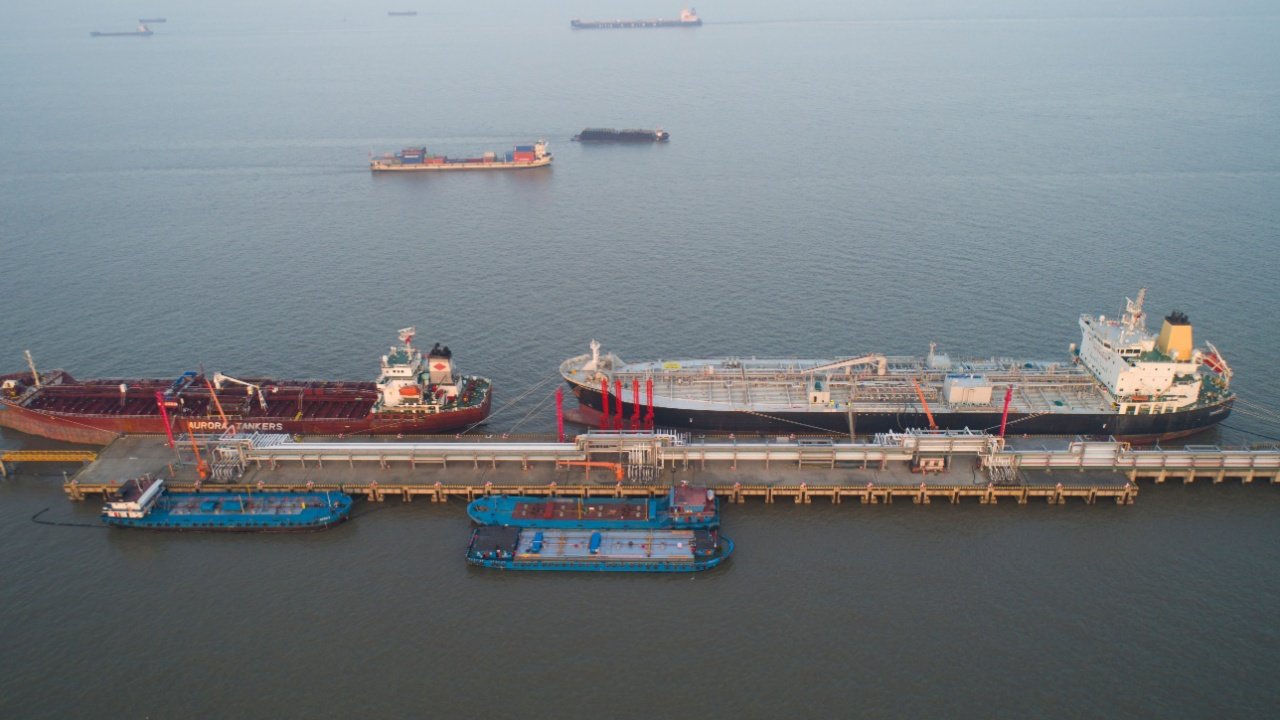
The US blockade aimed at Iranian coercion inadvertently severs China’s primary energy artery. Beijing perceives this as deliberate encirclement, positioning it to leverage rare earth monopolies as defensive retaliation. The operational carve-out for Chinese tankers negates the blockade’s coercive logic against Tehran.
The Trump administration’s improvised naval blockade may prompt China to retaliate with its own trade restrictions.
When the recent US-Iranian peace talks in Islamabad failed to yield an agreement, President Donald Trump faced an immediate dilemma: how to increase the pressure on its adversary without paying the steep price of renewed military escalation? The answer Washington settled on—a US blockade of the Strait of Hormuz, layered atop Iran’s own blockade—seemed odd but viable in theory. Stop Iran’s exports, squeeze its economy, force a more desperate leadership back to the table. Project strength without putting boots on the ground—and without threatening to “annihilate a civilization” again. It was a classic, if improvised, application of economic coercion. It was also a strategic miscalculation of the first order.
The problem is not necessarily the blockade’s intent. It is its effects. Roughly 90 percent of Iranian oil exports flow east, to China. When Washington announced it would enforce a blockade of the Strait, it was not merely pressuring Tehran. It was, functionally, blocking Beijing’s access to energy supplies it considers critical to national security—especially in an increasingly scarce oil marketplace due to the war. The Trump administration appears to have walked into this confrontation without fully appreciating what it was triggering.
The Chinese defense minister, Dong Jun, issued a careful yet quietly menacing statement establishing Beijing’s position: China’s ships were transiting the Strait with the permission of Iran, which controls those waters. “We expect others not to meddle in our affairs,” he said of the US blockade. This was not the language of a power ready to stand aside and allow Washington to dictate the terms of China’s energy security, which had already been severely affected by the war. Bowing to the blockade would be a sign of weakness.
Instead, Beijing’s warning was delivered with the confidence of a government that has done its homework and is ready for the possible outcomes. While the Trump administration appeared to be improvising—imposing a blockade without a clear theory of escalation management—China had almost certainly war-gamed this scenario in considerable depth. What looks from Washington like a possible misstep, from Beijing’s vantage point, looks like an opportunity. Consider the position China now occupies: it can cast itself as a victim of increasing American desperation and overreach, as Trump tries to salvage leverage in an otherwise disastrous war of choice.
While Beijing has characteristically—and doctrinally—avoided intervening in the ongoing conflict, it may now sense an opportunity to gain an advantage. Should the US Navy move to intercept Chinese vessels, Beijing would have a pretext to weaken its great-power rival, handed to it on a platter.
Although a maritime confrontation with the US risks escalating into a military engagement, China need not fire a shot to inflict serious damage. Beijing’s most powerful leverage is economic and strategic, not military. While it could aim for the US economy at a vulnerable moment, the more likely play is to leverage its control of critical resources like rare earths—a domain in which China holds something close to a monopoly and upon which America’s advanced civilian and military technology is profoundly dependent.
Washington cannot build its state-of-the-art weapons systems, from guided munitions to stealth aircraft, without rare earth inputs that China controls. A decision by Beijing to suspend those exports—it already began putting restrictions last year in response to Trump’s trade war—would not be framed as aggression, but rather as a proportional, defensive response to an American blockade that is threatening Chinese energy security.
It is also an opportunity with a limited window. The Trump administration began funding rare-earth processing plants and other related ventures over the past year to gain strategic autonomy from China. But this could take time to bring online.
With vital American military hardware under significant strain from the war—and the two and a half years of defending Israel that preceded it—a sudden loss of processed rare earth exports could further undercut the US military and open the door for China to make a play for Taiwan.
This scenario has additional resonance given the broader context. The Trump administration’s decision in January to intervene militarily in Venezuela and seize control of Venezuelan oil exports—suspected to be driven, in part, by an effort to cut off Chinese supply chains—suggests a pattern of Washington using third-party pressure to constrain Beijing’s energy access. If that reading is correct, Beijing is not confronting an isolated miscalculation on the Strait of Hormuz. It is confronting a deliberate, if poorly executed, American strategy of energy encirclement. That changes the stakes considerably.
Meanwhile, the immediate crisis appears to have reached an uneasy, ambiguous pause. Reports suggest Washington is allowing Chinese vessels to transit the Strait, quietly stepping back from the most dangerous edge of the confrontation. If true, this is a significant, if largely unacknowledged, retreat. The blockade’s strategic logic depended on its universality. A blockade with carve-outs for Chinese vessels is not a blockade—it is a gesture. Iran’s largest customer continues to receive its oil. The economic pressure on Tehran is substantially diminished.
This leaves the Trump administration in a difficult position. It does not want to return to the grinding, costly military campaign that preceded the Islamabad talks. Iran, for its part, has demonstrated something like escalation dominance on the battlefield—the ability to absorb and respond to military pressure in ways that match or raise costs for Washington and its partners. The administration wants to squeeze Iran without deploying ground troops or escalating against critical civilian infrastructure. Still, the tools available for that pressure are now visibly constrained by Beijing’s presence in the equation.
Washington crossed a line without realizing it. The question now is whether it has the strategic coherence to find its way back—before Beijing decides it is more advantageous not to let it.