
This analysis surveys global maritime chokepoints beyond the Strait of Hormuz — including the Bab el-Mandeb, the Suez Canal, the Taiwan Strait, and the Strait of Malacca — and explains why each carries its own risk of disrupting global trade and energy flows.
Hormuz has dominated headlines, but it’s far from the only waterway that can bring global trade to a standstill. As the Houthis threaten a fresh blockade of Saudi Arabia, attention is shifting to the wider network of global maritime chokepoints that keep oil, gas, and shipping moving between the Middle East, Europe, and Asia.
The Bab el-Mandeb Strait, the Suez Canal, the Strait of Malacca, and the Taiwan Strait each carry enough traffic — and enough vulnerability — to trigger their own economic shock if disrupted. History shows these closures aren’t hypothetical: Suez has shut down three times before, twice from war and once from a grounded container ship. Understanding how these pressure points connect explains why a single regional conflict can ripple through gas prices worldwide.
Global Maritime Chokepoints: Hormuz’s Uneasy Reopening
As of this week, the Strait of Hormuz is “open” for commercial transit, according to the US Central Command (CENTCOM), which oversees US military operations in the Middle East. Despite CENTCOM’s reassurances, however, traffic remains severely disrupted and far below pre-conflict levels due to the ongoing US and Iranian military engagements in the region. Even as the US Navy and CENTCOM continue to escort ships through Hormuz, the Islamic Republic is actively targeting and attacking commercial vessels—and the risk of an attack, even despite US protection, is significant enough that most shipping and insurance firms are unwilling to take the risk.
The lack of traffic sent oil prices higher on Wednesday, with Brent crude surpassing $93 per barrel and US West Texas Intermediate (WTI) reaching $86. (The fungibility of oil and the tight integration of global markets means that even oil supplies with no connection to the Persian Gulf—Brent Crude from the North Sea, WTI from Texas—are affected by the Hormuz blockade.) The US national average gas price once again passed $4 per gallon earlier this week after a brief decline in June and early July, according to the American Automobile Association (AAA).
As bad as the situation at the pump is for many Americans, it could still get worse, as one of Tehran’s regional proxies threatened to impose a naval blockade of Saudi Arabia this week. The Yemen-based Houthis could open a new front against the United States and the West, which could further slow the flow of oil from the Middle East to Europe.
A Houthi Blockade Threatens Global Maritime Chokepoints
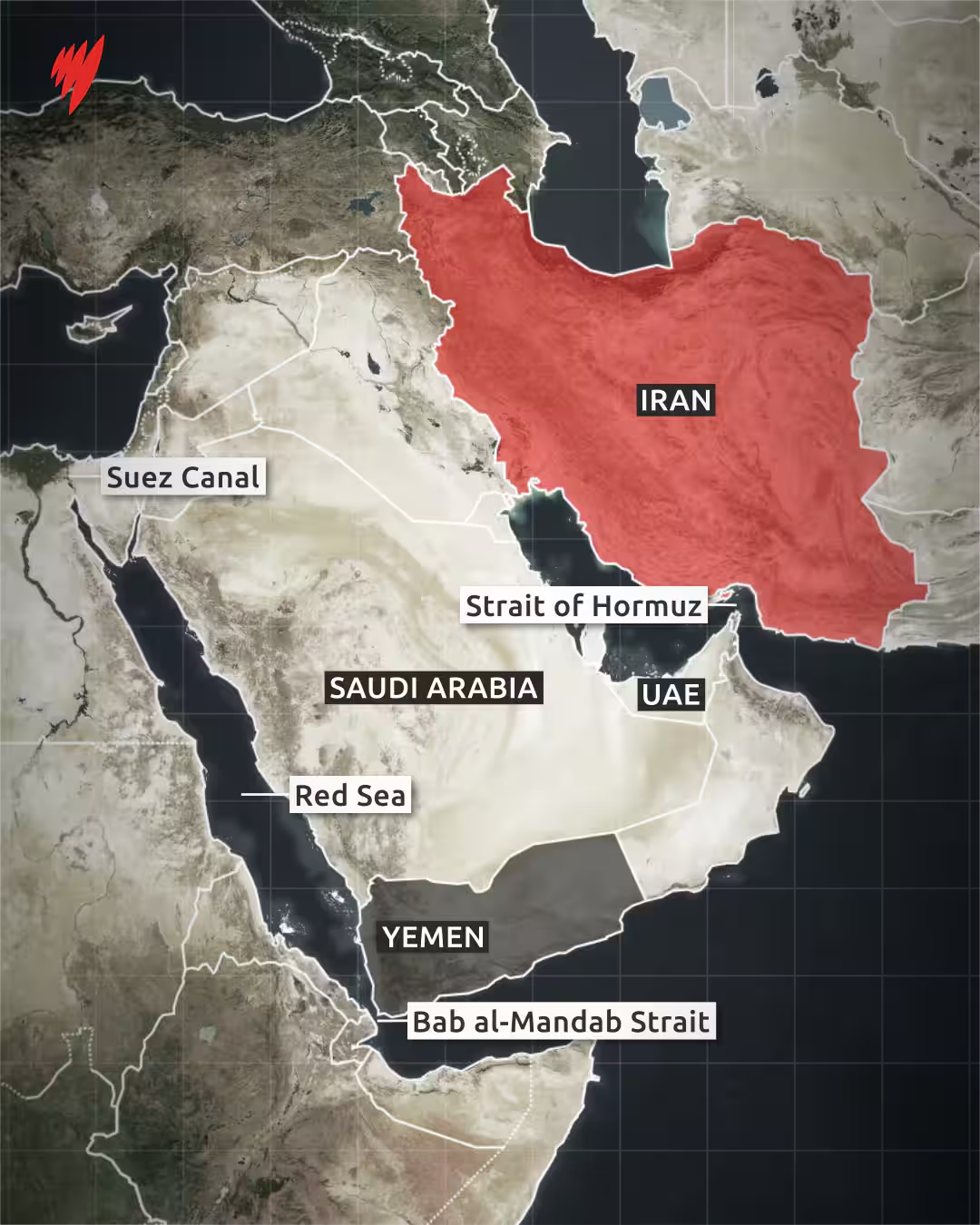
Although much attention has been on the Strait of Hormuz, through which one-fifth of the world’s oil transits, it is just one of several regional chokepoints in the Middle East. The other major chokepoint is the Bab el-Mandeb Strait, which connects the Red Sea with the Gulf of Aden and the Arabian Sea.
Since the start of the US and Israeli campaign against Iran that began on February 28, 2026, the Houthi militants, which control much of northern Yemen, have remained on the sidelines. Following the Trump administration’s “Operation Rough Rider” strikes on the group in early 2025, Washington reached an agreement with the Houthis in May 2025, in which the US agreed to halt its bombing campaign if the Houthis ceased targeting US or US-allied ships.
The agreement has largely held throughout the past year, but the Houthis’ recent belligerency is a warning that the Red Sea and the Bab el-Mandeb Strait remain another strategic chokepoint that could be quickly shut down, with serious consequences to the global economy.
The Bab el-Mandeb, which means “Gate of Tears” in Arabic, has been known for centuries as a potential navigation hazard due to its shallow waters, reefs, and unpredictable winds that can create high waves capable of swamping small watercraft. The strait, just 20 miles (32 km) wide at its narrowest point, is nevertheless a vital waterway connecting the Red Sea to the Gulf of Aden and on to the Indian Ocean. Around 10 percent of global oil traffic passes through the strait every day, much of it crude oil and liquefied natural gas (LNG) from the Middle East to the Mediterranean and Europe via the Suez Canal at the north end of the Red Sea.
The Bab el-Mandeb is not as vital as the Strait of Hormuz, both because of its lower volume of traffic and because ships have another (albeit expensive) option: rather than sailing through the Red Sea, they can sail around Africa via the Cape of Good Hope. That route adds more than 3,500 nautical miles (4,000 miles) to the journey, extending voyage times by 10 to 14 days and costing roughly $1–2 million per trip in additional fuel and operating expenses. Even so, many ships have taken this route during past rounds of Houthi belligerency, raising global commodities prices.
The Royal Navy’s flagship aircraft carrier HMS Prince of Wales and her escorts passed through the strait last year during Carrier Strike Group 25’s Operation Highmast. Still, the last US Navy aircraft carrier to transit the Bab el-Mandeb Strait was the second Nimitz-class supercarrier, the USS Dwight D. Eisenhower (CVN-69), which sailed through it in December 2023, soon after the Houthis began their attacks on commercial shipping in response to the war in Gaza.
Earlier this spring, the USS George H.W. Bush (CVN-77) sailed around Africa to reach the Arabian Sea, likely to avoid a potential clash with the Houthis in the Bab el-Mandeb.
Prior to its return to the United States in May, the USS Gerald R. Ford (CVN-78) also remained in the Red Sea during its operations against Iran—possibly so that it would not need to transit the strait.
Suez Canal Joins the List of Global Maritime Chokepoints
The greatest danger from the ongoing conflict with Iran may not be that Tehran shuts down the Strait of Hormuz; it may be that other nations begin to understand how they can extract concessions by threatening to shut down other vital passages.
On the other end of the Red Sea, the Suez Canal—the man-made waterway connecting the Mediterranean Sea to the Red Sea, and from there to the Indian Ocean and Asia—is another chokepoint, and one that has been closed in the past. In 1956, Egyptian leader Gamal Abdel Nasser nationalized the waterway, the UK, France, and Israel invaded to gain control and to topple Nasser. Backlash from the international community and political pressure from both the United States and the Soviet Union forced the three invaders to withdraw. Still, for about five months from late 1956 to early 1957, the canal stayed closed.
The canal suffered a much longer closure beginning in June 1967, when Israel invaded and conquered Egypt’s Sinai Peninsula—effectively turning the canal into the new border between the two nations. The canal served as the front line in a low-level war for the next half-decade and remained closed to traffic. In October 1973, Egypt overran Israeli fortifications along the canal and crossed into the Sinai, in a major blow to Israel; although Jerusalem regained much of its territory in the Sinai, a 1974 ceasefire agreement returned full control of the canal to Egypt, which reopened it to commercial traffic the following year.
More recently, the Suez Canal was closed for six days in March 2021 after the Chinese container ship Ever Given steered into one of its banks, running aground and fully blocking the waterway.
Asia’s Global Maritime Chokepoints Carry the Most Risk
Another vital waterway that could see a potential flare-up is the Taiwan Strait, which China claims is not international waters but rather a sovereign Chinese waterway. The United States disagrees, and periodically sails US Navy vessels through the strait in “freedom of navigation operations” to annoy Beijing, most recently in January.
Arguably the most important strait of all is the Strait of Malacca between Thailand, Indonesia, Malaysia, and Singapore, which is now the world’s busiest shipping lane by volume. The latter strait connects the Indian Ocean to the South China Sea, and is the primary route for trade and energy between Asia, the Middle East and Europe. Maritime experts have warned that in a conflict in the Indo-Pacific, an adversary could disrupt much of the global trade by shutting down the Strait of Malacca—though nearly every important player involved, including China, depends on the strait for commercial traffic, so the benefits of doing so would probably be outweighed by the drawbacks.
Why Global Maritime Chokepoints Are a Shared Vulnerability
Taken together, these waterways reveal something Hormuz alone doesn’t: chokepoint leverage isn’t unique to Iran. Any state bordering a narrow, high-volume passage — from Yemen to China — has learned that the credible threat of closure can extract concessions or apply pressure without firing a shot, making global maritime chokepoints a recurring feature of geopolitical strategy rather than a one-off crisis.