
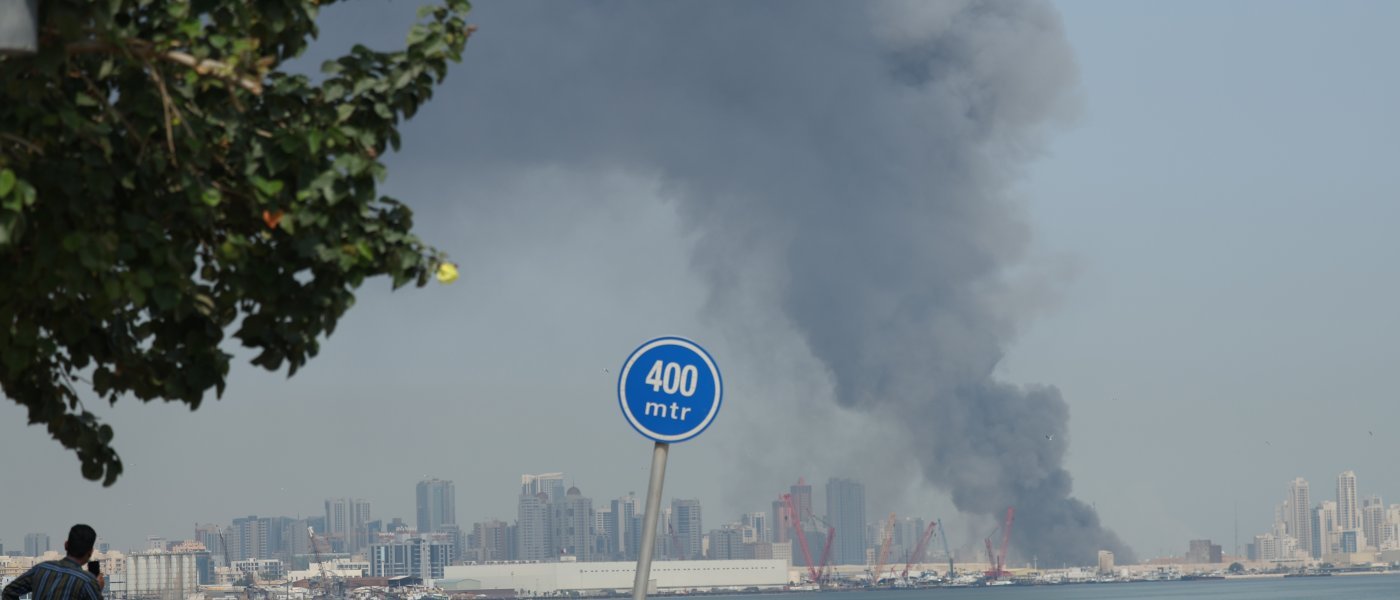
CSIS experts assess the Iran war: U.S.-Israel achieved rapid air dominance, killing Khamenei. Iran retaliates by targeting Gulf energy infrastructure. Duration likely months; key indicators: munition stockpiles, proxy involvement, regime cohesion. Oil markets underprice risk.
Mona Yacoubian: Over the weekend, the United States and Israel launched joint strikes against Iran, decapitating regime leadership, including the supreme leader, and hitting a wide array of targets across Iran. Iran has retaliated with missile and drone strikes against Israel and nine Arab countries, and as far afield as Cyprus. Four U.S. servicemembers have also been killed and three U.S. fighter jets were downed in a friendly fire incident over Kuwait. As the conflict widens, what can we expect in the coming days and weeks?
I’m Mona Yacoubian, director of the Middle East Program here at CSIS. And to help me unpack what’s happened and what to expect I’m joined by my CSIS colleagues, Seth Jones, president of the Defense and Security Department and Harold Brown chair, Emily Harding, vice president of the Defense and Security Department and director of the Intelligence National Security and Technology Program, and Clay Seigle, senior fellow, and James R. Schlesinger chair in energy and geopolitics.
So let’s dive in. It’s been less than 74 hours since this war began, and there’s so much to go over. Seth, as of yesterday a U.S. official said that the U.S. and Israel have hit 2,000 targets in Iran so far. And yet, we are also seeing the conflict expand in numerous ways. What is your assessment of the effectiveness of U.S. and Israeli military action to date?
Seth G. Jones: Well, thanks for the question, Mona. And great to be on.
I mean, first, probably critical to raise the specter of what Carl von Clausewitz, the Prussian general, calls “the fog of war.” So I think anybody who could give you a very confident answer about the effect would be lying.
So with that caveat, I mean, I think what we have seen is the U.S. and the Israelis already, in the span of two days or so, gain air dominance, or largely gain air dominance in Iran. That is an enormous feat. It’s something that the Russians, over four years in Ukraine do not have. So there’s a remarkable speed with which they have gained air dominance, can fly not just stealth aircraft, F-35s or F-22s, but also some F-16s that are not fifth-generation aircraft. We’ve seen a number of different targets struck across Iran. So, you know, that’s partial effectiveness. They’ve struck missile compounds, command and control structures, obviously senior leaders, including the supreme leader.
I think what is less clear is, for example, to what degree has the regime been weakened. The Islamic Revolutionary Guard force or the Basij, for example? And how will that impact the future strength of the Iranian government? That is a big open question. And frankly, it’s going to be very difficult, I think, to do major damage to the Iranian regime largely from air and naval assets, and that we can come back to.
The Impossibility of Airborne Regime Change
Ms. Yacoubian And we’re going to – we’re going to go there right now. So, I mean, in fact, we do see that while the Iranians are on the back heel they also have instituted some sort of temporary transitional council that’s taken charge. Not clear yet who will be the successor of the supreme leader. And of course, given that they are all in the crosshairs of future strikes, we may not hear an announcement of a new supreme leader any time soon.
But the administration has talked about regime change as being a key objective of this campaign, and yet, as you know, we’re doing everything from the air. President Trump just earlier today hinted that he wouldn’t completely dispel the notion of needing ground troops. But help us understand, how can this go forward without ground troops? Can you successfully undertake a regime-change operation solely from the air?
Dr. Jones: Well, I think even with ground troops trying to social engineer a foreign government is incredibly difficult. There are not many, frankly, good cases. I mean, the ones that come to mind were after the end of World War II, but that was after a devastating global war where the Germans and the Japanese were utterly defeated and the number of casualties was extraordinary.
I mean, if we look at the examples of 2003 Iraq, 2001 Afghanistan, or even the Libya operation, in all three of those cases there were a combination of ground forces and even in the Libya case special operations and intelligence forces on the ground. Those wars persisted for years if not decades after that, you know, and we saw civil wars in all three cases and insurgencies. So trying to do that without a meaningful ground presence I think is going to be virtually impossible. And then you run the risk of what the U.S. did in 1991 in Iraq and Hungary in 1956, which is it urged individuals to rise up and they were slaughtered in both cases, the Kurds and the Hungarians.
Debating the Imminence of the Iranian Threat
Ms. Yacoubian: So, Emily, I want to bring you in. And one of the topics that’s getting a lot of attention over the last couple days is just how imminent was the threat posed by Iran. And there are lots of questions about intelligence community assessments, certainly with respect to was Iran able to move forward on its nuclear program despite its having been obliterated this past June. At one point I think the president referenced Iran’s ballistic missile capabilities and even noted potentially that Iran could hit the United States; I mean, essentially, an intercontinental ballistic missile. What is your sense on where our intelligence community was on these assessments and how imminent the threat has been?
Emily Harding: Right. So I’m going to try to lay out both sides of this very, very thorny argument, because it is very thorny.
The people who are in favor of this as a preemptive strike or as a self-defense strike are going to say that Iran had been developing capabilities to attack the United States for 40 years or more, and that in recent years that capability had accelerated. So they’re going to point to things like the advances in their ballistic missile program. They’re going to point to advances in their nuclear program. When Operation Midnight Hammer happened, there was discussion about Iran having a breakout capacity to a nuclear weapon very quickly, and then also having the capability to deliver those weapons perhaps by ballistic missile – at least Israel and Europe, and then stretching towards the U.S. All of those are valid. You add in that there is a threat always from Iran against our forces in the region – our forces in the Gulf, our forces in Iraq. They have proven over and over again that they’re willing to go after those troops, and sometimes with devastating effect. So all of that is what people are going to point to as this was an imminent threat.
The other side, however, is going to say it’s no more imminent today than it was three weeks ago, a month ago; why are we doing this today? And I think that is – also has some validity to it. I’m not sure there was anything that was saying that the Iranian regime was looking to attack those forces in the region or to attack the United States today in a way they weren’t going to, you know, a month ago or six months ago.
So, if you look at Iran posing a threat to the United States, the answer is clearly yes. This is a terrorist regime with proxy networks all over the world who has attempted to assassinate the president, to carry out terrorist attacks in the U.S. They have engaged on cyberattacks against critical infrastructure in the U.S. I mean, this is not a friendly government. But was it an existential threat to the U.S.? Absolutely not. Was it an imminent threat to the U.S.? I think that’s going to be debated.
And the intelligence community, you know, they have been at the center of this political football before. And they’re going to be very precise, very careful about how they explain that threat. And anytime their assessment of that threat changes, they’re going to be very careful in trying to sort of shade the nuances and describe what has actually changed. I used to joke that some of the most boring intel briefings I ever sat through were about the Iranian threat because it was so precisely calibrated to be exact and specific. You’ve got to sort of, like, work your way through the changes.
A Massive Intelligence Success
Ms. Yacoubian: So there are lots of intelligence challenges when it comes to a theater as complex as the one we see in Iran. Seth and I were chatting for a moment about what’s happening within the Iranian leadership, given this pretty significant decapitation that’s taken place, I think the estimates are up to 40 leaders or senior-level officials killed. What is your sense of the U.S. intelligence community’s understanding of these very, very kind of opaque leadership struggles, leadership structure inside Iran?
Ms. Harding: My entire career we’ve always talked about Iran as being one of the hardest of the hard targets – North Korea, Russia, China, Iran. And partially it’s because they are so secretive. Partially it’s because it’s very hard to sort of get into inner circle dynamics, because they do keep it so closely held. All that said, this is clearly a massive intelligence success. And one of the things that I find fascinating about it, after Operation Midnight Hammer, the 12-day war, you expected to see a massive Iranian purge of their internal security apparatus. They would be looking for spies. They’d be looking for penetrations, from a technical perspective. So you would have thought that our intelligence picture would degrade quite a bit after the 12-day war and up to now.
However what we saw in this operation is that not only did we know what was happening on the ground, we knew what was going to happen on the ground. I mean 10, 12 hours ahead of time. This morning at the press conference they said that the go order was given at 3:00 on Friday, which means that they knew where the supreme leader and the security apparatus was going to be 10 hours later. That’s an amazing intelligence success. And I think the partnership between Israeli intelligence and U.S. intelligence has borne a lot of fruit over the years. It’s also had some tension over the years. (Laughs.) But I think this is an example of a true success.
Energy Markets at a Critical Inflection Point
Ms. Yacoubian: So, Clay, I want to bring you in at this point. We’ve all been watching very closely questions around energy infrastructure and how various markets are responding. You wrote a really interesting piece just a couple weeks ago mapping out various scenarios of what oil market disruption might look like. We’ve seen just in the last 12 hours a pretty significant escalation by Iran targeting energy infrastructure in Saudi Arabia. The largest refinery in Saudi has halted operations. The Qataris have noted that they have ceased their LNG production at this point. Where are we – (laughs) – right now in terms of the risks and the disruption? How do you see things?
Clayton Seigle: Hi, Mona.
I think where we are is at a critical inflection point for global energy security and affordability. What strikes me most of all this morning is the stark disparity between, at face value, the risks that are facing global energy security because of this war in the Mideast Gulf, and apparently the expectations of both the Trump administration and a lot of market participants, traders, that seem to be so far pretty sanguine about the risk of a major supply disruption – even in the face, as you said, from earlier today and overnight some of the biggest energy export facilities in the world have come under fire now.
So in the scenarios that we talked about a couple of weeks ago we were looking at two major vectors for supply disruptions. One of them was to shipping, exporting all the cargoes of oil and natural gas out of the gulf to world markets. And the other one was the potential disabling or even destroying of infrastructure and assets in the gulf that are needed to load the ships.
So far already in this war that started a couple days ago we have seen both. We’ve seen five small tankers, not supertankers but small tankers, come under fire or otherwise get damaged from combat in the Gulf. But the bigger effect for shipping has been almost on the technical side. It’s those insurers that have get the right premium for war risk who want to cancel contracts, declare force majeure, and get a higher premium for continuing to operate in the area. That’s caused a lot of the ships in the Gulf to just drop anchor and wait for further instructions.
Another really technical, important obstacle for continuing those exports has been the disruption of navigation systems. So just think of it as all the ships’ GPS is being jammed in the area. It’s actually dangerous to transit those narrow straits until that’s cleared up. So that’s without the fleets that are exporting these cargoes actually coming under significant fire from drones, from antiship missiles, from submerged explosive mines, and some of the other threats that they might be facing.
And then, as we said, we saw this attack on Ras Tanura – 550,000 barrels per day of capacity; that’s Saudi Arabia’s largest – and the Ras Laffan LNG export terminal in Qatar, which exports 10 billion cubic feet per day – about 20 percent of global needs – through the Strait of Hormuz. So I say that there’s a really interesting discrepancy between what looks like the setup for triple-digit oil prices and very high natural gas prices and the disposition of both President Trump, who has a long track record of expressing sensitivity to high oil prices and high fuel prices here at home, has recognized the connection to the fight against inflation and economic prosperity.
And then I also have to ask about my friends on the trading side, on the trading desks. You know, when we were thinking about just 5 million barrels per day – just 5 million barrels per day of Russian supply going offline in 2022 – we ran up to $130 in crude, $5 a gallon for U.S. gasoline prices. At this time, oil is up maybe $7 or $8. So either the traders and the administration know something that we don’t on the analyst side that the situation is more benign than we’re expecting or we could be sleepwalking into triple-digit oil prices pretty soon.
Iran’s Existential Response and Gulf State Anger
Ms. Yacoubian: So help us understand a little bit better. I mean, we’ve already seen a pretty significant shift just in the last 24 hours. I mean, you – and you did sort of lay some of this down in your recent piece, but help us understand some of the kind of what would be the key scenarios you would be mapping out going forward.
Mr. Seigle: Well, I’m most interested in finding out whether the Strait of Hormuz is going to remain open.
And a lot of people are asking about mitigations to a supply disruption. One of the classic cushions the oil market has is spare oil production capacity. It’s at a relatively low level right now, probably 3 million barrels per day or less, and it’s concentrated within just two of those local producers: Saudi Arabia and the United Arab Emirates. But it’s all upstream of the Strait of Hormuz, so if traffic is not egressing through the Arabian Gulf into the world market it doesn’t matter.
Saudi Arabia and UAE have a little bit of capacity to redirect exports from the Gulf to outside the Hormuz bottleneck, but it’s pretty minor. So I’m watching to see whether the Strait of Hormuz remains both legally open, which it is today, and also practically open.
The second question that has to be on everyone’s mind is, are these attacks against infrastructure, particularly offshore infrastructure, going to continue and be more debilitating for exports than we’ve seen so far? Maybe at Ras Laffan in Qatar some of the slowdown or shutdown is preemptive in nature. I think it probably is. In Ras Tanura refinery, we saw some units that were curtailed on an operational basis but not related to exports. That’s refining pretty much for the domestic market. So we need to look if the export terminals in places like Saudi, UAE, Iraq, and Kuwait are impacted by direct fire, and if that inhibits the loading of ships for export. That’s the key.
Ms. Yacoubian: So, Seth, I want to turn back to you as we continue to sort of think through how this conflict could evolve. Help us understand a little bit better the Iranians and how they’ve been engaging. We’ve seen them undertake hundreds of drone and missile strikes, as I noted at the outset, even going and hitting as far afield as a British military base in Cyprus. Help us understand what Iran’s strategy is in this. I mean, clearly, this is a regime that is pulling out all the stops. I mean, they – the struggle for them, I think, is existential. They’re going for broke. And so but help us understand how they’re undertaking this, and especially when there are questions even about who’s in charge. And do you think about and worry about questions around command and control?
Dr. Jones: Well, Mona, I have a hard enough time trying to understand what U.S. strategy is, but I will take a stab at Iranian strategy. I mean, it does appear that the Iranians are conducting attacks against a broader target set, I think, than I would have guessed early on. That has included airports, for example, and civilian targets across the gulf. We have seen Hezbollah, at least one of the major partner forces, get involved as well. Iran has used a range of its missiles, ballistic and cruise, as well as drones. They have a number of different types of Shaheds, which the Russians have imported and are building and using in their war in Ukraine as well. So we’re quite familiar with the Shaheds.
And I think, in terms of strategy, you know, it’s unclear if part of the Iranian strategy was to put pressure on gulf states so that they would push the U.S. to try to curb this war as soon as possible. I mean, my conversations with a range of different officials in gulf states suggest that it could have the opposite effect. Which is, we see a lot of anger in a range of different gulf states at the Iranians for not just targeting the Israelis or the Americans, but targeting civilian infrastructure, including what we just heard on the energy side. And if that’s the case, you know it’s not entirely out of the question that we see some gulf states get more involved in this, providing information, allowing their territory to be used for offensive strikes, not just defensive ones.
And just one last thing on the Iranians, because I think, you know, it’s not clear where this is headed. We have not seen a lot of activity yet by the Houthis in Yemen, which does raise the prospect, as we saw in 2025, of not just the Strait of Hormuz but the Bab al-Mandab Strait, which also is a key chokepoint for commerce, coming under threat, commercial vessels. And they have the capability to conduct attacks against commercial vessels, against Israel, against U.S. ships in the region. So there are a number of interesting indications and warnings as we look over the next few days.
Cyber Operations and Psychological Warfare
Ms. Yacoubian: Yeah, and we’ll turn to that in a moment, because I want all of you to sort of speculate – (laughs) – on what we might see in the next week or so. But, Emily, I want to turn to you and kind of draw you out a little bit on the cyber elements of this. So there was reporting I saw over the weekend that Israel undertook, it said, the largest cyberattack in history, as part of this offensive against Iran. Give us a laydown of sort of the cyber elements of this. And also, what are Iran’s capabilities? Because, of course, we’ve long noted that Iran is actually fairly sophisticated in terms of its ability to undertake cyberattacks.
Ms. Harding: Mmm hmm. These are two sophisticated actors that are definitely using this weapon against each other, and then you add the U.S. into the mix too. So there’s a lot of hyperbole being thrown around in this conflict. I would be very skeptical about a claim that this is the biggest cyberattack in history.
Ms. Yacoubian: (Laughs.) Not hyperbole! Say it isn’t so! (Laughter.)
Ms. Harding: Yeah, definitely. I mean, that said, initial reports out look like – we know the following things. Internet traffic in Iran dropped precipitously at almost the exact same time as the attack. From 100 percent it went to 4 percent of traffic. Now was that because the Israelis shut down the Iranian internet? Maybe. Was that because the Iranians shut down their own internet? Maybe. We have seen them do that several times in order to squash the ability of protesters to organize, to squash the ability of the people to organize.
On the other hand, this is a tactic that we saw the Russians use in Ukraine to try to shut down internet capability so that if the official military channels went down that officials could not then turn to their cellphones, you know, Signal, all of the semi-secure ways that we all communicate on a daily basis, to kind of backfill for those lost communications. It didn’t really work very well when the Russians did it in Ukraine, because the Ukrainians were ready for them. The Iranians are far less resilient. And the Israelis are really very good at what they do in the cyber domain.
What we’ve seen is a lot of leaning into psychological operations for cyber. So one kind of snippy little thing it seems like the Israelis may have done here was go after a religious calendar app. You know, the kind of thing that tells you it’s time to pray. It’s Ramadan right now, right? So, of course, it’s time to break your fast. And that the – there was a message that appeared on the app that said something like “the time of reckoning is here,” and encouraged people to throw out their support for the regime and then come out into the streets. Now that is a very direct message to a group of people that may be more likely to be regime supporters.
And that kind of psychological operation, we’ve seen suggestions there were attacks against Iranian news networks, a lot of messaging to the population that, look, your regime is weaker than they’re letting on. It is time to step up and perhaps try to overthrow them. Now, again, that leads to all of the problems that Seth was talking about at the beginning. Do you really want to encourage a population to put themselves in that kind of danger? But we are seeing cyberattacks used in these twin elements of a psychological operation and then also a disruptive operation.
As you mentioned, the Iranians are also very sophisticated in this realm. They have proven themselves very aggressive in the past. They’ve gone after U.S. elections. They have gone after U.S. water facilities. They have gone after U.S. power facilities. I mean, they have not pulled many punches in the cyber domain. And this could be a tactic that they turn to. Right now, they’re busy fighting a kinetic war, though. (Laughs.)
Market Mitigations and China’s Strategic Exposure
Ms. Yacoubian: Indeed, they are.
Clay, we’ve talked a lot about the sort of negative impacts that we’re witnessing right now, especially in the oil and energy markets. But can you help us understand a little bit better? You started to talk a bit about some of the mitigating measures that can be taken. And you’ve also noted that what we’re seeing right now still pales in comparison to what we saw in 2022 when the Russians invaded Ukraine. Help us understand a little bit better. Give us some positive news here in terms of what kinds of mitigating measures can be taken to lessen the impact of some of these disruptions that we’re seeing.
Mr. Seigle: Sure. Well, the oil market traditionally has two, you can think of them as cushions, against supply disruptions. One of them that I mentioned before is spare production capacity. And that’s sort of the volume of oil that certain producers can bring on within a certain period of time and sustain it for a period of several months. So I think it’s, like, 30 days to bring on, 90-plus days sustained. That’s sort of the official definition. And it’s all in Saudi Arabia and UAE right now. The other big – so it’s relatively low. It was 5-6 million barrels per day a year-plus ago, and now it’s less. One of the reasons it’s less is because OPEC and its partners have been increasing supply from April through December of last year. And they took a little pause in the first quarter, and now they’ve just announced that they’ll be increasing supplies again starting in April. So, of course, the other side of the coin, as you add production into the market, you decrease that cushion of spare capacity that could be brought to bear against a future disruption.
The other big cushion that the global oil market has against disruptions is inventories on hand. And inventories are held in two ways, by industry and also by governments. So for example, here in the United States we have, since the 1970s, had the Strategic Petroleum Reserve. It’s not nearly as full as it used to be before the Biden administration undertook a large drawdown. Again, going back to our 2022 case study, fearing a big removal of Russian barrels from the market the Biden administration drew down 180 million barrels from the reserve when it was close to full, around – a little bit below 700 million barrels. Today it’s only a little more than half full. It’s maybe 415 million barrels. So it’s relatively modest. And, of course, this administration has said that it’s only to be used in the event of an acute supply disruption, and not to mitigate price increases.
So and then on the industry side, it’s a mixed picture between crude and refined products. But let’s just say that we have a modest level of oil inventories and spare capacity to act as cushions against supply disruptions. Then the last thing that really can moderate prices when they start to really climb into that triple-digit territory is demand curtailment. And we did see that as well in 2022. If we get back to those levels, either for oil or in natural gas, where we’ve seen prices increase 50 percent just today, based on what happened in Qatar, and who knows how long lasting that effect will be, then that’s another way of adjusting to these new market realities.
If I can, just one of the biggest influences that we should be looking for in this situation is the behavior of China, because China has so much at stake here. It was just a couple months ago we were talking about China’s exposure to the U.S. operation in Venezuela, because almost all of Venezuela’s oil went to China. That’s now being redirected to other places. Now we have Iran’s output potentially at risk, or at least being throttled. And all of that oil goes to China. But the much bigger question for China is its overall dependence on the Mideast gulf. Forty-five percent of its 11 million barrels per day comes from the gulf. So planners, risk managers in Beijing have to be really concerned about the direction of travel with Washington using energy as leverage in these conflicts.
Key Indicators and Duration Forecasts
Ms. Yacoubian: Thank you for raising China and kind of broadening the aperture.
We are pretty much at the end of our time. I do, though, want to have a rapid round with each of you. And I’ll kick it off to say, kind of, what are the key indicators that you’re going to be watching for over the next few days to indicate whether or not this conflict is continuing to expand, or whether things are starting to kind of level out a little bit? And attach to that, how long should we expect this conflict to go on for?
So I will start by saying I’m watching Lebanon closely and watching this interaction between the Israeli forces and Hezbollah. We’ve seen Israel take on pretty significant strikes against Hezbollah targets across the country. The big question in my mind, does Israel actually commit ground forces? Which I think would signal a significant expansion, yet again, of this conflict. My own view, I don’t think we should be measuring our intervention in days or weeks. I think we’re actually talking months.
Seth.
Dr. Jones: Yeah. I’ll add two more to that. The first is U.S. munition stockpiles. In 2025, the U.S. expended more than a quarter of its entire THAAD air defense munition stockpiles. We’re already using THAAD and Patriots, as well as a number of offensive munitions. So the more the U.S. fires the less munitions it has, offensive and defensive, including available for its war plans or OPLANs against China in the Taiwan Strait, against North Korea on the Korean Peninsula, and against Russia, with its OPLAN for Russia. So I’m watching what our stockpile – and how concerned our military leaders are.
And the second issue is I’m also quite interested in how a number of Iranian partner forces respond. Do the Houthis start firing from Yemen? Do we see Iraqi Shia militia start conducting attacks, including against U.S. forces in Syria, or Iraq, or Jordan, or other locations? So do we see the – or do we see the Islamic Revolutionary Guards Quds Force and its partners conduct attacks elsewhere? We know they’ve conducted assassination plots, at least in the U.S., including in the city of Washington. So how does that – how does that expand?
Ms. Yacoubian: And days, weeks, months? What will be the duration?
Dr. Jones: I think when you start talking about trying to shape a regime, I think you’re talking about months, if not longer.
Ms. Harding: So I’ll be watching Iranian leadership control over their own territory. I think the biggest assumption that I am making in my own analysis here is that this regime is a robust bureaucracy and has a very deep bench of talent. So even though the decapitation strikes, even though the killing of so many leaders has been effective, there are plenty of people who are behind them. They have a robust succession plan to step up and keep the government running. Now, I’m assuming that based on, you know, the past 20 years of following this country – (laughs) – and seeing how robust their bureaucracy really is.
However, at some point, you know, you get deep enough in the ranks and the whole mechanism starts to teeter a little bit. Whoever is on this three-man organization that is supposed to be running the country, there is the possibility – I think it’s remote – but there is the possibility that they pull something along the lines of the fall of the Berlin Wall, and they say, look, we’re not going to enforce the prohibition on people going out in the streets. We are, in fact, going to abandon the nuclear program. We’re going to ask for sanctions relief. I think that would be the best outcome for everybody here, if they could summon the courage to just cry uncle and to say, look, we want to focus on fixing our domestic problems instead of engaging in this adventurism.
Chances of that are slim. There’s kind of a wildcard scenario here that I think Israel may also have in the back of its mind. And that is that some of the provinces inside Iran could split off. That you could see sort of a balkanization of the Iranian amalgamation of ethnicities. Again, I think that’s a slim possibility, but people tend to underestimate the possibility for dramatic change. This does feel like a moment of dramatic change. So I’ll be watching to see if either one of those two things come to fruition, and we see Tehran really start to lose a hold on their territory.
Ms. Yacoubian: And, duration?
Ms. Harding: You know, the president was just saying in the press conference that they expected it to take weeks to do the leadership strikes they were planning on doing. And they managed to do it in hours. I would suspect that this kind of tempo lasts weeks, not months. But, I mean, once the sorties stop, what really happens is on the ground in Iran there’s lots of sharp elbows. And that piece of it I would say is going to last years.
Ms. Yacoubian: So, Clay, last but not least, what are you looking for? What’s the duration? And I would like you to entertain the nightmare scenario that Seth helpfully laid down of the Houthis getting involved and then the Bab al-Mandab also being implicated along with the Strait of Hormuz.
Mr. Seigle: And that’s entirely possible. We had a huge disruption to global economies a few years ago when a – when, basically, a commercial container ship got stranded in the Suez Canal, which blocks the same path even without, like, malign actors. That’s basically, like, a parallel parking accident – (laughter) – and global economies were greatly affected by that.
Then you have the campaign of the Houthis in more recent years, since October 7th of ’23, and that absolutely could be reactivated, notwithstanding the fact that the United States waged a military campaign against those forces which may or may not have materially degraded them.
What I’m really watching for is to build on the colleagues’ expectations for the duration and talk about what it means for energy security, because the longer this thing goes on the more likely that both Iran and the United States/Israel are liable to play stronger energy leverage cards in order to force an outcome to their advantage. That could mean more attacks on ships. It could mean more attacks on offshore facilities that could be really difficult and take a long time to repair. And that means the potential for a larger supply disruption.
And the last thing to end on – I know you asked me to focus on positive news – but even when the United States declares, if it’s not too soon, mission accomplished and starts to wind down major combat activities, that does not necessarily mean that energy security is going to be more assured in the Mideast Gulf region. And we have to look at the pieces that are left to pick up and the resulting geopolitical balance of power in order to make a better assessment at that time.
Ms. Yacoubian: So I want to thank all of you for your rich insights. You’ve given us, I think, a lot to chew on and certainly a lot to look for in the coming days and weeks ahead.
To our online audience, thank you so much for tuning in. Please visit CSIS.org, where you can see more insights and analysis on the confrontation with Iran. Thank you.