
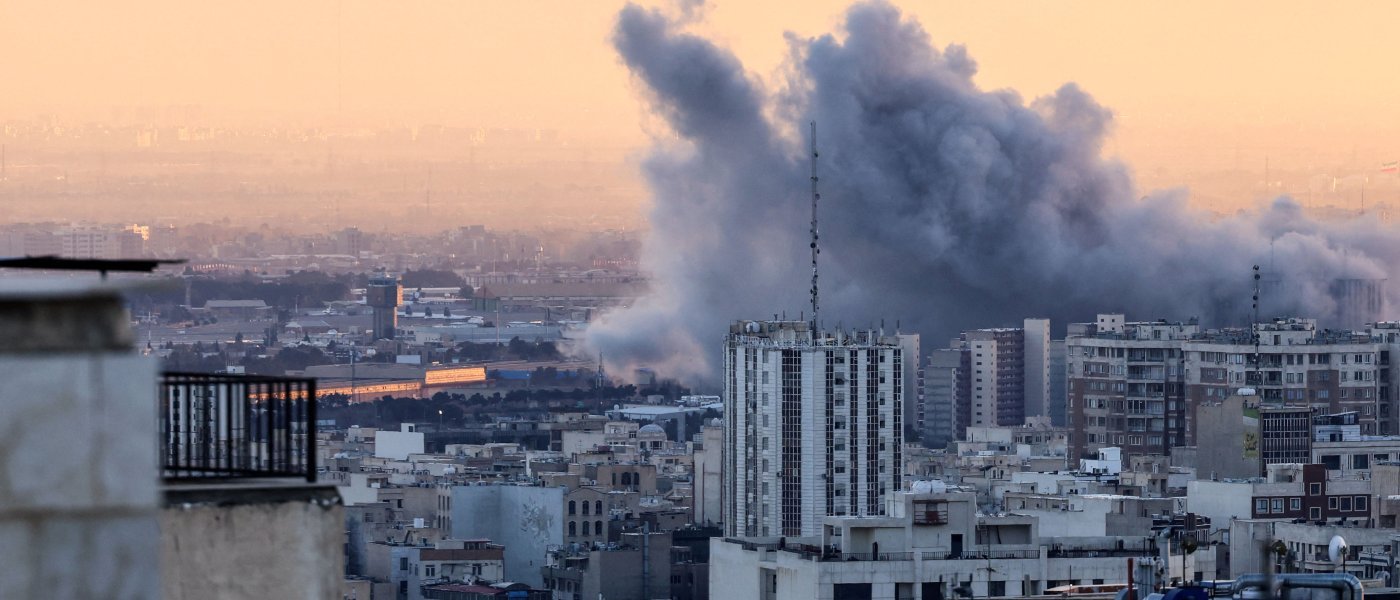
CSIS experts debate regime change in Iran, citing past failures. U.S. war aims unclear—oscillating between limited strikes and regime change. Risks: encouraging uprising without support, ending with “weaker but worse” regime. Historical lessons: decapitation rarely works.
Will Todman: Shortly after launching Operation Epic Fury, President Trump indicated an interest in regime change in Iran. He told Iranians that it would soon be time to “take over your government.” But U.S. efforts to bring about regime change in the Middle East have not gone well in recent decades. Are we really heading towards regime change in Iran? What are the risks? And what lessons can we draw from past regime change efforts in the Middle East and beyond? I’m your host, Will Todman. Welcome to this special live episode of State of Play.
All right. So just earlier today Secretary Hegseth said that the U.S. will soon have air supremacy over Iran by the end of the week. We’ve seen reports about the CIA supporting Kurds, Iranian Kurds and Kurds that might cross over the border into the northwest of the country. And President Trump has said some mixed things about whether or not regime change is really his aim or not his aim. So today the four of us are going to be discussing kind of what lessons there are from regime change experiences and efforts around the Middle East, and also more broadly.
So I am delighted to be joined, and I’ll go around in order. Dan Byman is the director of the Warfare, Irregular Threats, and Terrorism Program here at CSIS. John Alterman is the Brzezinski chair in global security and geostrategy. And Mona Yacoubian is senior advisor and director of the Middle East Program.
So let’s dive right into it. Are we heading towards regime change? Is that what the U.S. seems to be aiming at? Or is that becoming the aim of the U.S.? What does it look like to you? Maybe, Dan, can I start with you?
Daniel Byman: Sure. And one of the many difficulties on the U.S. side is the president and the administration have not made clear what U.S. priorities are. So certainly, regime change has been mentioned repeatedly. We have Israeli military operations that are not only killing large numbers of senior Iranian leaders, but also going after police stations and security forces in general. But at the same time you have people like the Secretary of Defense and others that are laying out quite different goals. There’s a focus on the nuclear and missile programs, on the Iranian navy. So it’s kind of all of the above, which in some ways makes it none of the above, because it’s very hard to prioritize.
Ghosts of Regime Change Past
Mona Yacoubian: Can I jump in? Because I think one of the things that has struck me – I’ve been listening closely to Secretary of War Hegseth’s comments, in particular. And it’s striking to me how the ghosts of regime change past seem to be looming over this. So he explicitly said, this is not a regime change war, but the regime has changed. Which I think is kind of fascinating to try to sort of unpack what that means. And sort of moving away from mission accomplished, that was a comment he made today, talking about this is not about promoting democracy. This is not about nation building. So I think that I was kind of struck with how he has actually – the secretary of war – listed very narrow objectives, and actually stayed far away from regime change, explicitly. And I think that speaks to some of the challenges that the administration already is anticipating about what happens when you embark on a regime change adventure.
Political Objectives Versus Air Campaign Limitations
Jon B. Alterman: And it seems to me that, as a military objective, the military objectives are destroying targets, right, destroying capability, certainly destroying air defense, destroying Iran’s ability to attack others. I think the challenge here is so much of what they’re trying to do is fundamentally political. It is very hard to do political things that change political decisions through an air campaign. And I think the chairman of the Joint Chiefs understands that and has driven that home. The president seems to not have thought deeply about it, would think regime change would be nice, doesn’t want to make it an explicit goal. Interestingly, and I’d be interested in Dan’s comments, are the Israelis on the same page as us when it comes to this? You’ve spent a lot of time talking to Israelis. My sense is maybe we and the Israelis don’t have the same view of attacking leadership and what regime change would mean.
Israeli Cynicism and the Turban-to-Uniform Swap
Dr. Byman: My sense of the Israelis is, you know, would they be happy with a new regime in Tehran? Sure. But they’re very cynical about that. I think the conversations I have is they’re aware of how difficult that would be, how entrenched this regime would be, and they also believe that some of the likely successors, let’s say, military leaders among the Islamic Revolutionary Guard Corps, are also anti-Israel. So you might be changing the guy in a turban for a guy in a uniform, but in terms of Iranian policy changes, probably not much.
Having said that, Israel is using relatively scarce munitions to go after some targets that are more in the regime change bucket. But I do think that’s more an appearance thing than an expectation that this is actually going to work.
Regime Collapse Versus Regime Change
Mr. Todman: And I remember when we had a conversation after the 12-day war – actually, during the 12-day war last June – with you, Dan. You said one of the things to look for would be a targeting of the internal security forces, the Basij and whatnot, and we’ve seen that, right?
Dr. Byman: That’s right.
Mr. Todman: And I’ve seen some commentary that Israel is seeking regime collapse, not regime change – that it doesn’t necessarily want to shape what comes next but it wants a weakened Iran that, perhaps, can no longer pose a threat to it. Do you think that’s fair to talk about regime collapse as a strategic aim here?
Dr. Byman: I think that a weakened Iran is probably the Israeli objective, and that could be in an absolute sense of, you know, fewer missile launchers and reduced rocket and missile arsenals, of course, ending the nuclear program but also, as you say, some degree of weakness and chaos.
And perhaps on one end that’s collapse, but perhaps it’s just a regime that is dealing with reconstruction, that has a restive and angry population, and is too busy at home to cause problems abroad.
The Five-to-Ten-Year Unconsidered Horizon
Dr. Alterman: The danger of that, of course, are, first, if you have large areas of ungoverned space, the U.S. has had bad experiences with areas of ungoverned space in the Middle East.
The other thing, and Ray Takeyh and Reuel Gerecht, who are in no way apologists for the Islamic Republic, had a piece in the Wall Street Journal that said, you know, one of the outcomes of this war may be driving the Islamic Republic even more firmly toward having a nuclear deterrent.
So I think one of the really important things that is not at all being considered here is you have objectives for the week, but actually judging how this works out is a five to 10-year process and I don’t sense there’s any thinking about the many, many different ways this could go in five or 10 years and, importantly, the really bad ways it could go in five or 10 years.
New Critical Infrastructure Vulnerabilities
Mr. Todman: So let’s talk about that then. Let’s talk about some of the risks involved. You know, clearly, the – as you just said, Jon, the political calculations of whatever is left of the Iranian regime could shift quite significantly and could shift in a direction that is not at all good for the United States. They could take the lesson that the only way to prevent this would have been to have a nuclear deterrent. Beyond that, what are some of the other risks involved?
Dr. Alterman: You can have factionalization and people fighting proxy wars not only in Iran but in neighboring states in the Gulf. You could have continued aggression against some of the Gulf States. We’ve seen, I think, tremendous vulnerability of some of these data centers in the UAE and it’s very hard to protect them, and if you really do have to have some sort of protection, that’s a whole different game. The U.S. is putting a lot of money into that space.
Mr. Todman: Mona, you just wrote about this.
Ms. Yacoubian: Yeah. No, exactly. I mean, I think we aren’t understanding that this is not the Gulf of the last major conventional war that took place, which was Saddam’s invasion of Kuwait. There wasn’t even an internet back then in 1990, 1991.
Now you have a gulf in which we do see this emergent AI infrastructure. Yes, three – I think it’s three data centers that have been targeted thus far, or maybe four. Subsea cables that are also at risk. We saw this already happen in 2024, which not clear how it happened, whether it was accidental or was there sabotage.
But I think the target list, the potential critical – types of critical infrastructure that are at risk as a result of an expanding conflict go far beyond what we typically think of, which is oil and gas infrastructure, and we are starting to see that play out.
There’s another concern about desalination plants being potentially next on the target list, which would have enormous impacts for all kinds of things, both in terms of health and public safety kinds of impacts, and also related actually to the cooling functions of the data centers. So you can see how enormously complex this region is now.
The Hard-to-Find Success Stories
Dr. Alterman: And just to play this out, if we do start to see the two sides targeting each other’s energy infrastructure, destroying the Iranian energy infrastructure could make it hard for a successor government to secure control, and could pave the way for the bad guys to have been pushed from power and then work their way back into power because the central government doesn’t have access to enough resources. So on the one hand it’s true the IRGC is deriving income from the oil production. The flipside is if you destroy the oil production you may undermine the ability of any future government of Iran to move forward in a positive way, and then the bad guys come back.
Dr. Byman: Let me add two risks, each quite different, that I see when we think about regime change.
I’m with the Warfare, Irregular Threats, and Terrorism Program, so naturally enough I think about terrorism. And Iran, of course, has sponsored terrorist attacks around the world, but it hasn’t sponsored them everywhere all at once on a large scale. So we’ve certainly seen plenty of attacks over the years, but in particular Iran has been very cautious about the U.S. homeland. And there is a debate, one I don’t know the answer to, about how much capability Iran has here. But I’ve always said that Iran would be very cautious because it would want to save this capability for a really dire situation, such as when the regime itself was threatened. This is a dire situation, and so we may see Iran engaging in attacks, especially if it feels more desperate, as part of an attempt to push back, to increase the cost.
A second cost to me is the United States, unfortunately, has a tradition sometimes of encouraging people to rise up, to demand their rights, but then not doing much to back them up. And President Trump has been quite explicit about calling on Iranians that, you know, this is your moment; now you should seize your government. And certainly I think the vast majority of Iranians would be delighted to take the government away from the current regime, but the people in the current regime, even if we – even if under tremendous pressure, they have the guns, and they’ve shown they’re willing to kill thousands – probably tens of thousands – of their own people to stay in power. And I really worry that after the bombing stops or perhaps even before then they will start to rise up and just be mowed down in the streets and there won’t be much more other than additional funerals to show for it.
Dr. Alterman: And we saw this in Iraq in 1991.
Pretexts, Mission Creep, and the Rump Regime Risk
Mr. Todman: So let’s talk about, then, some of the past experiences in the Middle East, and there are several of the U.S. trying to change regimes, I think hoping for better political outcomes, and having perhaps not better political outcomes, you know, sometimes leading to devastating conflicts that have lasted for decades in the case of Afghanistan. What are some of the lessons, I suppose, from some of these efforts elsewhere in the Middle East? Which sort of echoes are you thinking about, are you focused on as you’re thinking about Iran today?
Ms. Yacoubian: I mean, I think you’d be hard-pressed to find a success story of regime change in the Middle East. Even Iran, which is sometimes – 1953 is sometimes raised, what happened in Iran I think laid the seeds for instability, anti-democratic movements, and even eventually the Islamic Republic itself.
What I am struck by, Will, is just how in these moments, as we move toward what we’re seeing ourselves and now something akin to regime change, we often create pretexts that may not actually exist. So weapons of mass destruction seems to be a popular one. That’s – certainly, we have all the evidence of how that intelligence was manipulated in the runup to the war in Iraq. And it’s interesting the questions even about how imminent was the nuclear threat here with respect to Iran today, and really no clear evidence that there was an imminent threat. And so that’s one thing I think we see.
The other is the ways in which risks and costs are often underestimated. And again, I think all you have to do is look at both Iraq and Afghanistan, trillions of dollars – 5 (trillion dollars) to $8 trillion, I think, is the number; thousands of Americans killed. Afghanistan is the – is a poster child for failed efforts. Twenty years later, we see the chaotic withdrawal of the U.S. from Afghanistan and the Taliban back in control, basically back to square one.
Defining Success and Avoiding the Messy End
Mr. Todman: And I think, as you were saying at the start, that this – the Trump administration has been quite careful to – at least rhetorically to say that they have learned some of these lessons. At least some senior officials have said this is not about regime change, this is not about nation building; it’s a more limited – there are more limited goals. But also, as we said, it’s that we ultimately don’t fully understand what those goals exactly are. But if it was limited – if it was more limited than nation building, what else do you think the U.S. administration should be thinking about in terms of the lessons from other parts of the Middle East, where regime change was –
Dr. Alterman: I agree with Mona. The track record globally for, not only our efforts to regime change, everybody’s efforts at regime change – whether it has to do with Congo, whether it has to do with Haiti, with any country. When you assume that the problem is a single leader and not a system, I think you’re fundamentally seeing the problem the wrong way. And, as you know, I have a piece that just went up on the CSIS website last night that talks broadly about the fundamental challenges of regime change, because often the leader is on top of an entire organization which has, as Dan suggested, guns and money. It has patronage relationships. It has some degree of legitimacy, although I would argue the Iranian government has lost a lot of its legitimacy because of its bad performance. There is no conceivable alternative in the mind of many Iranians.
And I think that puts you in a position where you’re likely to have not only the regime come back, but it’s hard to imagine how you get to a much better place. I can guarantee you, as somebody who served in the State Department until late 2002, we weren’t planning on a multi-decade involvement either Afghanistan or in Iraq. When I raised my concerns about how we were going to manage an Iraq occupation, I was told we’re not having an Iraq occupation. Ninety-day personnel service contracts were in and out. So you don’t start off saying, this is what we’re going to do. It’s that you start seeing these real problems, real threats. You say, we’ll just do a little incremental more, a little increment more, a little increment more. And then suddenly you might have learned some lessons, but forgotten other lessons.
The fundamental lesson to learn is, the easier it is to change a regime, the less likely it is you’re going to have a good outcome. And the kinds of really positive outcomes are places like Germany and Japan after World War II. And we put a huge effort into those. Those were really destroyed societies. That’s not what we’re going to be looking at here. So I don’t know even what people’s model of where they’re trying to get to and how they’re going to go there.
The Longer-Term Perspective and Mowing the Grass
Dr. Byman: Let me add a variant of regime change in terms of unexpected consequences. So sometimes regime change comes from military defeat. It’s not that the United States or another victor is imposing a new regime. It’s that the embarrassment from a disastrous military performance discredits the regime further and it falls. So the Falklands, for example, where the Argentine junta fell shortly after the military defeat. And we saw this repeatedly in the Middle East. Various wars with Israel in 1948 and ’67 led to regime changes. But they weren’t necessarily the regime changes people wanted, right? They brought in, often, military dictatorships, rioting, a surge of Arab nationalism, broader populism.
And in terms of what would be best for Iran, but also what would be best for the United States and its allies in the region, I’m not sure that sort of government, kind of an authoritarian populist mix, would necessarily make the situation better. It’s very hard to know, of course, but I can imagine this regime, you know, which said, look, you must sacrifice economically. You must give up your political rights because of the – we need to defend against Israel and the United States. After yet another humiliating defeat, I could imagine it collapsing. That’s plausible to me. I still would bet on the gunning protesters down, but it’s plausible that change might occur. But I don’t think it’s going to be the change that people want.
Dr. Alterman: My – go ahead.
Ms. Yacoubian: Sorry. I was just going to say, if you – just one more way to think about regime change is the challenge of mission creep. So in Libya, another example from the Middle East, you know, we went in with a responsibility to protect mission. That was why we went in. There was a U.N. Security Council resolution. Gadhafi was, you know, on the verge of going after – going, quote, unquote, door to door to cleanse the, you know, anti-Gadhafi elements. But we saw how quickly it morphed and it shifted from the one objective, of protecting civilians, to regime change.
And so I think this is – again back to Iran, when we talk about these sort of more defined objectives, let’s also not forget. We did actually remove the supreme leader. I mean, he has been taken out as well as 40-plus other – at least, perhaps more – senior leaders. So aren’t we already in something akin to a regime change operation? And the only other point I’d make is, I’m with Dan. I think where we’re going to end up is some kind of a rump regime that is actually worse than its predecessor.
Dr. Alterman: You know, if your real goal is you’re tired of looking at clerics in turbans and robes running Iran, I think you have a reasonable chance – not certainty – a reasonable chance of moving beyond that. If you really want a fundamentally different Iranian government that’s going to be open to engagement with the West, and have a relationship with Israel, and all those – and live peacefully in the region, all those kinds of things, that’s much, much harder. I think Dan’s right. Israel may not even be looking for that. They may be looking for a miserable, hostile regime that is at least weaker. And that may be okay from an Israeli point of view. I’m not sure it serves American interests as well as it serves Israeli interests, partly because we have so many interests – so many more interests than Israel does in the immediate periphery around Iran.
Mr. Todman: And, Jon, we were chatting before. And one of the things that you brought up is also the timeline that we’re talking about. So there were some, you know, revolutions in the Middle East that seem to go quite well at the start, and then have taken a different turn.
Dr. Alterman: And you’ve written about Tunisia and sort of flourishing of civil society in Tunisia, and then the closing down of civil society.
Mr. Todman: Yeah. Yeah. So we need to take quite a long – a long term – a longer term perspective as well when we think about what success might look like.
Dr. Alterman: And, again, I’ve been hearing from Israelis for twenty years about this mowing the grass, that every few years you go in, you destroy things, you remind people of your ability to destroy them, and that’s just the way it is. I think that the U.S. approach to the world has not been mowing the grass. The U.S. approach to the world is you try to fix problems and then you move on to fixing other problems. I think the Israeli approach is oftentimes based on the idea that there are a lot of problems that just can’t be fixed and so you manage them until you’re in a better place.
And that means that you have to take violent action periodically and always be on a war footing. And that – to me, that’s a distinction between the American security concept and the Israeli security concept. I think people are willing to accept it from Israel because it’s surrounded by neighbors and Israel is relatively weaker. Are people willing to accept a United States which is overwhelmingly powerful and periodically lashes out at any country that it feels offended by?
Steps to Avoid the Worst Outcomes
Mr. Todman: So let’s bring this back to Iran then, and sort of what lessons we should be drawing from some of these other cases for what should happen in the days, the weeks, even the months ahead in Iran. What steps would the U.S. and Israel need to take to avoid some of the worst outcomes that I think all of you have highlighted? Dan, do you want to start?
Dr. Byman: Sure. I mean, part of it is, rhetorically at least, certain cats are out of the bag. So one thing I would say is, don’t encourage people to rise up if you have no plans to support them on the ground. We’ve already done that. It’s harder to walk back. I can’t imagine – it’d be hard for any administration to walk that back politically. I can’t imagine President Trump in particular doing that. But, you know, one piece of advice is, be very careful with your rhetoric.
A second is, identify what you would take as a negotiated position, what you would say yes to. And I think Iran could cut a deal. And, frankly, I believe it was willing to cut at least some sort of deal before all this that was favorable to the United States, compared with past arrangements. And I think that’s quite plausible. I think the Iranians have a dozen reasons to want this to end. So we need to lay out a set of objectives that we actually really want. And, to me, prioritizing the nuclear program should definitely be one of those. So those would be places I’d start.
Mr. Todman: Jon.
Dr. Alterman: I agree very much. I think we have a war without war aims. There are kind of war aims. I think limiting the war aims and articulating the war aims is important, so you can start defining what success looks like. This is partly about the slippery slope problem. But I think the world is, frankly, looking for some reassurance from the United States that this is purposive, and it can end. And the danger is that we get into a position, which is certainly what the Chinese would like and probably what the Iranians would like, which is that what happens over time is the United States grows more isolated. And Iran doesn’t really win, but by not losing in any obvious way, they take that as a victory. And rather than – and the president for either political reasons, economic reasons, whatever, decides, OK, we’re going to take our balls and go home. And rather than having a clean end, you have a messy end that ends up with a world less willing to work with the United States, a less stable gulf, a worse Iran. And I think all of that – as Dan suggested, all of that is sort of the space you get into when your war aims are all the above.
Ms. Yacoubian: Exactly. (Laughs.) I mean, I think it’s this lack of clarity that is, to me, the most dangerous element of this. Because from that lack of clarity then comes a lack of planning, a lack of ability to really sort of have an idea of how we – what are the off ramps, what is the end state that we are seeking? And what concerns me also is the rhetoric coming out of the president, in particular, about, you know, they’re crazy, they’re mentally ill, whatever. That these aren’t people we can work with, et cetera. We run the risk of boxing ourselves in, I think, in very dangerous ways, given the complexity of what we’re dealing with respect to Iran. And so that – to me, those are really the concerns. And we end up setting ourselves up for even potentially worst-case scenarios, where we end up, again, I think, and perhaps likely, with a regime that’s actually worse than where things started. And that, I think, is something we’re going to have to be thinking long and hard about.
Dr. Alterman: And the danger is – as Dan suggested – is weaker but worse is not better for the United States.
Dr. Byman: Yeah. Yeah. I’ll add one last point from – that I’m focused on. Unfortunately, President Trump has not made the case to the American people. And I think, first of all, that’s a basic part of democracy. But even putting that aside, in order to sustain a war – which inevitably wars have ups and downs – you want the people to be behind it. And I worry that relatively small disruptions, whether it’s increases in energy prices, an unlucky Iranian strike that kills larger than expected number of U.S. servicemen, that these things might derail things in very counterproductive ways. And that sort of – that sort of approach to me, is necessary. Karim Sadjanpour, who’s a long-time Iran watcher, he had a line that I thought was very compelling. Which is, this might be the only war where the people being bombed are more supportive of the war than the people who are doing the bombing, right? And that’s not a good long-term situation if you have ambitious goals and are trying to achieve very difficult effects.
Concluding on the Need for Clarity and Off-Ramps
Mr. Todman: OK. We have covered a lot, I think, in a short time, but I just want to touch on some of the key things that I think you’ve pointed to.
Well, there was this theme of clarity and the lack of clarity from the U.S. about exactly what the aims are. So we’ve seen different statements coming out from the president himself, sometimes talking about regime change, sometimes pulling back a bit; same from other senior administration officials.
And there are real dangers, Dan, you’ve said, about encouraging people to rise up and then not providing the support. And not being clear about what an acceptable outcome would be – what kind of concessions does the U.S. really want to see Iran agree to that could get us to a – to an acceptable endpoint?
And the danger is, then, that you have a messy outcome, Jon, as you were saying, and you were saying that a weaker but – a weaker Iran might actually end up being worse for the United States and for others, because you’ve talked about some of the risks that are involved, the fact that there are a whole new set of risks in the region – the AI datacenters, the undersea cables, the desalination plants – and that targeting – and for the U.S. if it were to target some of Iran’s key infrastructure, that could make it even harder for a future government to recover. Jon, you mentioned the oil infrastructure there.
And we could see this expand even further. I mean, just today it has expanded to the – off the coast of Sri Lanka. Turkey has now intercepted projectiles, I think, or a drone coming from Iran. And it could get even further. Dan, you said that we don’t know exactly what Iran’s capabilities are in the U.S. and the degree to which it could target the U.S. homeland if it really feels like this is its last chance.
And then, looking back to history, it’s really hard to find examples of positive regime change examples to draw from. Pretexts were used that didn’t exist. Decapitation very rarely works. Sometimes we have a military regime – or, the collapse of a regime after a military defeat that then leads to an even more nationalist government.
So I think the question that we posed right at the start is: Could regime change solve the Iran challenge? And I think the three of you have highlighted that it would come with very serious risks, and that the outcome could actually be even worse for the – for the United States, for those in the Gulf, and even wider. So I think some worrying days ahead, as we don’t know exactly what the U.S. goals are, but hopefully some of that clarity will come and we can begin to articulate what a – what an offramp would look like, what an acceptable outcome would come – would look like.
Mona, Jon, Dan, thank you so much for joining me for this. I would say I enjoyed it. I don’t know if – (laughs) – “enjoyed” is the right word given what we’ve been talking about, but it was – it was great to have you on. Very grateful for your insights.
And to those of you watching at home, CSIS has been releasing a lot of analysis about this in just the first few days, and I know there is a lot more to come. So I would really encourage you to go to our homepage, click on the Iran analysis button there, and you can watch and read all of the content that the various regional and topic experts have.