

Congressional reliance on a continuing resolution for defense funding freezes 2027 priorities, causing a daily $1.7 billion loss in buying power, stalling industrial base momentum, and delaying critical emergency supplemental spending for Iran conflict operations.
The inability of Congress to enact full-year defense appropriations before the fiscal year deadline presents a systemic risk to national security that compounds with each passing day. A continuing resolution, now passed by the House, would freeze spending at prior-year levels, severing the military’s ability to execute new starts, accelerate modernization, and replenish war stocks depleted by active conflict.
The projected 65-day defense budget delay translates into a daily loss of $1.7 billion in purchasing power—resources that could procure hundreds of Patriot missiles or fund critical readiness accounts. This fiscal paralysis arrives just as industrial base momentum, shipbuilding expansion, and AI-driven capabilities are gaining traction after years of resource-strategy mismatches. The emergency supplemental request, driven in large part by unbudgeted costs from the Iran conflict, amplifies the urgency; without immediate action, training cancellations and deferred maintenance will set back force generation cycles for years.
The defense budget delay thus becomes not merely a procedural inconvenience but a direct erosion of combat credibility. While committee work in both chambers signals recognition of the stakes, the gap between legislative intent and enacted funding widens dangerously. The strategic calculus is unambiguous: every day of delay extracts a compounding penalty from deterrence, readiness, and the defense industrial base, leaving the nation’s uniformed personnel to absorb the consequences of political dysfunction.
Defense Budget Delay’s Daily Cost
As the August congressional recess approaches, the foundational task of the nation’s elected legislators to provide for the common defense remains undone. Rather than passing annual appropriations, congressional attention has already turned to stopgap spending bills. The House just passed one such measure that would extend current baseline funding and priorities from the end of the fiscal year on September 30 through December 4, offering a glimpse at the best-case scenario should Congress fail to pass the defense budget and emergency supplemental funding the nation needs.
A 65-day continuing resolution would mean a loss of $1.7 billion per day in defense buying power, the difference between a continuing resolution extension of current funding and the budget needed for next year. Put another way, just one day of lost buying power would be enough to purchase 379 of the critically needed advanced Patriot air defense missiles. The full 65-day delay adds up to about a $788 loss per taxpayer in money that could, and should, be going toward national security.

Momentum Builds Across the Industrial Base
The historic $1.5 trillion 2027 defense budget request held great promise. The nearly $1 trillion 2026 budget, most of which Congress just passed 5 months ago, is starting to fix the long-standing strategy-resource mismatch for the nation’s military. Momentum is just now building through industrial base and supply chain revitalization, investments in unmanned systems and AI capabilities and capacity, a shipbuilding surge, and overall modernization and readiness improvements.
Can Congress Avoid a Halt?
All that is about to come to a destructive and unnecessary halt unless Congress takes decisive action; Their efforts to date, while admirable, have not gotten the job done.
A Partial Bill Emerges in the House
In June, the House Defense Appropriations Subcommittee introduced a bill to fund part of next year’s military budget request. While again noting the difficulty of a two-bill strategy for defense that would provide part of the money through normal discretionary appropriations and part through a mandatory budget reconciliation bill, House defense appropriators released a bill with $1.1 trillion of base budget funding.
Bill Pushes Autonomous Tech, New Suppliers
The hundreds of pages of bill and committee report provisions and tables include support for the Defense Innovation Unit, the Accelerate the Procurement and Fielding of Innovative Technologies initiative, the Defense Autonomous Working Group, and the Joint Interagency Task Force 401, all of which would advance autonomous systems, counter-unmanned aircraft systems, and potentially AI‑enabled kill‑chain capabilities.
The bill contains language encouraging new suppliers for low-cost munitions, signaling Congressional intent to open the door to non‑traditional vendors and alternative production approaches. The bill would also invest in numerous systems across all five warfighting domains—ground, air, sea, space, and cyber.

Iran War Costs Press the Senate
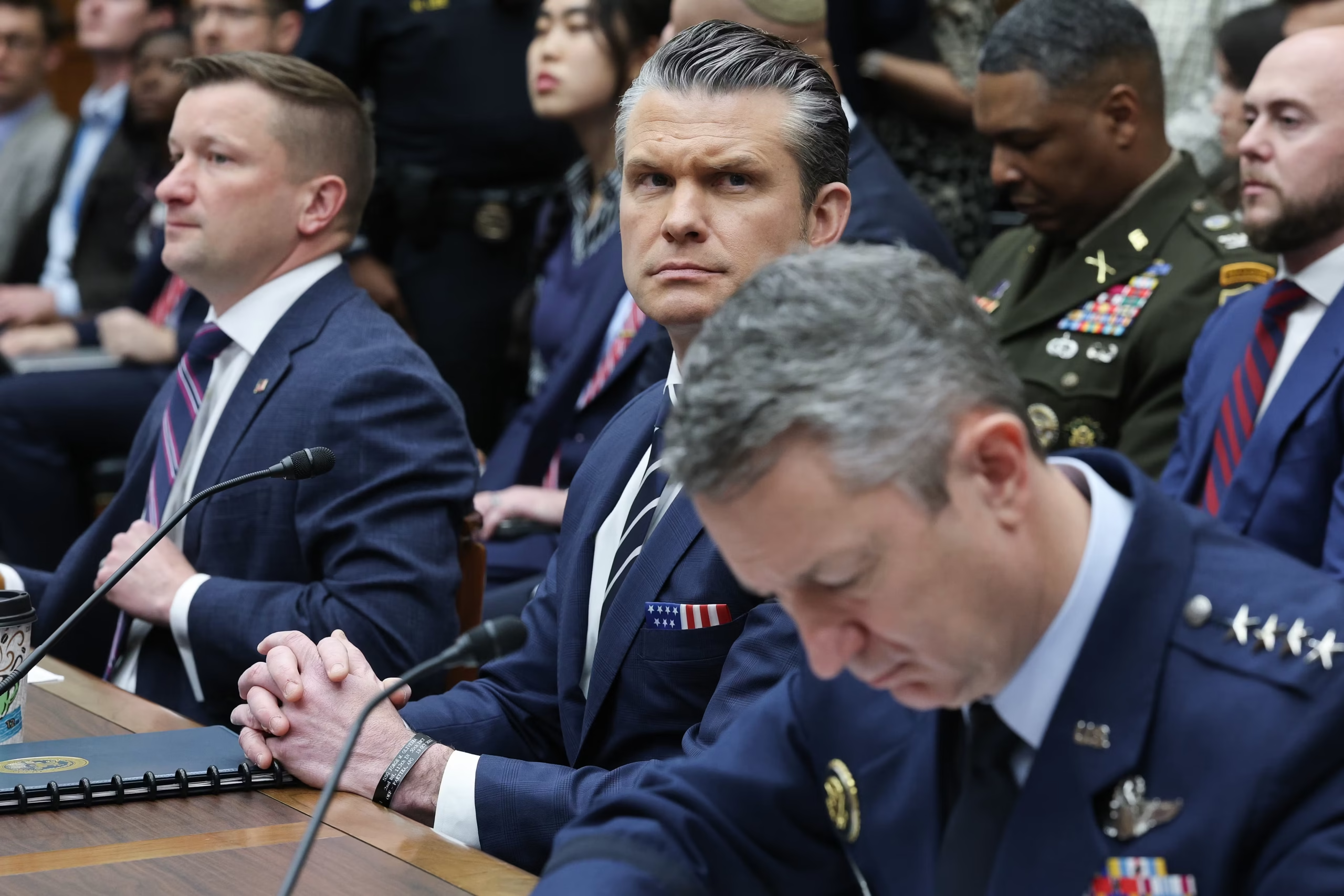
In the Senate, the Appropriations Committee heard from Defense Secretary Pete Hegseth and Chairman of the Joint Chiefs of Staff General Daniel Caine last month on the urgent need for emergency supplemental spending to cover unbudgeted costs that currently threaten to overtake modernization and readiness programs and activities. The conflict with Iran accounts for a large share of those unbudgeted costs ($37.5 billion), according to Secretary Hegseth. Generally consistent with my estimates, this funding would reimburse services that are struggling to fund operations and special pay while backfilling expended munitions and lost or damaged equipment.
Defense Budget Delay’s Strategic Damage
In chairing the session, Senator Susan Collins (R-ME) made the crucial point that the military does not control what it is tasked with by its political masters. The debate over the value of the Iran War should be separated from support for servicemember requirements—now and in the future. General Caine succinctly summarized the urgency, saying that the funding was needed while we are still in the “window of opportunity” for it to matter. That goes for the supplemental request and the entire 2027 budget. Before training and exercises are canceled. Before modernization momentum is lost.
That has been it so far from Congress on the military budget. A partial spending measure from a House committee and plenty of hearings. This is important work to be sure. But committee bills and hearings don’t amount to the outcome the nation and its uniform defenders need. Defense authorizers have made further progress—the full House passed a bill, and the Senate Armed Services Committee produced one. These bills are important for the policy direction and authorizations they contain. But even if the bills had moved further toward enactment, you can’t spend an authorization. The Pentagon needs funding.
What happens now? Without fast congressional action, nothing good. Not for the military. Not for national security. Not for the taxpayer.
Congress must return from the August recess ready to put the nation’s security and its military above all other concerns, and to pass both the required emergency spending and the full 2027 budget request before the end of the fiscal year and before asking voters to let them keep their jobs.