
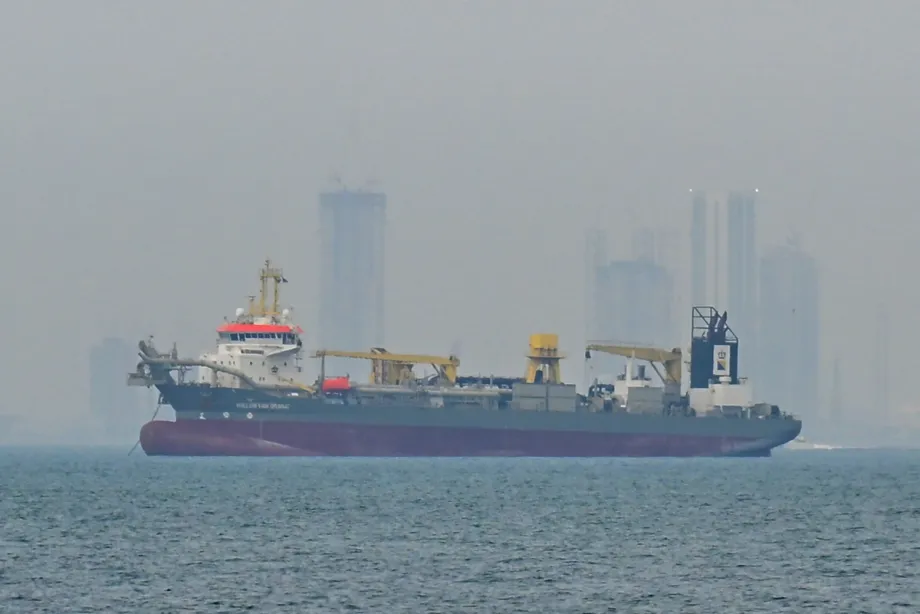
The Hormuz blockade dismantles the illusion of diversified global energy security. Structural vulnerability at the chokepoint enables Russian rehabilitation as a swing supplier and accelerates U.S. LNG market entrenchment amid soaring benchmark prices and economic contagion.
The Strait of Hormuz is a single waterway that at its narrowest point is barely 33 kilometers, but its significance is understated as it can disrupt global energy flow and halt economies. After the United States and Israel launched joint strikes against Iran on 28th February 2026, to effect a regime change, Iran took retaliatory action by effectively blockading the Strait of Hormuz in March. This move resulted in a nightmare for states depending heavily on the Gulf States’ oil and gas. Now, after its closure, the Strait of Hormuz stands between the world and an energy catastrophe of historic proportions.
What began as a targeted military campaign to change the Iranian regime and neutralize its nuclear and missile program has turned into one of the most severe energy security crisis in the world. The crisis of Hormuz also uncovered two uncomfortable truths about energy politics. The first is that the global energy structure is vulnerable because it is based on the routes that pass through a handful of geographical chokepoints. The second point is that during such a geopolitical catastrophe, some suffer while others profit from the chaos. Understanding both is essential to making sense of the world after Hormuz.
The world’s most dangerous bottleneck
The Strait of Hormuz has long been described as the world’s most significant chokepoint. Its importance is not rhetoric, as the number of energy vessels that pass through fully communicates the repercussions of its closure. In 2025, approximately 25 to 30 percent of the world’s seaborne oil trade and roughly 20 percent of all Liquefied Natural Gas (LNG) transited this narrow passage. That translates to around 20 million barrels of oil and petroleum products per day, along with over 110 billion cubic meters of LNG annually. Some 93 percent of Qatar’s LNG exports and 96 percent of the UAE’s LNG exports passed through the Strait. Presently there is no cost effective alternative. Countries such as Iran, Iraq, Kuwait, Qatar, and Bahrain rely almost exclusively on the Strait for their energy exports, unlike Saudi Arabia and the UAE, which have limited overland pipeline capacity to reroute a combined 3.5 to 5.5 million barrels per day from the east coast to west.
Before the war, approximately 138 ships transited the Strait each day, according to the Joint Maritime Information Centre. Since the beginning of March, fewer than 100 vessels have made the crossing in total, with an average of just five to six per day. Most of the ships that are permitted to pass have connections to Iran itself. Several Gulf oil producers, unable to export, have been forced to cut total output by more than 11 million barrels per day as onshore and offshore storage fills. The prices are also staggering; before the conflict, Brent crude oil traded at $71.86 per barrel. Currently, it has risen above $116. Oil prices have risen nearly 60 percent in just over a month. J.P. Morgan has estimated that even a moderate scenario, with Brent crude holding at $80 per barrel through mid-year, would depress global GDP growth for the first half of 2026, and it would also push global consumer price inflation above 1 percentage point.
The economic shockwave
The immediate economic fallout is severe, and it is also widespread. When shipping through the Strait was effectively halted, global insurance markets went into crisis mode. Furthermore, the higher energy prices are not merely an inconvenience for import-dependent economies, but they are existential for everyone. Europe, which entered 2026 with gas storage levels, faces a second energy crisis following the one triggered by Russia’s invasion of Ukraine. It has been estimated that European gas shortage will be around 22-27 percent. Dutch TTF gas benchmarks nearly doubled to over €60 per MWh by mid-March. The European Central Bank has already postponed planned rate cuts and raised its inflation forecast for the year from 1.9 percent to 2.6 percent. The closure of the strait has not simply affected the energy market; damage has spread to other markets as well. Around 46 percent of the world’s fertilizer comes from the Gulf, and with Qatar’s largest Urea plant halted, agricultural supply chains in South Asia and Africa face compounding shortfalls. Aviation has been severely disrupted: key flight corridors between Africa, Asia, and Europe have been closed, and airlines are forced onto longer routes around the Arabian Peninsula, significantly raising airfare.
The vulnerability of the single route
The crisis has also unraveled an uncomfortable truth about the world’s energy architecture. Decades of investment in global LNG trade created the illusion of energy diversification; however, all roads and routes led through a 33-kilometer gap between Iran and Oman. The 2022 Russian gas crisis revealed Europe’s overdependence on a single supplier, and now the 2026 Hormuz crisis showed something more fundamental: that the global energy system is critically over-dependent on a single transit point. Now, the Strait, once thought of as a reliable passage because of its importance to all parties, has been weaponized, and all parties, whether importers or exporters, are bearing the brunt. In the past, Iran repeatedly threatened to close the Strait if anyone violated its sovereignty. Now that the taboo has been broken and its repercussions have been observed, the likelihood of future blockade of the Strait has increased.
Who is benefiting from the chaos?
In the first two weeks of the conflict alone, Russia earned an additional 672 million euros in oil sales, according to the Centre for Research on Energy and Clean Air. President Trump, facing a global energy emergency, granted India a temporary 30-day waiver on Russian oil sanctions on 6th March, effectively legitimizing Moscow’s role as a swing supplier. Tankers carrying Russian crude have been rerouted mid-voyage from China to Indian ports to meet surging demand. Russia is also eyeing Europe’s gas storage crisis as an opportunity and in March alone the overall Russian exports to Europe increased by 17 percent (from 1.33 million tons to 1.7 million tons). For the Kremlin, the Hormuz crisis has been a geopolitical windfall with higher revenues, renewed strategic leverage, and, as the European Council President Antonio Costa noted, reduced international attention to the Ukrainian front.
American LNG exporters are the other significant commercial winners of the crisis. U.S. LNG exports are now approaching 11.7 million metric tons in March, and with benchmark gas prices domestically hovering around $3 per MMBtu compared to over $20 in Europe and Asia. The largest buyer of American gas is Europe with 7.49 million tons, a total of 64 percent of entire American export in March. Other important buyers are Egypt (with 620,000 tons in March), Jordan, South Africa and South America. American exporters are generating revenues of $870 million per week. Sellers of U.S. LNG are making at least $40 million per cargo compared to less than $5 million before Russia’s invasion of Ukraine triggered the first energy crisis of the decade. New production capacity at Golden Pass, Calcasieu Pass, and Corpus Christi is scheduled to add 3.5 billion cubic feet per day of additional LNG by the end of 2026. Taiwan, Japan, South Korea, and EU nations have all signaled their intent to increase long-term American LNG purchases. The Trump administration has been explicit about seizing the moment to entrench U.S. LNG’s global market position.
Both face infrastructure bottlenecks that limit how quickly they can ramp up supply, but their geopolitical stability and geographic insulation from the Middle Eastern conflict make them increasingly attractive long-term partners for energy-anxious importers in Europe and East Asia.
What comes next?
The closure of the Strait of Hormuz has not merely disrupted energy markets; it has nullified the assumptions that the international energy system has rested on for decades. The idea that global LNG trade had created genuine supply diversification has been exposed as partly illusory, since that trade still funneled through one narrow chokepoint. The belief that the strait was too important to be weaponized has been refuted. The notion that Western sanctions had neutralized Russia as an energy power has also been challenged.
What comes next depends on the duration of the conflict and the extent of infrastructure destruction. A swift ceasefire might allow markets to partially recover, though the damage to the infrastructure will constrain global supply for years. A prolonged conflict will speed up every trend already happening: the rise of U.S. LNG in global energy trade, the rehabilitation of Russian oil as an indispensable swing supplier, the urgent pursuit of renewable energy as a strategic rather than merely environmental imperative, and the growing fracture of the global energy market into geopolitical blocs. Countries profiting from this crisis do so not from wisdom or virtue but from geography and timing. The countries suffering are paying the price for a structural vulnerability decades in the making. The world’s energy architecture must be rebuilt with redundancy, diversification, and resilience at its core, and the Strait of Hormuz has made that argument more forceful.