
Washington expands naval blockades and financial isolation against Tehran, sharply reducing Iranian oil exports. However, targeting shadow currency networks and enforcement across maritime corridors risks sparking severe economic friction with major Chinese buyers.
The intersection of economic warfare and international maritime commerce reached a critical threshold as Washington escalated financial and physical containment strategies against Tehran. Broad energy blockades and secondary trade restrictions aim to cripple sovereign state revenues, forcing target regimes toward compliance or systemic collapse.
As economic pressures intensify, the compounding Iran Sanctions Squeeze demonstrates the complex operational mechanics behind modern coercive diplomacy across key strategic waterways. By restricting seaborne crude exports and disrupting clandestine currency exchanges, coalition regulators seek to sever vital fiscal lifelines supporting regional proxy networks and defense programs. However, enforcing intense pressure against a major global oil producer produces widespread collateral disruption across international commercial corridors, specifically threatening stability among Asian trade partners dependent on energy imports.
The expanding Iran Sanctions Squeeze forces major economic powers like China into difficult diplomatic recalculations regarding bilateral trade compliance versus national energy security requirements. Ultimately, balancing maritime blockades with unilateral financial sanctions risks triggering significant counter-measures, destabilizing delicate diplomatic equilibria, and increasing global market friction across intercontinental supply networks.
Escalating Washington Economic Pressure Strategy
President Donald Trump’s administration is signalling the US is ready to push Iran’s economy to its limits, after imposing financial pressure and a naval blockade to force Tehran to reopen the Strait of Hormuz.
Mr Trump told Fox News on Friday the US is prepared to hit Iran hard economically to break the deadlock in the six-month conflict, following a similar line of messaging from senior officials in his cabinet.
Treasury Secretary Scott Bessent told Newsmax on Thursday that the US was preparing to announce new measures amounting to a “combination of economic isolation like the world has never seen before”. US Energy Secretary Chris Wright said Iran’s strategy would ultimately lead to the collapse of its government as its economy was “strangled”.
Mr Wright told Fox News that Iran had “one card” left in the strait “and it’s shrinking in size”. He also said the ability of the US to escort products through the waterway was growing.
The renewed emphasis on economic pain marks a US shift towards squeezing Tehran financially after nearly six months of war, rather than immediately escalating Washington’s military campaign.
Analyzing the Iran Sanctions Squeeze
However, the remaining levers at Mr Trump’s disposal each carry a set of risks.
Iran remains the second-most sanctioned country on the planet. More than 6,000 sanctions have been issued against its financial, energy and petrochemical, aviation and cryptocurrency sectors. This is in addition to a secondary sanctions framework that the US has used to discourage third countries from engaging in trade with Tehran.
Leading economic indicators in Iran are flashing red. Figures from the central bank showed inflation accelerated at a 53.9 per cent pace from April 20 to May 20, compared with 36.8 per cent over the same time last year. The International Monetary Fund expects a contraction of 6 per cent this year and the rial recently sank to an all-time low against the dollar.
Iran, which has weathered numerous sanctions since 1979, remains defiant.
“Iran has demonstrated over decades that it will not be strangled by these exhausted refrains,” Foreign Ministry spokesman Esmail Baghaei wrote on X on Monday.
Targeting Clandestine Shadow Banking Networks
As negotiations on a durable ceasefire remain stalled, and with the Iranian leadership facing an existential crisis, the question is which economic lever Mr Trump pulls, and at what cost.
“The economic levers that it [the US] has got left that are viable – there’s not a lot,” said Ryan Bohl, a senior Middle East and North Africa analyst at the Rane Network.
Due to its isolation from the global financial network, Iran relies on a shadow banking system to evade sanctions. This network consists of Iran-based exchange houses and foreign companies to sell oil and other products abroad and launder the money, which it uses to support its proxy groups and fund its military and weapons programmes.
Can Unilateral Measures Force Capitulation
The US Treasury clamped down on this system last week, taking aim at Iran’s crypto exchanges and clandestine currency networks. The latter was the Treasury’s eighth action this year targeting Iran’s shadow banking structure.
“I think we could see more of that. As Iran finds new alternate channels, we could see US sanctions in that way,” said Rachel Ziemba, founder of geopolitical risk firm Ziemba Insights.
Considering the regime’s ability to circumvent sanctions, Ms Ziemba questioned whether new designations would have a meaningful effect on Iran’s economy. “They’ll probably be more about closing loopholes rather than additional components,” she added.
There are additional measures the US can use under Section 311 of the Patriot Act, which authorises the treasury secretary to designate foreign financial jurisdictions owing to money-laundering concerns.
The Lindsey Graham Act, passed by the Senate last week, would give Mr Trump another tool by imposing secondary sanctions and tariffs on countries that continue to buy oil from Iran and Russia. “The issue is it would probably cause energy prices to go up, which Trump doesn’t want to see,” Mr Bohl said.
Blockade brings new squeeze
The biggest change in US policy came with the implementation of the naval blockade aimed at preventing Iran from exporting its oil.
By pairing military enforcement with leverage over financial institutions, the blockade introduced a new, physical dimension to US sanctions architecture.
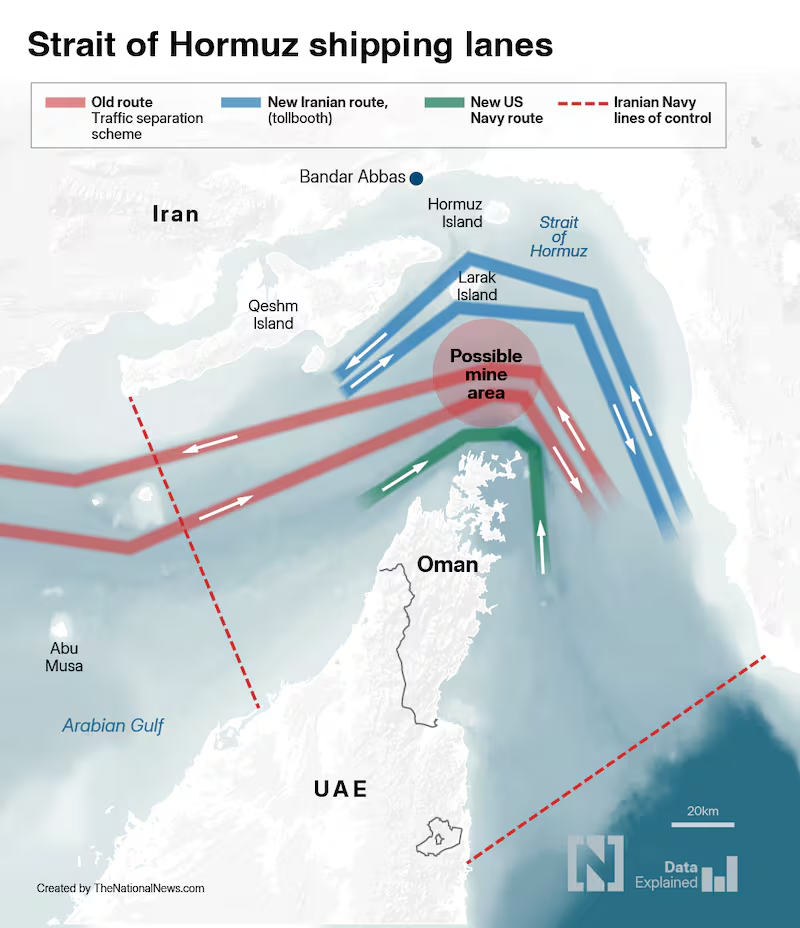
Iran’s oil exports quickly dried up. Its seaborne crude exports fell from 2.7 million bpd in February, when Tehran was in a rush to get its crude to markets, to 502,000 bpd in May after the US first imposed a maritime blockade on Iranian ports, according to data from energy intelligence firm Kpler. Iranian crude exports averaged 1.18 million bpd in July, well below the 2017 peak of about 2.5 million bpd reached under the Iran nuclear deal.
The Treasury Department said average loadings of Iranian oil had declined from 1.8 million bpd before the war to less than 500,000 over the past month. The blockade has cost Iran $435 million in economic activity each day, research from the Foundation for Defence of Democracies shows.
“That’s been a game-changer in terms of further economic effect,” Ms Ziemba said.
How Iran Sanctions Squeeze Impairs Trade
It also cut off a key purchaser in China, which takes in about 90 per cent of Iran’s oil exports. China is one of the few countries willing to take on the sanctions risk and bypass the measures through so-called teapot refineries.
TankerTrackers said it estimated Iran exported more than 50 million barrels of crude oil during the brief window in which the blockade was lifted.
“Because so much of it was off transponders, it’s hard to tell where all of it went, but it flooded out to India, to China, to countries that basically had a backlog and were taking that opportunity to get as cheap oil as they could,” Mr Bohl said.
Friends and foes
Secondary sanctions and further measures could also alienate key partners, while inflaming tension with China, the US’s chief economic rival.
“It’s absolutely intertwined with the broader bilateral relationship between the US and China,” said Alex Zerden, a former Treasury official and founder of Capitol Peak Strategies.
Mr Trump appeared to recognise the balance he needs to strike in his approach towards China. He warned Russia and China last month that supporting Iran “would be very bad for them”, before acknowledging that while the two countries may have provided support to Iran, the impact was minimal.
The US President is due to host Chinese President Xi Jinping next month in a high-stakes summit, with tensions already simmering over trade and Beijing’s ties with Tehran.
The meeting will offer the leaders an opportunity to extend a trade truce agreed last year, even as Washington’s pressure on Iran risks adding another point of friction to the relationship.
“The question is to the degree and how provocative or escalatory the US might be in the lead-up to the next summit or subsequent summits,” Mr Zerden said.