
Washington’s push to expand the Abraham Accords via direct Israel-Lebanon talks fails to account for Hezbollah’s parliamentary representation and popular support. Israel’s ongoing occupation and targeting of Shia civilians mirror the “Gaza model.” A resolution requires political realism, not maximalist demands for disarmament.
Israel’s unattainable goal of disarming Hezbollah will likely keep the conflict in Lebanon hot.
Washington hosted the first direct talks between Israel and Lebanon since 1993 on April 14, marking the latest effort to expand the Abraham Accords and bring about a ceasefire. Hailed as a “historic opportunity,” the meeting comes amid major regional upheaval across the Middle East, with Lebanon among the main arenas. Yet the effort to normalize relations between the two eastern Mediterranean countries within the Abraham Accords framework, even if successful, is highly unlikely to resolve the conflict or the core issues plaguing the civilians—particularly Lebanese—caught in the crossfire of Israel’s ongoing conflict with Hezbollah.
US Secretary of State Marco Rubio opened the meeting with a brief statement, describing the talks as a “process” with “complexities” that he hoped would produce an outcome in which “the people of Lebanon can have the kind of future they deserve, and so that the people of Israel can live without fear of being struck by rocket attacks from a terrorist proxy of Iran.” Recognition of the difficulties plaguing the long-running issue is certainly welcome, but the overall statement ultimately indicates why the overall approach misses the mark.
The official statement released after the talks highlights this dynamic. That statement fails to recognize relatively basic facts on the ground, largely laying blame for today’s situation in Lebanon on Iran, the Lebanese government, and Hezbollah. While such statements are meant to be relatively tempered to garner buy-in from the negotiating parties, this text oversimplifies the issue while repeating the same Israel-friendly language typically pushed by US mediators in talks between the Israelis and other actors, failing to recognize the Israeli role as a driving force in the conflict.
Biased text of this sort is indicative of the parties’ thinking, as well as of the success or failure of such diplomatic efforts. While never perfect, mediators should play a neutral role, ensuring a fair environment for talks as unbiased actors interested in a resolution. Yet US affirmations at the top of the statement fail to meet these standards, largely reiterating Israeli government talking points while ignoring the painful realities defining the Lebanon front in the broader regional war between Israel, the United States, and Iran.
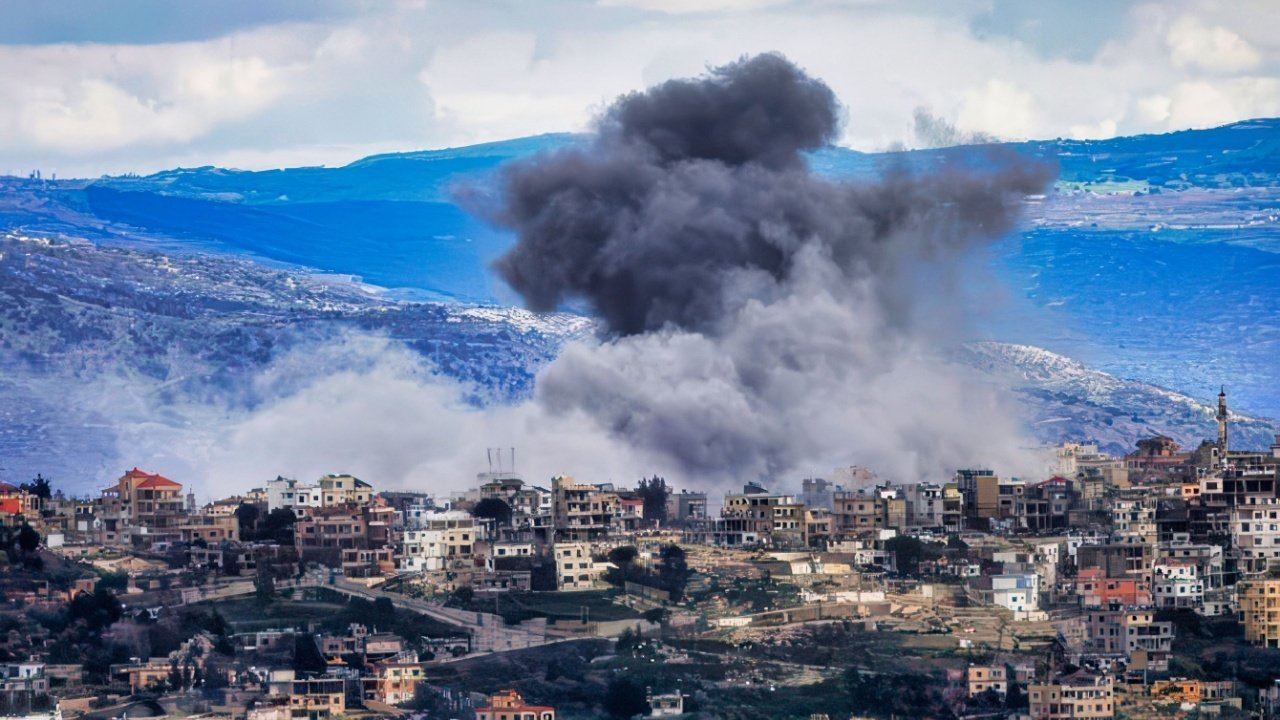
For one, it is Israel—not Hezbollah—that is occupying sovereign Lebanese territory, murdering Lebanese civilians, assaulting cultural heritage sites, and destroying Lebanese civilian infrastructure in an open admission of exporting the “Gaza model.” The Israeli army continues to raze entire villages in southern Lebanon, openly forecasting an indefinite occupation while forcibly and specifically displacing Shia communities, as well as uprooting them from villages they have fled to across the country, through intimidation. These tactics constitute violations of international humanitarian law, including the war crimes of forced displacement, ethnic cleansing, and collective punishment.
To be clear, the model Israel is exporting to Lebanon from Gaza is one of total war. In the Gaza Strip, leading genocide experts have defined it as such: genocide. While the Israeli state claims to be fighting Hezbollah, it is choosing to fight its entire support base and most Lebanese citizens directly or indirectly as well. Most of that support base is not, in fact, participating in the fighting, meaning the intentional displacement and targeting of such civilians also constitute violations of international humanitarian law, including crimes against humanity.
Reaching these conclusions hardly amounts to a defense of Hezbollah or Iran. The Lebanese state has, for far too long, suffered under the competing interests of warlords who garnered and retained their power during and after the country’s 15-year civil war between 1975 and 1990. That conflict witnessed the rise of Hezbollah and other non-state militias, alongside a bevy of human rights violations on the part of all involved. Lebanon has never truly reconciled with this past, in no small part because the leaders of these factions have run the country since the war’s end.
Hezbollah was the strongest actor to emerge from the civil war. They have retained their power through threats, assassinations, and corrupt practices that have heavily contributed to the general failure of the Lebanese state. Their periodic actions against Israel also constitute violations of international humanitarian law, including the war crime of indiscriminately targeting civilians and civilian infrastructure in northern Israel. Hezbollah is hardly innocent, to say the least.
Yet the reality in Lebanon is that Hezbollah is also a leading political actor, with 14 Members of Parliament (MPs) in parliament and a coalition of up to 61 MPs. Its political bloc can and does dictate policy in the country. While it lost its majority in the last parliamentary elections in 2022, the party and its political allies garnered well over 600,000 votes between shared and purely Hezbollah electoral lists. These voters are an integral part of the Lebanese population—a reality that cannot be ignored or erased.
Herein lies the key fault in direct talks between the Lebanese and Israeli states: a substantial proportion of Lebanon directly supports Hezbollah and armed resistance. Talks that ignore this dynamic will not succeed. In fact, Israel’s ongoing military campaign targeting what appears to be strictly Hezbollah and its supporters is more likely to bolster the group’s raison d’être of resistance while shattering a country that has yet to heal from its civil war, a mere three decades ago.
That reality could explain the clear divergence in state interests undergirding the talks. For Lebanon, the focus has almost entirely been on achieving a ceasefire. While US President Donald Trump announced a 10-day ceasefire on April 16, Israel’s focus on eliminating Hezbollah—one way or another—will be its ultimate downfall. Washington, meanwhile, hopes to expand the Abraham Accords in a badly needed win for Trump.
Washington likely understands this divergence but is once again choosing to side with the Israeli state’s maximalist objectives given its interests, as it has since the so-called 2024 ceasefire between Hezbollah and Israel that has produced 15,000 Israeli violations to date. That approach is rooted in the “ironclad” relationship between the two states, but also in a probable understanding that Beirut has no capacity to disarm Hezbollah today.
Arguments that Hezbollah and its supporters “occupy” the country, as Israeli Ambassador to the United States Yechiel Leiter claimed after the April 14 meeting, indicate the likelihood of this assessment in both capitals. Most concerning is that thinking may accept that a Lebanese civil war is therefore necessary and acceptable to achieve the goal of disarming Hezbollah.
That line of reasoning is flawed. To draw similar comparisons, few seriously believed that the Provisional Irish Republican Army (PIRA) “occupied” Northern Ireland during “The Troubles,” when the group battled the British army with the goal of ending British rule in Ireland. Importantly, that group had a political arm—Sinn Féin—with widespread support from the local population. That political party still exists today.
The only resolution to that similar yet unique conflict was a real diplomatic endeavor that recognized realities on the ground—not unrealistic desires based on one party’s fantasies and maximalist demands. Indeed, any outcome based on violence that could foster civil war should be unacceptable to any official working on the Lebanon file. The Middle East has witnessed enough misery and war. True peace will not come through more of the same—it will entrench trauma for the next round of fighting.