
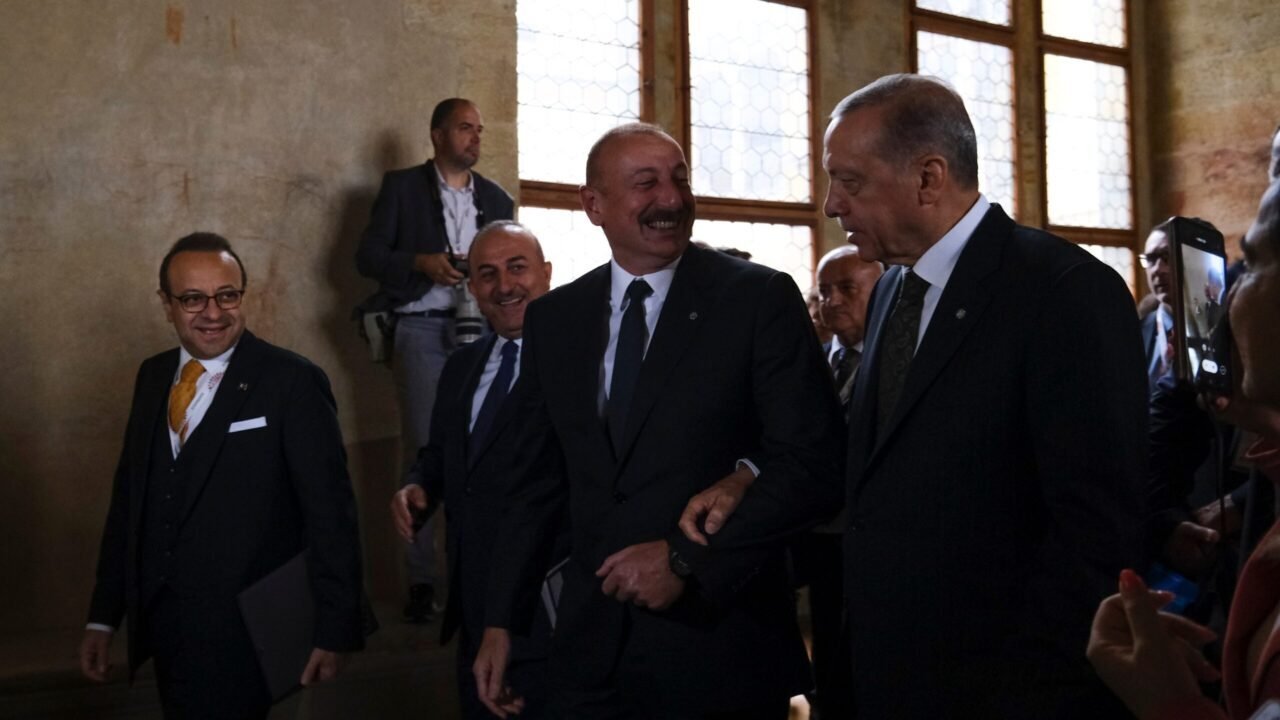
The “one nation, two states” alliance between Turkey and Azerbaijan faces unprecedented strain over Armenian normalization, Israeli military ties, and Iran policy. Baku’s post-war hubris now clashes with Ankara’s shifting regional calculus, exposing real strategic divergence.
For decades, the “one nation, two states” slogan masked deep structural divergences. Now, Turkey and Azerbaijan are navigating a relationship strained by Armenian normalization, Israeli ties, and Iranian tensions. This friction exposes how Turkey and Azerbaijan no longer share automatic alignment as Baku asserts its own strategic agency.
Turkey and Azerbaijan Clash Over Borders
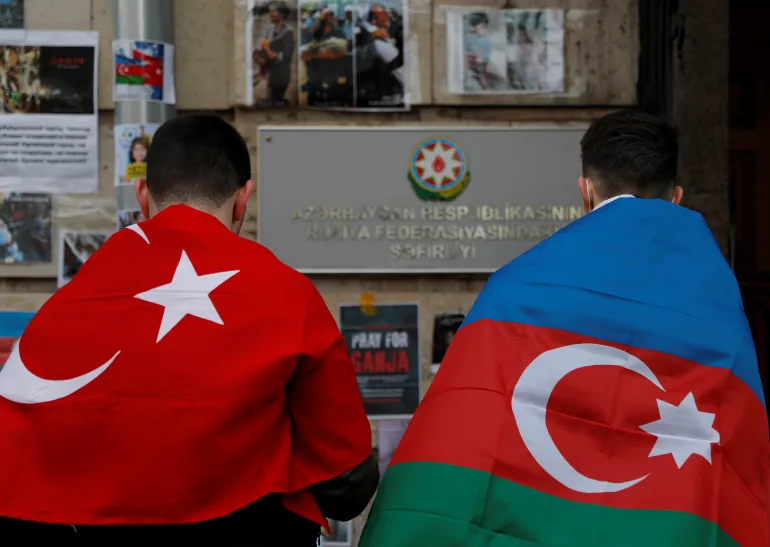
For decades, the slogan “one nation, two states” has defined Turkish-Azerbaijani relations. It evoked ethnic brotherhood, energy interdependence, and a military alliance—most recently during the 2020 Nagorno-Karabakh War. But beneath the pan-Turkic rhetoric, fault lines are emerging over the issues of Armenian normalization, Israel, and Iran.
The latest flashpoint: Azerbaijan’s ambassador to Ankara recently declared that the Turkey-Armenia border will open after Armenia’s June elections, once constitutional amendments are made. It’s Baku’s long-standing demand that Armenia amend its constitution to expunge any lingering claims to Nagorno-Karabakh. If the party of the incumbent Prime Minister Nikol Pashinyan wins the elections, it is expected to move forward by putting those changes to the referendum.
What’s striking here is a foreign ambassador publicly announcing the timeline and conditions for Turkey’s sovereign border policy. This demand illustrates the trend identified by the Washington-based Middle East Institute’s Gonul Tol. Over the past year, Turkish diplomats increasingly complained about how “difficult” Azerbaijan has become—particularly when Baku tries to dictate terms to Ankara.
The ambassador’s public statement takes matters to a new level. As the former diplomat Fatih Ceylan noted, “in a period when official Ankara is carefully avoiding statements targeting Baku over Azerbaijan’s strategic military ties with Israel, the Azerbaijani ambassador’s comment on Turkey-Armenia normalization is, at the very least, unfortunate. More accurately, it is a case of not knowing one’s place,” Ceylan said he expected the foreign ministry to issue “a sharp rebuke shortly.”
The rebuke never came, but the friction is real. It feels like 2009 all over again, when Turkey and Armenia signed the Zurich Protocols to normalize relations, only for Azerbaijan to apply political and diplomatic pressure—forcing Ankara to back down. Azerbaijani media lashed out at Ankara’s envoy to Armenia, Serdar Kilic, for daring to say that he “felt at home” during a recent visit to Yerevan. A pro-government analyst, Farhad Mammadov, attacked him for supposedly “ignoring Baku’s red lines.”
Why Turkey and Azerbaijan Face Tensions
But 2009 is not 2026. Turkey has fewer incentives to defer to Baku today. The Nagorno-Karabakh War is over; Azerbaijan achieved its territorial aims with Turkey’s help. Ankara’s own strategic calculus has shifted: détente with Armenia could reduce Russian influence in the South Caucasus, open a direct trade route to Central Asia, and improve Turkey’s standing with the West.
A deeper fissure is emerging over Israel. Baku and Jerusalem have quietly built one of the most robust military-intelligence partnerships in the post-Soviet space. Israeli drones and loitering munitions played a decisive role in breaking Armenian defenses in 2020. Today, Israeli arms account for nearly 70 percent of Azerbaijan’s advanced weapons imports. In return, Baku supplies Israel with roughly 40 percent of its crude oil—a lifeline for a country engaged in a permanent war with its neighbors.
But here is the growing problem for Baku: Israel and its advocates in Washington are increasingly framing Turkey as the “new Iran.” The opposition leader Naftali Bennett sounded an alarm over the “emerging Turkish threat.” Prime Minister Benjamin Netanyahu accused Turkish President Recep Tayyip Erdogan of oppressing Kurds, violating the reddest of Ankara’s red lines.
Israeli politicians and officials now compare Ankara’s regional ambitions—its military bases in Qatar and Somalia, its ties with the post-Assad Syrian regime and Hamas leadership—to the Iranian Islamist revolutionary export model.
More strikingly, pro-Israel, hawkish think tanks in Washington, such as the Foundation for Defense of Democracies (FDD), have begun replicating the same rhetorical framework they applied to Iran for decades—now aimed at Turkey. Turkey is tarred as an “Islamist” regime that is developing long-range missile programs and destabilizing NATO from within. Rhetoric that was once reserved for the Islamic Republic is now routine rhetoric against a NATO ally.
Strains Between Turkey and Azerbaijan
What FDD calls an “Islamist threat” from Turkey, in fact, resonates with parts of Baku’s staunchly secular establishment. In elite circles, there is a degree of cultural contempt for Erdogan’s visible piety. While Azerbaijan’s President Ilham Aliyev is largely a product of the Soviet education system, Erdoğan built his career on Islamist roots, from his early days as mayor of Istanbul to his rhetorical embrace of Hamas and the Muslim Brotherhood. And Aliyev has certainly never compared Israeli leaders to Adolf Hitler, as Erdogan has.
For years, both men successfully managed this cultural and political gap, focusing on shared Turkic identity, security, and economic interdependence. But the success of the 2020 Nagorno-Karabakh War has bred hubris in Baku. Aliyev no longer sees himself as the junior partner seeking Ankara’s protection. He sees himself as the regional victor, and he expects Turkey to follow his lead. This attitude grates on Turkish officials, who remember providing the drones, the military advisors, and the diplomatic cover that made that victory possible.
Turkey and Azerbaijan Diverge on Iran
Israel’s war on Iran further exposed the divergent perspectives. Tehran suspects Baku of covertly aiding Israel by allowing it to use its airspace for strikes on Iran in June 2025. When Iranian-originated drones landed in the Azerbaijani region of Nakhchivan in March 2026, hitting the airport and wounding four civilians, Aliyev called it an “act of terror” and promised retaliation.
However, the incident was promptly downplayed, and Aliyev dispatched humanitarian aid to Iran for Nawruz, the Persian New Year widely celebrated in both countries.
According to Altay Goyushov from the Baku Research Institute, an independent think tank, the turnaround was, at least in part, the result of quiet Turkish pressure on Aliyev to de-escalate. While Azerbaijan sees strategic benefit in strengthening its position in the Azeri regions of Iran, for Turkey, any schemes of Iran’s partition along ethnic lines are an anathema as it fears the Kurdish separatism such an enterprise would fuel.
Israel, on the other hand, offers Azerbaijan a diplomatic room for maneuver, including cherished ties in Washington. That is particularly valuable as Baku seeks the permanent repeal of Section 907 of the Freedom Act, adopted in the early 1990s, that bans Azerbaijan from receiving direct American military support.
So, what happens if Israel and Turkey ever come to direct blows? On the current trajectory, Baku may have to choose between Ankara and Jerusalem at some point. For now, however, neither Ankara nor Baku has an interest in forcing this dilemma.
When Israel Tests Turkey and Azerbaijan
The ties that bind remain formidable. Azerbaijan is bound to Turkey by the Shusha Declaration—a mutual defense pact. The Trans-Anatolian Natural Gas Pipeline (TANAP) and the Baku-Tbilisi-Ceyhan oil pipeline make Turkey an indispensable transit hub for Azerbaijani energy to Europe. Military cooperation continues. Turkey provides Azerbaijan with diplomatic cover against Iran and Russia.
But the cracks are real. “One nation, two states” was always aspirational, not constitutional. When one state tries to dictate the other’s borders and maintain a covert alliance with the other’s declared adversary, the fiction becomes strained. Not yet broken, but no longer effortless.