
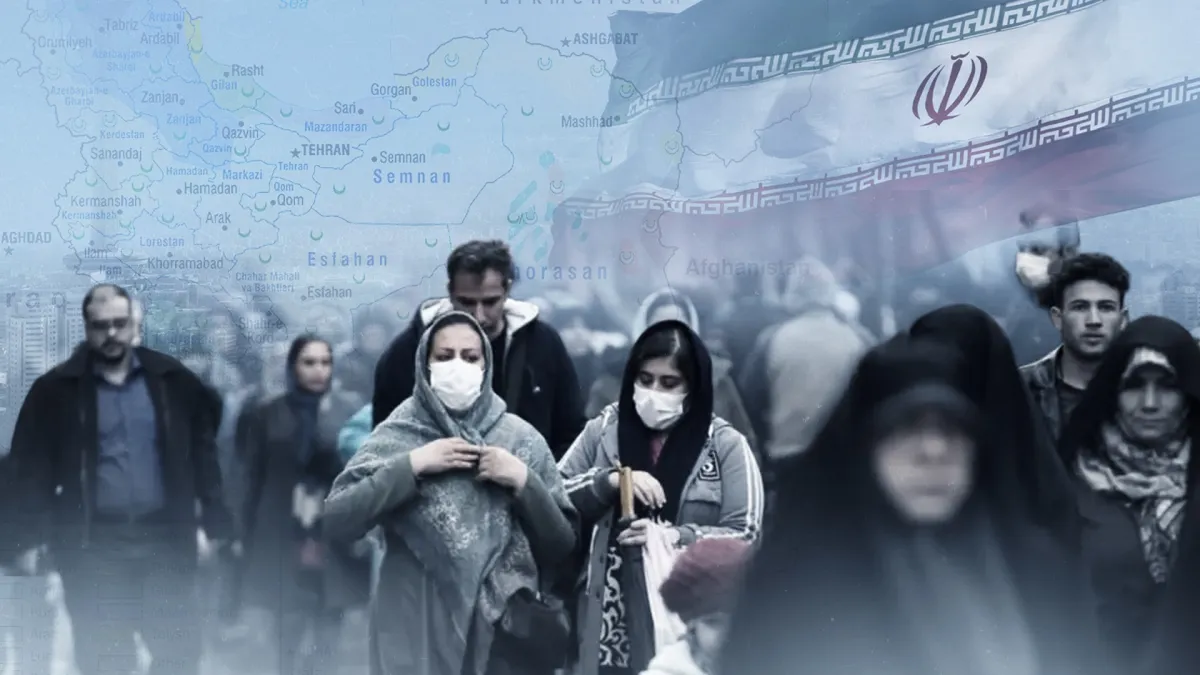
Iran is not a Persian monolith. Half the population is ethnic minority—Azeris, Kurds, Arabs, Baloch—concentrated in border regions, with cross-border ties. The state’s Persian-centric, centralized model fuels tensions. In crisis, these fault lines could fracture the regime.
Many analysts and strategists oversimplify Iran by equating it with a singular Persian identity, overlooking the distinction between “Persian” as a historical cultural label and the Islamic Republic of Iran as a modern, multiethnic state home to a wide range of ethnic communities.
Contrary to common stereotypes, Iran is not a homogeneous country dominated solely by Persian culture. While Persians make up roughly half of the population, the country is home to multiple ethnic groups, including Azerbaijanis, Kurds, Arabs, Baloch, Lurs, and Turkmen. These communities are largely concentrated in border provinces, maintaining their own languages, cultures, and traditions, as well as historical and cultural ties with neighboring countries such as Iraq, Turkey, and Azerbaijan.
Shukriya Bradost, an Iranian-Kurdish researcher on minority affairs, told Alhurra that understanding Iran requires looking back at the history of the modern state. For centuries, the country was a multiethnic empire. But after the establishment of the nation-state in 1925, the political identity of the state was built on a Persian identity, making the identities of other groups appear as a threat to the new national framework.
Bradost noted that these communities are not small minorities numerically but represent a significant portion of the population. She said the Azerbaijani population alone may exceed 20 million, while Kurds number between 12 and 15 million, alongside millions of Arabs and Baloch.
This ethnic diversity is geographically concentrated. Azerbaijanis live in the north and northwest, Kurds in the west, Arabs in the southwest—particularly in Khuzestan—Baloch in the southeast, and Turkmen in the northeast.
Hossein Raisi, an Iranian opposition lawyer and law professor, told Alhurra that this diversity is not a recent phenomenon but reflects centuries of population and cultural intermingling within Iran. He noted that these groups “are spread across different parts of the country, even central regions, with historical intermarriage and interaction among them.”
The Iranian state has long pursued policies promoting the Persian language and culture, while imposing restrictions on the use of minority languages in education and administration. These policies began during the Qajar era, were reinforced under the Pahlavis, and have continued under the Islamic Republic.
Bradost said this approach reflects the centralized nature of the Iranian state. “When the state fails to resolve a political issue, it often turns it into a security matter,” she said, noting that this has been the case with ethnic issues in Iran.
This approach has fueled tensions in some minority regions, where cultural and linguistic demands sometimes escalate into political and security crises.
Among these minorities, Kurds stand out as one of the most politically active groups in opposition circles. Kurdish regions in western Iran have a long history of protests and clashes with central authorities, dating back to the early years after the 1979 Islamic Revolution. Bradost said Kurds were among the few groups to continue resisting the Iranian regime during that period.
Nevertheless, many Kurdish movements insist that their demands are not about secession but about broader cultural and political rights, such as recognition of the Kurdish language and expanded local governance.
Tehran, however, views some of these movements as security threats, especially given the national ties between Kurds in Iran and Kurdish communities in Iraq, Turkey, and Syria.
Religion also plays a significant role in state-minority relations. While Iran’s political system is based on Shiite Islam, large segments of minority populations, including Kurds, Baloch, and Turkmen, follow Sunni Islam. Raisi said this religious difference adds another layer of tension between these communities and the central government.
Shiites make up about 90% of Iran’s population, according to the U.S. State Department’s 2020 Religious Freedom Report.
“The Iranian system is based on a Shiite religious ideology that seeks to centralize authority in Tehran, which leaves some Sunni minorities feeling politically and culturally underrepresented,” Raisi said.
This tension is particularly pronounced in Sistan and Baluchestan in southeastern Iran, where the Baloch live in one of the country’s poorest regions, despite its strategic location on the border with Pakistan and Afghanistan.
Minority regions also experience significant economic disparities compared with major urban centers. Khuzestan, home to the country’s largest oil fields, is among the poorest and most environmentally degraded provinces. Estimates indicate that about 98% of Iran’s oil comes from this region, yet it suffers from weak infrastructure and recurring environmental and water crises, which have sparked widespread protests in recent years.
The significance of these minorities extends beyond Iran’s borders, as most have ethnic ties to neighboring countries. Raisi said these connections are natural given the region’s borders: “There are family and cultural ties across borders. Kurds in Iran have links with Kurds in Iraq, and Azerbaijanis are connected to Turkey and Azerbaijan.”
These cross-border ties can also influence regional politics, particularly during crises.
Despite participation by many minority members in opposition to the Iranian regime, disagreements with some Persian opposition currents prevent the formation of a unified front. Some opposition forces focus on general political change, while minorities advance additional demands for local governance and cultural and linguistic rights. This divergence creates a gap within Iranian opposition and complicates efforts to unify it.
Bradost said this is why Tehran treats minority issues with extreme sensitivity, often framing them as matters of national security. The Iranian regime fears that if minority demands coincide with major political or economic crises, they could escalate into separatist movements threatening national unity.
In a multiethnic country like Iran, decision-makers understand that accumulated pressures in peripheral regions could at any moment ignite a crisis at the heart of the state.
With ongoing economic, environmental, and political challenges, ethnicity is likely to remain a key factor in shaping Iran’s future. The country is not a single nation-state but a complex mosaic of peoples, identities, and shared history. Scholars continue to ask whether Iran can manage this diversity within a more inclusive political system. Historical experiences in the region suggest one constant: the greater the pressure, the higher the risk of explosion.