
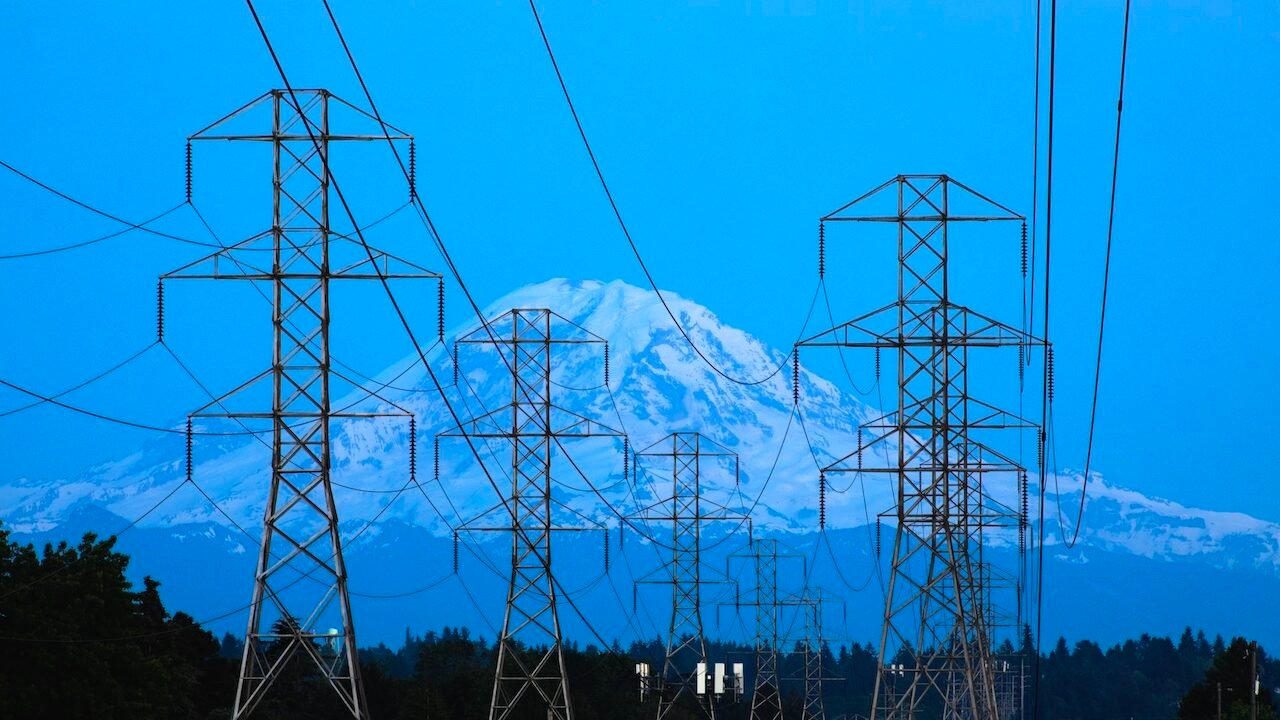
A high-level strategic assessment detailing how shifting norms in gray-zone warfare position national utility grids and public networks as prime targets for state-sponsored cyber disruptions and domestic proxy assets.
Geopolitical escalation has fundamentally transformed asymmetric warfare, shifting the primary theater of conflict from conventional military engagements to vulnerable national assets. For global risk managers and state actors alike, assessing tactical vulnerabilities requires evaluating non-traditional entry vectors, where a country’s critical infrastructure now serves as the primary pressure point. Iran’s refined capabilities in distributed electronic warfare and domestic infiltration mean that public utilities are no longer secondary concerns but central strategic nodes. Consequently, safeguarding these foundational networks against host-state proxies is the defining security mandate of the modern era, as any prolonged disruption to critical infrastructure instantly destabilizes domestic economic stability and national continuity.
Critical Infrastructure Exploited Through Cyber Warfare
Since the beginning of the Iran War, many media pundits have been assuring the American people that Iran is incapable of attacking the American homeland. But is this true?
When analyses of Iran’s capabilities to attack the United States are discussed, they primarily revolve around Iran’s current missile and rocket capabilities. If that were the only threat, then yes, we could assure the American people they are safe.
However, Iran and its proxies have a formidable cyber warfare division and have demonstrated the ability to target US critical infrastructure in the past. US agencies such as the Cybersecurity and Infrastructure Security Agency (CISA), the Federal Bureau of Investigation (FBI), the National Security Agency (NSA), and the Department of Defense Cyber Crime Center (DC3) have issued multiple advisories confirming this, particularly for sectors such as energy, water/wastewater, manufacturing, transportation, and local government.
In addition to their significant cyber capabilities, Iran surely has a substantial “sleeper cell” presence in the United States today, which, in the event of escalation, has the potential to conduct physical attacks against our critical infrastructure, military, and civilian targets. During the Biden administration alone, roughly 1.7 million Special Interest Aliens (SIA) were encountered trying to cross our Southern border, and roughly 75 to 80 percent of them were then released into the country, with a notice to appear in court. SIAs are those immigrants whose travel patterns “potentially poses a national security risk” according to the Department of Homeland Security (DHS), and “possibly have a nexus to terrorism.”
In addition to this are the 1.7-2 million known “gotaways” that were witnessed crossing the border but were never detained. And then there are the unspecified number of border crossings that we are unaware of and never witnessed. So, while there are no official government numbers for SIAs that specifically originated from Iran or its proxies, it’s safe to assume that the number could be in the multiple thousands (or more).
Iran’s Sleeper Cells and the Homeland Security Threat
Why should that concern us?
It’s hard to fathom, but the attack on 9/11 that killed over 3,000 of our precious citizens was over a quarter of a century ago. In the last 25 years, with modern technology, drones, and artificial intelligence (AI), data mining of online information on our critical infrastructure, the ability for a few terrorists to commit mass casualty events against a modernized enemy has increased exponentially.
You no longer need dozens of people involved, vast state-sponsored financial backing, and years of planning to conduct a terrorist attack with catastrophic consequences. In truth, the average American has no idea the potential devastation that could be in store for them in the near future should these sleeper cells be turned loose on the American homeland.
This isn’t mere speculation. In March, shortly after the killing of Iran’s Supreme Leader, US authorities intercepted encrypted shortwave radio transmissions believed to originate from Iran. These messages were reportedly an “operational trigger” for “sleeper assets” or “clandestine recipients” outside Iran, instructing them to pre-position operatives for activation, and to make those preparations without using internet/cellular networks.
Targeting Domestic Vulnerabilities: Critical Infrastructure Risks
A Nationwide Electric Grid Attack Is the Worst-Case Scenario
Without question, the worst-case scenario would be if the sleeper cells targeted our electric grid infrastructure in this country. It is possible and feasible for a couple of state-sponsored sleeper cells, using low-cost kinetic attacks, to take down dozens of extra-high-voltage (EHV) transformer locations across the Eastern, Western, and Texas Interconnections and create a nationwide blackout. Even if they only targeted one segment of our grid, the fallout would be catastrophic. Depending on how many high-voltage (HV) substations they attacked and brought down, the majority of the electric grid could be out for weeks (or longer).
Today, every aspect of human life revolves around access to electricity. Every one of our nation’s 16 critical infrastructures requires electricity. After two to three days, we are talking about no access to clean drinking water, no food resupply, no HVAC, no communication, no internet, no media, backed up or overflowing septic treatment facilities, no fire hydrants operational, no gas stations to refuel, no access to your bank account or your electronic funds, military bases not functioning,police stations and prisons not functioning,
no interstate trucking to deliver supplies, no court systems, no hospitals or pharmacies functioning, no capabilities for firefighters, no grocery stores or retail businesses open for business…this is just the high level effects. In the case of a widespread (possibly national) grid-down event that uses combined arms warfare, cyber and physical attacks, we might be without power for weeks or months (possibly years).
Within days, our deteriorating society and social cohesion would crumble, and rioting, looting, violence, starvation, death, and disease would commence on a scale unseen in our country’s history. History suggests that when people truly begin to starve, no amount of martial law will keep order.
Grid Failure Would Trigger a Humanitarian and Social Breakdown
“That could never happen in this country.”
Of course it can. Our government and military have known about the extreme vulnerabilities of our national electric grid to numerous threat vectors such as cyber, solar, high-altitude electromagnetic pulse (HEMP), and physical attacks, for over 20 years, but have done virtually nothing to harden the grid and protect the American people. They all know it can happen…they’re all just hoping it won’t happen under their watch.
Why Iran Might Target US Critical Infrastructure
Why would Iran focus its attention on attacking our electric grid and other critical infrastructure?
Why wouldn’t it? This week, the United States conducted its first attack on Iran’s critical infrastructure. The United States carried out air strikes on the southern cities of Jask and Sirik, striking two reservoirs supplying the Bemani and Kouhestak areas of Sirik town. Iranian State TV is reporting local water officials as saying, “Unfortunately, following this attack, 20,000 residents of the region have lost access to safe drinking water, and with temperatures ranging between 45°C [113°F] and 50°C [122°F], conditions have become extremely difficult and critical for local inhabitants.” The conditions on the ground there could get far worse if repairs cannot be made quickly.
Modern Warfare Threatens Critical Infrastructure
In civilized warfare, under the Geneva Convention, you’re only permitted to attack military targets, and everyone is to minimize civilian casualties as much as feasible. Sadly, it is also a grey area. It seems to be becoming more and more justified to target critical infrastructure such as dams, bridges, railroads, electric grids, pipelines, and water treatment facilities. While potentially causing mass casualties amongst the civilian population, some make the case that the foreign military forces also rely on those same infrastructures, so it’s justified.
The Growing Acceptance of Critical Infrastructure Warfare
But the United States would never take part in that kind of warfare, would it?
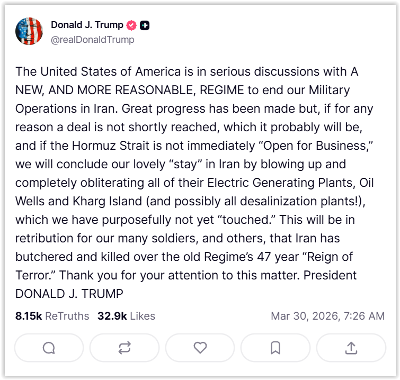
In a March 30 Truth Social post, President Donald Trump threatened to blow up and completely obliterate Iran’s electric generating facilities, water desalination plants, and its oil rigs.
Less than a week later, Trump posted the following to Truth Social, threatening to attack bridges and power plants, and threatening them with, “Open the Fuckin’ Strait, you crazy bastards, or you’ll be living in hell!”:

Critical Infrastructure Under Imminent Threat
Two days after that, President Trump escalated the rhetoric even more with “A whole civilization will die tonight, never to be brought back again.” He threatened to start bombing Iran again if they didn’t surrender to his demands. Here is that Truth Social post:

I used to think that as a country, we would not operate in the “grey areas” of warfare, which result in massive civilian casualties. Many media pundits speculated that President Trump was merely bluffing and trying to strong-arm the Iranian leadership into making a deal. But with today’s attacks on Iranian water infrastructure affecting 20,000 civilians, we can’t be so sure anymore. Will these types of attacks on civilian infrastructure in Iran escalate in the future? Who can know for sure.
Asymmetric Strategies Targeting Critical Infrastructure Sabotage
But if the war picks back up and this administration does follow through on these threats to take down the Iranian electric grid, water treatment facilities, bridges, and other critical infrastructure needed for the survival of their civilians…the question is not, will they turn loose their sleeper cells to attack our American electric grid and critical infrastructure? The question is, why wouldn’t they?