
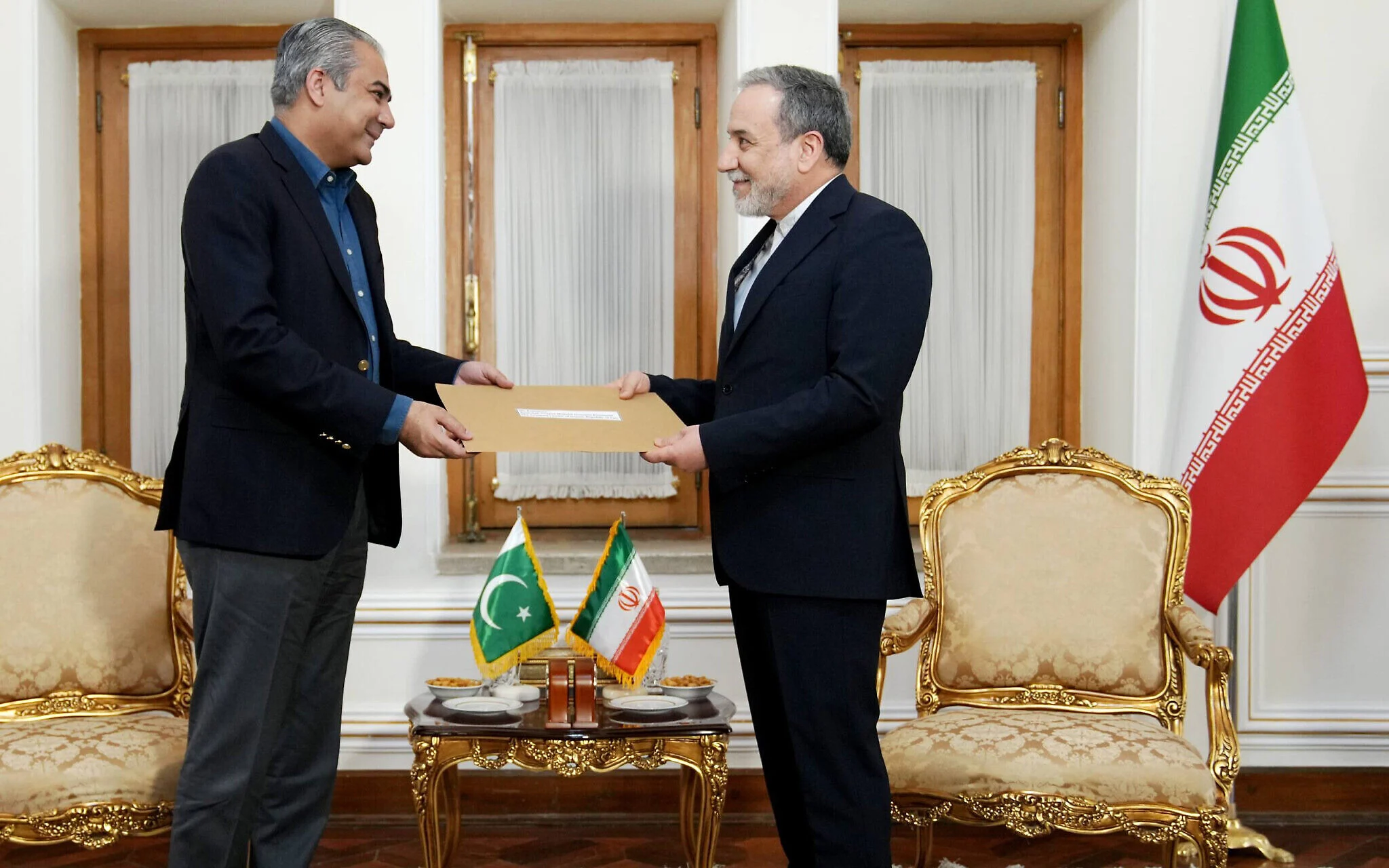
The U.S.-Iran memorandum trades Hormuz access for sanctions relief but defers enrichment, verification, and regional hegemony to an uncertain final phase while Gulf states question American reliability and Tehran’s hardliners claim victory.
The memorandum’s strategic tradeoffs suggest Washington views a Postwar Middle East through the narrow lens of chokepoint access and sanctions relief, yet the nuclear omissions and sixty-day timeline reveal a framework built on urgency rather than transformation. For Gulf states and Tehran alike, this Postwar Middle East remains defined by deferred hard questions—enrichment, verification, and hegemony—that no interim deal can truly resolve.
Postwar Middle East opens with strategic tradeoffs
Richard Nephew
At its core, Washington’s new memorandum of understanding (MOU) with Tehran trades the reopening of the Strait of Hormuz for ending the U.S. blockade on Iranian ports. This exchange is paired with promises about future negotiations and a substantial sanctions relief package meant to lock in Iranian compliance.
On the nuclear file, there is little new or substantive content in the agreement—Iran commits to keep its nuclear program static if the United States keeps its sanctions program static. The harder questions, including the fate of the regime’s stockpile of high-enriched uranium (HEU), are deferred to a final deal. Language pointing to the dilution and possible export of this material could eventually neutralize the threat it poses, but for now that threat remains unaddressed. Moreover, the text is largely silent on verification and the role of the International Atomic Energy Agency (IAEA).
These omissions are especially concerning when set against the scale of relief on offer. The MOU’s $300 billion reconstruction fund would only materialize in a final deal and therefore matters less than two immediate provisions: one that essentially unfetters Iranian oil exports and revenues, and another that gives the regime access to restricted funds held around the world totaling somewhere between $24-100 billion. Tehran could direct that rapid cash infusion toward rebuilding its missile force, bolstering its proxies, and other destabilizing activities.
Another urgent question is what happens after the MOU’s prescribed sixty-day window for negotiating a final deal. This timeline can be read as prudent space for negotiators, one that can be extended indefinitely. The cost of exiting this diplomatic track is a return to war, so the MOU could in a sense become the final agreement.
Measured against the interim Joint Plan of Action reached in 2013—a more apt comparison than the 2015 Joint Comprehensive Plan of Action (JCPOA)—the new memorandum concedes more value on sanctions and delivers less on the nuclear side. The 2013 agreement secured actual dilution of enriched uranium and specified how international monitors would be given access in exchange for limited oil sales and controlled Iranian access to revenues; in contrast, the current MOU encourages expanded oil sales and barely mentions the IAEA. The Iranians are well incentivized to stay in the deal, though they will likely keep angling for more relief.
Looking forward to the coercive strategy needed to make progress toward a final deal, President Trump has foreclosed some of his leverage through repeated statements against renewed conflict. To make his preferred approach work, officials will need to ensure that Iran actually receives the benefits it bargained for—a paradoxical and risky proposition. And given the MOU’s mention of UN sanctions and insistence on Tehran getting its desired economic benefits, the United States will also need to bring along international partners and competitors alike, including Russia and China. For regional partners, these shifting U.S. decisions likely reinforce a familiar whiplash, and a quiet wish that Washington would step back and let them lead.
Iran’s Hormuz gambit in Postwar Middle East
Dennis Ross
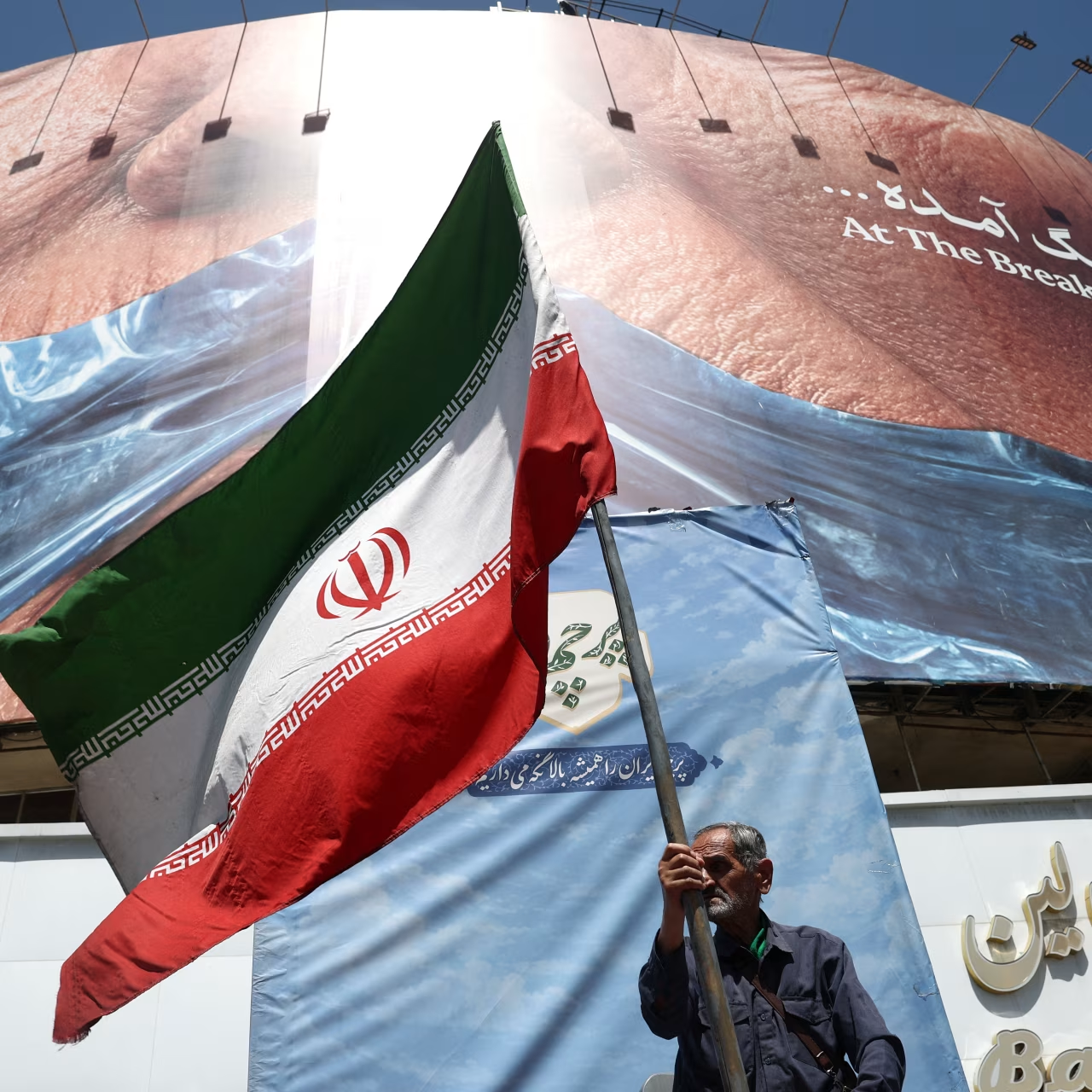
The new MOU specifies that the Strait of Hormuz will be open for sixty days with toll-free passage; afterward, Iran will engage in discussions with Oman and the Gulf states regarding administration and “maritime services.” This sets the stage for Tehran to impose its management schemes on the waterway—a dangerous precedent for other countries bordering key international chokepoints.
Linking Hormuz to Lebanon is also a strategic mistake. Tehran’s priority is to save Hezbollah, not Lebanon. If U.S. officials aim to protect the Lebanese government and preserve any hope for restoring its sovereignty, they must not give in to Iran’s demand that resolving issues in the MOU depends on maintaining a ceasefire in Lebanon—which in Tehran’s view would mean Israel halting all of its operations, Hezbollah rebuilding rather than disarming, and Israeli forces withdrawing.
To avoid these scenarios, the United States will need to exercise the leverage that both President Trump and Vice President Vance have repeatedly mentioned is in Washington’s hands. Yet the president has sent the opposite message with some of his recent comments—for example, when he declared that opening the strait and ending the war were important because he did not want to be like Herbert Hoover and invite a 1929-type economic collapse.
Many comparisons have been made between the current negotiations and the Obama administration’s JCPOA, but this is really an apples-to-oranges situation. For one thing, the 2015 agreement was not negotiated in the aftermath of a war. Moreover, Iran did not have any HEU refined to the levels seen today, while the JCPOA capped enrichment at 3.67 percent and mandated that 98 percent of the regime’s uranium stockpile be shipped out of the country.
Although Iran is not currently enriching uranium given the wartime damage inflicted on its program, the MOU does not provide for removing its large existing stockpile of HEU—only possible downblending inside Iran, to be monitored by as-yet-unnamed authorities. Worse yet, this is the MOU’s only mention of monitoring for a program previously subjected to extensive IAEA oversight.
The MOU also raises more questions than it answers about America’s reliability as a security partner. The Iran war has starkly demonstrated the importance of integrating regional air and missile defenses in order to reduce the vulnerability of vital energy infrastructure in the Gulf states. The U.S. forward base presence did not deter attacks against these states, and the evacuation of many U.S. facilities during the fighting has likely left local officials wondering whether America will actually keep these bases. Despite the weakening of Iran’s military, any permanent withdrawal from U.S. bases would leave the Gulf states feeling highly vulnerable.
One silver lining is that the increased interest in bolstering regional defenses and bypassing the Strait of Hormuz will likely lead to more investment in weapons acquisitions and infrastructure development. On the latter front, the India-Middle East-Europe Economic Corridor (IMEC) may offer an alternative to both Hormuz and the Bab al-Mandab Strait. The resultant boost to economic integration could include Israel, though no new moves toward political normalization should be expected. Although Saudi Arabia and other Gulf states may also decide to invest in Iran as part of the $300 billion reconstruction and rehabilitation package, any such offers will likely be limited—more serious Gulf investments will presumably be withheld absent real change in Tehran’s behavior.
The Trump administration’s approach is seemingly based on the assumption that Iran’s desire to join the twenty-first-century global economy will give Washington enough leverage to transform the Islamic Republic. Yet this ignores the proven power of the regime’s ideology and self-image. Iran’s current leaders still seek regional hegemony for both offensive and defensive reasons, so they will not be swayed by a U.S. strategy that offers inducements without showing them what they stand to lose.
Domestic optics shape Postwar Middle East
Holly Dagres
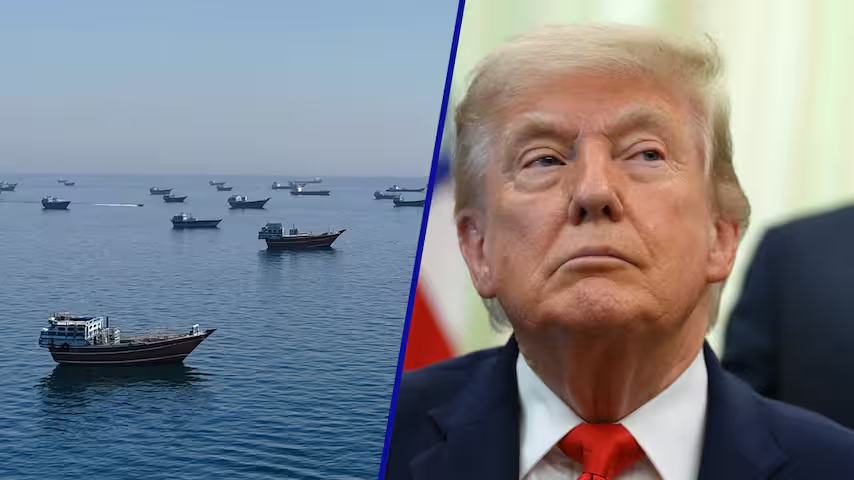
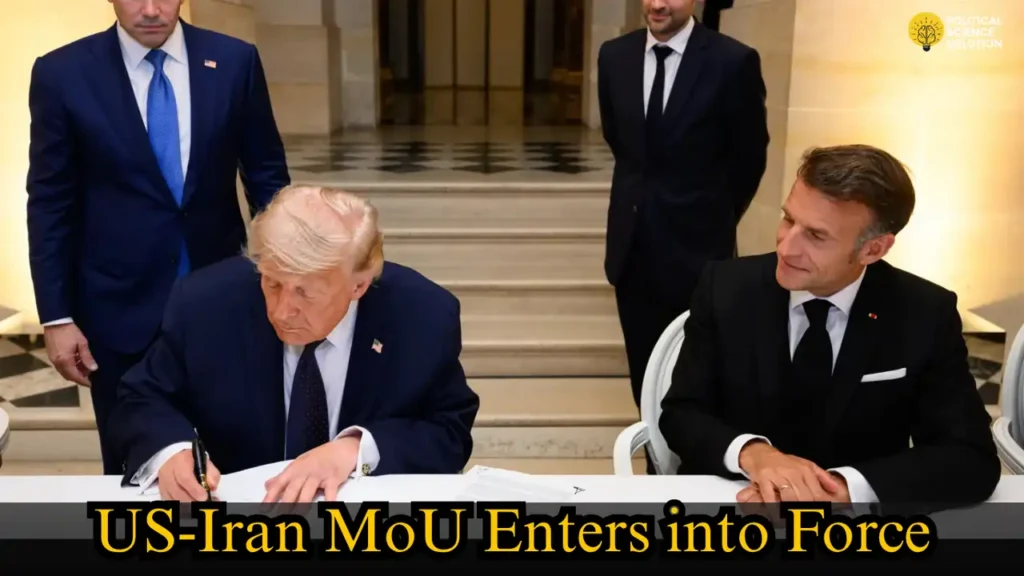
Afew key angles have largely been missing from discussions of the new MOU. First, the optics of the agreement are noteworthy. President Trump signed the MOU in Versailles, which the Islamic Republic has used to cast itself as the victor and the United States as Germany at the end of World War I. Moreover, the same political conversations playing out in Washington are also playing out in Tehran.
Some hardliners (aka “principlists”) strongly reject the MOU, much as they opposed the JCPOA. They argue that the United States has proven itself untrustworthy and/or that Iran has conceded too much, including its leverage over the Strait of Hormuz. Meanwhile, some reformists claim the deal represents a victory over an overreaching United States, which has now been forced to recognize Iran’s sovereignty and influence.
As for anti-regime Iranians, many of them feel betrayed by the MoU, since it fails to address human rights mere months after President Trump promised them that “help is on its way.” The White House claims that repression in Iran has eased, but a growing number of individuals who participated in the January protests are facing execution—indeed, the highest number since the 1980s. The regime is also relitigating old grievances in order to reassert control over the public (e.g., targeting a singer who published a video without wearing her hijab in 2024).
The Trump administration has proven that it can talk about human rights in Cuba, so it can do the same in Iran. For starters, it should call for a moratorium on executions, demand the release of political prisoners, restore U.S. funding to organizations that work on human rights and internet freedom, renew the visas of Iranian students, and allow asylum seekers to stay in the United States.
The administration’s failure to include human rights in the MOU has turned one of the most pro-American populations in the world against the United States, convincing many ordinary Iranians that neither Republicans nor Democrats have their interests at heart.
Some observers have argued that sanctions relief will provide economic improvements for the people, but these benefits will be slight—most of that money will go toward other priorities, as determined by a regime that has become even more hardline and emboldened by the war. In the long run, any economic boost from the MOU will be insufficient without addressing systemic mismanagement and corruption. Moreover, the agreement essentially kicks the nuclear can down the road by not addressing that issue in depth.
Postwar Middle East faces internal Iranian shifts
Going forward, Iran will likely turn its focus inward for a while rather than furthering its regional agenda. Funeral ceremonies for the late Supreme Leader Ali Khamenei will begin on July 4, and the country has substantial rebuilding to undertake following the destruction of key infrastructure and defense capabilities. Speaker of Parliament Muhammad Baqer Qalibaf has told the domestic private sector to focus on facilitating economic recovery and courting China, Iran’s biggest oil buyer. The only immediate source of conflict would be if Israel continues its military activity in Lebanon, which Tehran has warned would violate the ceasefire and potentially result in more tit-for-tat missile strikes.
This summary was prepared by Kate Chesnutt, Wiam Hammouchene, and Meredith Zielonka. The Policy Forum series is made possible through the generosity of the Winkler Lowy Foundation.