
The Trump administration advances Christian nationalism despite declining US religiosity. This Christianity in politics divide pits Vance’s conservative Catholicism against Warnock’s progressive faith, exposing a partisan chasm where belief increasingly aligns with political identity.
The Trump administration’s aggressive promotion of Christian nationalism masks a profound paradox: as officials demand public policy reflect their faith, American adherence to organized religion plummets. This Christianity in politics divide is starkly illustrated by competing books from JD Vance and Raphael Warnock, revealing a nation where Christianity in politics increasingly polarizes along partisan lines rather than shared theological conviction.
Christianity in politics and the religious right push
Adherence to organized religion is falling in the United States, but defenders of the religious right are ascendant in positions of power in the Trump administration.
A report released Friday by the Religious Liberty Commission empaneled by President Donald Trump suggests effectively tearing down the wall between church and state in the United States by providing more public money to religious organizations, giving churches a more direct role in politics.
But argument from Trump officials that the US as a “Christian nation” is at odds with the views of the values of Christians on the left, who think government should do more to help people who need it.
Two new books – Vice President JD Vance’s midlife Catholic conversion story, “Communion,” and Senator (and Reverend) Raphael Warnock’s “The Crooked Places Made Straight” – preach these opposing views of faith-based politics.
How Christianity in politics shapes Vance’s worldview
Through the lens of his conversion, Vance “argues for prioritizing families over gross domestic product, limiting migration, rejecting universal basic income, and discouraging abortions by improving conditions for new mothers and young children,” CNN’s Steve Contorno writes.
You can put Vance’s conservative Catholicism alongside the Evangelical faith that Secretary of Defense Pete Hegseth wears on his sleeve when it comes to matters of politics and policy in the Trump administration.
Like many on the religious right, Vance has taken an adversarial view to the American left.
“For decades, the left has labored to push Christianity out of national life,” Vance said at the Phoenix memorial for Charlie Kirk last year. “They’ve kicked it out of the schools, out of the workplace, out of the fundamental parts of the public square. Freedom of religion transformed into freedom from religion.”
At the same event, he pushed the idea, popular in the Trump administration, that despite the lack of overt religiosity in the nation’s founding documents, “By the grace of God, we always will be a Christian nation.”
Vance notably wants to involve religion in politics at times, but he has also criticized the first American-born Pope, his church’s spiritual leader, for calling out the heavy handedness of the Trump administration’s immigration crackdown and war on Iran.
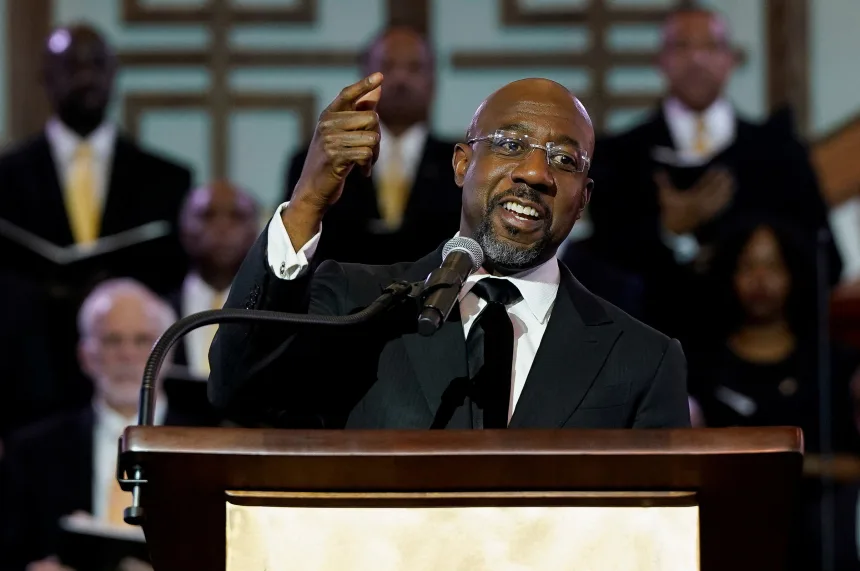
Warnock’s alternative to conservative Christianity in politics
Warnock, on the other hand, in addition to being a US Senator from Georgia, is also senior pastor at Ebenezer Baptist Church, the pulpit made famous by Rev. Martin Luther King Jr.
He has wondered aloud how leaders on the right can point to their Christian faith while also blessing the mass deportation efforts of Trump’s Immigration and Customs Enforcement agency and Trump’s tax and spending cuts bill, which anticipates cuts to Medicaid and food assistance.
“I have to ask whether the religion is more performative than substantive,” Warnock told The New York Times in a kickoff interview for his own book tour.
He told CNN’s Laura Coates something similar in December, when he argued Democrats need to reclaim the moral ground of faith.
“I think we ought to lean into faith,” Warnock said. “We ought not see the conversation around faith and values to people who are responsible for the largest transfer of wealth we saw with the One Big Beautiful Bill in American history.”
This is a moral argument for Warnock, but appealing to religious voters is a survival tactic for Democrats in a Southern state like his Georgia.
Christianity in politics and Trump’s divine intervention narrative
A major theme of Trump 2.0 is that Americans need more religion – and specifically Christianity – in their lives.
President Donald Trump is not known to be very religious, although he won over the religious right on his way to the White House in part by pushing the idea that his political rebirth and survival of assassination attempts were due to divine intervention.
And that’s added to that the biblical language in Hegseth’s war press conferences, the calls by Trump officials to bring religion more into public life, and the use of the Department of Justice to defend against what they see as anti-Christian bias.
There are fewer Christians in the US
Alongside the rise of a US government so focused on Christianity is a drop in the number of voters who describe themselves as Christian.
In the 2016 election that first brought Trump to power, 23% of voters described themselves as Catholic and 52% described themselves as Protestant or another Christian denomination, according to exit polls. The portion of voters describing themselves as Protestant or another Christian denomination fell in 2024, when just 43% of voters described themselves that way, according to exit polls, while 21% said they were Catholic in 2024. The portion of voters who are White evangelicals went from 26% in 2016 to 23% in 2024, which is not a meaningful shift, but the portion with no religious affiliation went from 15% in 2016 to 24%, nearly a quarter, in 2024.
Christianity in politics meets MAGA’s nationalist fervor
I asked Melissa Deckman, who is CEO of the Public Religion Research Institute, PRRI about the competing messages of Vance and Warnock and the larger trends in American religion.
“The intermixing of religion and politics is really at an unprecedented level in recent American history,” she said, arguing that while previous modern Republican presidents have paid some lip service to the religious right, Trump has done more to act on their behalf in their policies and with his Supreme Court nominations.
“There’s something going on within the current makeup of the Republican Party – the MAGA takeover,” she said.
“Many people within the MAGA movement, within the GOP, envision a world that the US should be identified more as a Christian nation with conservative Christian goals,” she said.
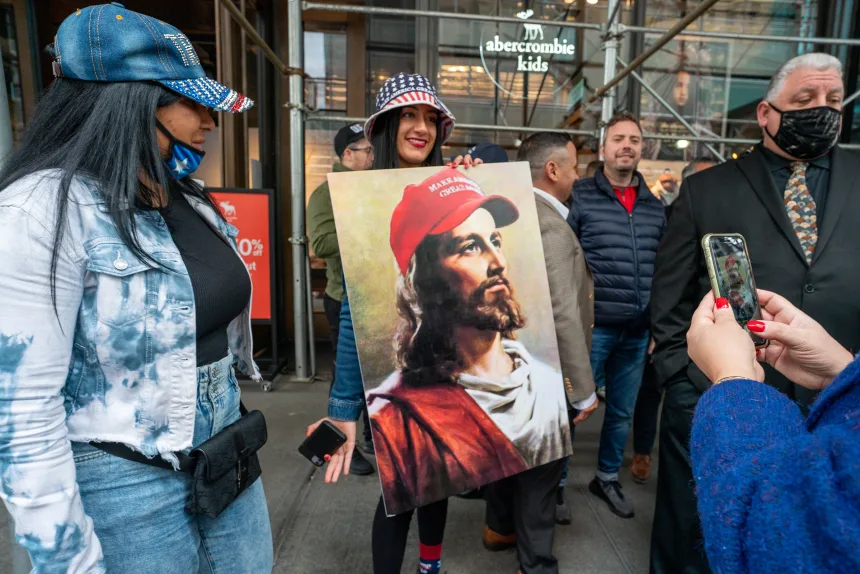
That’s in line with the more controversial idea of Christian nationalism, an ideology rooted in the belief that the United States was founded as a Christian nation and that its laws and institutions should reflect Christian values.
PRRI recently released the latest in a series of studies on American identity and it includes some interesting trends:
► Republicans are getting more comfortable with the term Christian nationalism.
From the report:
Just 25% of Americans hold favorable views of the term Christian nationalism, compared with… Nearly half of Republicans (48%) … 21% of independents and only 10% of Democrats. While support among independents and Democrats has remained relatively stable since 2022, Republicans are increasingly embracing the term, with favorable views rising 12 points, from 36% to 48%.
PRRI asked people a series of five questions and, depending on those answers, classified people as either adherent, sympathizer, skeptic or rejecter of Christian nationalism, according to Deckman.
► Democrats are less likely to see a divine American exceptionalism.
From the report: While Republican agreement that God has granted America a special role has remained relatively stable — dipping from 75% in 2012 to 63% in 2022, with about seven in ten agreeing today — Democratic support has collapsed, falling from 60% to just 27%. Independents declined as well, hitting a low of 35% in 2020 before a modest recovery to 40% in 2026.
“The Democratic Party, in many ways, is less religious,” Deckman said. “It’s also more religiously diverse. You tend to have many more non-Christians within the Democratic Party compared to the GOP, but you tend to have a very big cross section of Christians of color,” she said.
► Most Americans still prefer religious diversity
From the report: Nearly two-thirds of Americans (64%) would prefer “the US to be a nation made up of people belonging to a wide variety of religions,” compared with 34% who prefer “the US to be a nation primarily made up of people who follow the Christian faith. That’s a decline for pluralism since 2022, the first year the question was asked, by PRRI, and when 73% said they preferred a wide variety of religions. Today, a clear majority of Republicans, 60%, prefer the US to be made up of Christians, up from 52% in 2022.
Where is all of this heading?
The uncertain future of American Christianity in politics
When I asked Deckman what she sees happening with religion in American over the next ten years, she pointed to the rise in the number of people, particularly women, who do not practice a religion.
“Young women are really shedding religious labels for a lot of reasons,” Deckman said, adding that many women who leave organized religion are unhappy with their faiths’ approach to LGBTQ issues and how many religious traditions view women.
There have been periods of religious reawakening in US history, but the data she sees does not suggest that is happening at the moment, in part because of a multi-generational shift away from organized religion.
“If you haven’t grown up in a faith tradition, the odds are that you’re not going to necessarily become religious later in life,” said, adding that Vance is an exception to that rule.
While the data does not show a religious reawakening, she argued Americans could be in need of the kind of connection that organized religion offers.
“I do think Americans are craving an authentic face-to-face experience,” she said. “As we become more isolated and spending more time online, it seems that houses of worship might be that kind of place where people could actually have meaningful interaction, and there are lots of positive things that, you know, being part of a faith community provides.”