
When Iraq Forms New Government under billionaire outsider Ali al-Zaidi, the event reveals elite fragmentation, not stability. Amid U.S.-Iran war and fiscal collapse, his premiership tests whether patronage networks can survive regional turmoil.
After six months of deadlock, Iraq Forms New Government led by billionaire outsider Ali al-Zaidi—yet this moment signals not stability but accelerating state fragmentation. Whether Iraq Forms New Government can transcend patronage networks or becomes hostage to its creators will define the nation’s trajectory amid regional war and fiscal collapse.
Iraq Forms New Government Faces Immediate Security Crises
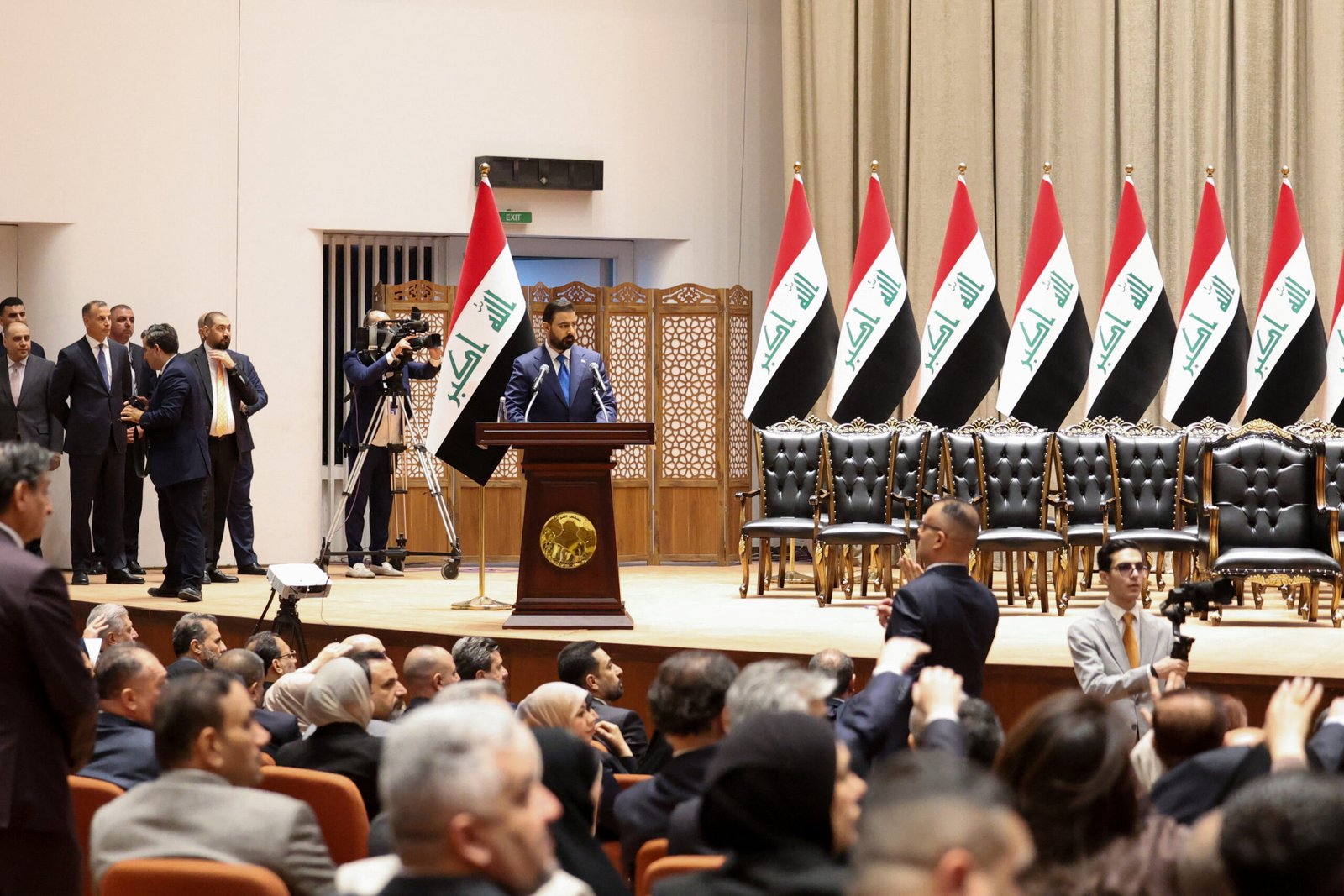
On 14 May, six months after general elections were held in November 2025, Iraq’s parliament approved a still-incomplete government led by a newly appointed prime minister, Ali al-Zaidi. A young billionaire businessman with no political or government experience, Zaidi emerged as an unconventional compromise candidate after months of deadlock within Iraq’s Shiite ruling coalition, the Coordination Framework.
Zaidi inherits an office facing multiple crises. The U.S.-Israeli war with Iran that began 28 February has turned Iraq into a battleground where the government can neither protect its sovereignty nor enforce the state’s monopoly on the use of force. All three of the main warring parties have struck targets in Iraq, and Iran-aligned armed groups have defied Baghdad’s official policy of neutrality by staging attacks from Iraqi territory. Relations with Washington and Gulf Arab capitals have deteriorated as a result. Meanwhile, Iraq’s economy is under severe strain after Iran’s closure of the Strait of Hormuz halted most oil exports, depriving the state of its primary source of revenue.
Yet Zaidi’s appointment signals less a strategic response to this mounting predicament than the accelerating fragmentation of Iraq’s post-2003 political order. Whether he can transcend the constraints of that system or becomes hostage to the powers that elevated him will define Iraq’s trajectory in the months ahead.
Why Iraq Forms New Government by Elimination
Choosing a political outsider to lead Iraq at a moment of national emergency may appear counterintuitive, but Zaidi’s nomination was primarily designed to break an intra-elite stalemate. The two leading contenders, then caretaker Prime Minister Mohammed al-Sudani and former Prime Minister Nouri al-Maliki, neutralised each other politically. Maliki’s candidacy faced strong opposition from Washington even before the Middle East war erupted, while Sudani was weakened by his inability to keep Iraq out of the conflict.
Both were determined to block the other’s return. Following Maliki’s consolidation of power during his second term (2010-2014), denying incumbents a renewed mandate has become the norm among the country’s political elites. Since then, the political system has increasingly defaulted to weaker compromise figures whenever dominant actors fall by the wayside. Yet this time, even when Maliki and Sudani proposed compromise candidates of their own, these also failed to garner enough support within the Framework (which set the minimum requirement to pass a nominee at eight of its twelve members).
The deadlock was broken by the intervention of the president of the Supreme Judicial Council, Faiq Zaidan. Though head of Iraq’s judiciary, Zaidan has long been a politically influential figure whose reach has grown in recent years. His support for Zaidi proved decisive in forging consensus within the Framework and in securing U.S. acceptance.
He had previously helped broker similar compromises over the speakership and presidency, which are allocated to Sunni Arab and Kurdish blocs, respectively, under the country’s ethno-sectarian appointment system. Unlike in this case, however, those compromise figures were political insiders. For example, when rival parties obstructed the nomination of a former parliament speaker, Mohammed al-Halbousi, he presented a compromise candidate from Halbousi’s own circles who eventually won the acceptance of other blocs in parliament.
Under pressure to form a government and unable to agree on one of their own, Framework leaders opted in Zaidi for a candidate unlikely to challenge their interests and acceptable to Washington and Tehran – both of which welcomed his appointment. Zaidi fits a mould that several Framework leaders had openly favoured prior to the election: a “general manager” rather than an independent power centre. His selection represents a further dilution of executive authority, as he is expected to act at the Framework’s behest, while his primary patron, Zaidan, is external to it.
Zaidi’s background reinforces this interpretation. Though unknown to the public, Zaidi is no stranger to Iraq’s political class. His business empire intersects deeply with the state. Nearly a decade ago, Zaidi’s holding company was awarded a lucrative contract with the Ministry of Trade to distribute ration cards and food baskets under Iraq’s public distribution system (a legacy of the 1990s sanctions era).
He chaired a bank that was barred in 2024 from conducting dollar transactions after the U.S. Treasury flagged money laundering concerns (Zaidi handed the chair over to his brother in 2019, though he remains part owner). He also recently established a private university licensed under the Ministry of Higher Education, which was then run by Sadiqoon, an Iran-aligned party.
That any of these economic stakes might present a conflict of interest is irrelevant to Iraq’s oligarchical elite. Rather than disqualifying him, these entanglements strengthened his candidacy as the Framework leaders made priorities of preservation of patronage networks and rent distribution. A prime minister who understands and depends on those networks can be an asset. But if Zaidi’s selection mainly reflected elite compromise, the composition of his cabinet illustrates the fragility of the bargain.
Cabinet Formation as Iraq Forms New Government
On 14 May, parliament approved just over half of Zaidi’s cabinet, the minimum constitutional requirement to activate the government. Remaining posts are expected to be voted on after the Eid al-Adha holidays at the end of May. The selection will be guided by the usual ethno-sectarian conventions.
Notably, the largest parliamentary coalition, led by former Prime Minister Sudani, began to splinter after key allies, including Faleh al-Fayadh and Ahmed al-Asadi, announced their withdrawal. In the meantime, Sudani had secured important ministries, such as oil and electricity, for himself but none for his partners. In the rival Shiite camp, Maliki’s candidate for interior minister was rejected. Other important ministries that remain vacant include defence, which is typically reserved for a Sunni Arab party.
The only element of continuity among the so-called sovereign ministries was found in the Ministry of Foreign Affairs, with the reappointment of Fuad Hussein, who hails from Masoud Barzani’s Kurdistan Democratic Party (KDP). Keeping Hussein as foreign minister reflects the elite’s acknowledgement of Iraq’s worsened relations with its neighbours. Many hope that Hussein, who has proven a reliable partner among his regional counterparts, will be able to mend ties.
While partial cabinet approvals are not unusual, this episode may be an early sign of a more serious rupture within the Shiite ruling coalition. Indeed, the failure of the Shiite leaders to reach consensus on a prime minister candidate from within the ranks of Framework parties is in itself evidence of deep-seated mistrust among them. Moreover, the government formation process has reinforced the notion that the influence of post-2003 Iraq’s political powerhouses, including Maliki’s State of Law and Barzani’s KDP, is waning.
In a sharp break from the past, they both failed to gain support for some of their nominees for the cabinet. In addition, State of Law lost the race for the premiership, and in a departure from tradition the KDP had no say over who became president. Though this office is normally allocated to the Patriotic Union of Kurdistan (PUK), the appointee typically emerges from negotiations between the two Kurdish parties over other portfolios. That did not happen this time; instead, the PUK went ahead with the support of non-Kurdish parties to secure the parliamentary vote for Nizar Amidi, which the KDP boycotted.
The next generation of political leaders from across the ethno-sectarian spectrum have proven pragmatic in their dealings. These include the PUK’s Bafel Talabani, former parliament speaker Halbousi and Qais al-Khazali of Sadiqoon, whose armed wing Asaib Ahl al-Haq is among the largest groups in the Hashd al-Shaabi – the umbrella force created during the war to defeat ISIS and later formally integrated into Iraq’s security apparatus.
The PUK has, for example, conceded what used to be key Kurdish demands – such as an independent oil sector in Kurdistan – for the sake of better relations with Baghdad-based parties, including those aligned with Iran. Khazali and Halbousi have similarly proven willing to rely on cross-sectarian political alliances in order to outmanoeuvre the old guard within their own groups.
Zaidi’s own positioning vis-à-vis the political forces that will shape his time in office is yet to be discerned. He may not mind the fracturing of the Shiite Coordination Framework, which could strengthen his own decision-making power. But the fissures could also turn into a liability if he is unable to mobilise support for his policies. As for the generational shift within the political establishment, the young businessman-cum-prime minister may be well placed to negotiate the increasingly transactional political landscape.
Iraq Forms New Government Navigates External Pressure
Zaidi’s more immediate challenge in forming the remainder of the government is U.S. pressure to reduce Iranian influence. The most striking feature of his cabinet to date is its apparent consideration of U.S. demands to exclude candidates from parties linked to groups Washington has designated as Foreign Terrorist Organizations (FTOs). Tellingly, Khazali’s party Sadiqoon – the political wing of the designated FTO Asaib Ahl al-Haq – did not receive a ministry despite being the third largest Shiite party in parliament.
Should Khazali wish to secure one in the next round, he may have to nominate a candidate considered independent rather than a member of his party. Another candidate excluded from cabinet consideration was deputy oil minister Ali Maarij, Maliki’s nominee for minister of oil. Just a week before the vote, the U.S. designated him under its Iran sanctions regime over allegations that he had allowed the blending of Iranian oil with Iraq’s oil exports.
Still, U.S. attempts to shape government formation are unlikely to have a far-reaching impact as political apportionments trickle down to the lowest levels of administration, in which Iran-aligned parties are bound to get their share. How Zaidi fills the remaining posts and other key state institutions will be an indicator of how far he can accommodate U.S. demands without provoking backlash from Iran-aligned parties.
Those who have invested in the political process, such as Khazali, are biding their time. Khazali’s partial distancing from other so-called resistance factions has not yet swayed Washington, but it may help secure his long-term political survival if he is able to persuade U.S. officials that he is sincere. In the short term, it lends Zaidi time to work with Washington on addressing concerns about the activities of Iran-backed factions operating in Iraq, which could trigger further U.S. sanctions.
Security and Fiscal Challenges When Iraq Forms New Government
Security and fiscal challenges will dominate Zaidi’s agenda in the coming months. U.S. pressure to curb or disarm Iran-aligned groups is mounting. In all likelihood, the U.S. welcomed Zaidi’s appointment based on Zaidan’s assurances that the new premier will take such U.S. demands seriously.
Yet his room for manoeuvre is narrow. Sudani’s caretaker government proved unable to prevent Iraqi territory from becoming a staging ground for attacks on U.S. and regional targets (or, for that matter, from becoming a staging ground for Israeli strikes on Iran); Zaidi will have just as much trouble reining in the Iran-aligned armed groups, especially while regional tensions persist. More feasible, though still fraught, could be efforts to at least better contain or integrate armed groups into more formal command structures.
More broadly, Zaidi faces a longstanding structural dilemma. Moving aggressively against Iran-aligned factions risks provoking intra-Shiite conflict and destabilising his government. Moving too cautiously risks further U.S. sanctions or even renewed military action. His strategy appears to centre on offering Washington a phased roadmap for integration and disarmament of the militias, despite the failure of a previous such endeavour on former Prime Minister Sudani’s part over the past couple of years. Sudani’s efforts sometimes appeared half-hearted, but even a stronger push would face significant challenges. Some factions, such as Harakat al-Nujaba, that have openly aligned with Iran during the war are unlikely to comply. Others, including those seeking long-term political survival, may prove more flexible.
The challenge is compounded by the institutionalisation of these groups within the Hashd al-Shaabi. While Washington often views the Hashd as an extension of Iranian influence, it remains deeply embedded in Iraq’s political and social landscape, employing tens of thousands and retaining legitimacy among broad segments of the Shiite population. Wholesale dismantlement is unrealistic. A calibrated approach – convincing both Washington and domestic actors that gradual disarmament and integration, starting with more amenable groups, is preferable to confrontation – may be Zaidi’s only viable path.
Even if he somehow manages to handle these security dilemmas and outside pressures, fiscal instability will pose an equally daunting threat. Iran’s closure of the Strait of Hormuz in response to the U.S.-Israeli war has halted most oil production in the Basra fields, which accounts for roughly 3.3 million barrels per day, the bulk of Iraqi exports. Given that oil revenues constitute around 90 per cent of government income, prolonged disruption would severely undermine Iraq’s ability to pay public-sector salaries.
Because Iraq’s political order is sustained by rent distribution, a fiscal crisis would not merely generate economic hardship; it would threaten elite cohesion and risk social unrest. For now, the government has resorted to domestic borrowing, which projections suggest could sustain liquidity for another three months. Yet this fix is only temporary. Even if the strait reopens under global pressure, or as part of a settlement between the U.S. and Iran, the episode underscores the vulnerability of Iraq’s rentier model and the urgency of diversifying both export routes and the broader economy.
Zaidi’s premiership may prove less significant for the policies he pursues than for what it reveals about both Iraq’s evolving state institutions and the tug of war between the U.S. and Iran for Middle East influence. Whether he becomes a transitional figure or consolidates unexpected authority will depend on his ability to steer through, and perhaps exploit, the very fragmentation that enabled his rise.