

The administration’s coercive triad of bombing, blockade, and bargaining imploded due to fractured Iranian authority and amateur US diplomacy, proving that premature withdrawal from pressure cycles empowers adversaries while offering zero strategic gain.
Abandoning the administration’s Iran strategy reveals a catastrophic failure of sequenced pressure tactics, where bombing, blockades, and negotiations collapsed under their own contradictions. Giving up on the diplomatic front was inevitable once it became clear no unified Iranian counterpart existed, yet Giving up on military coercion mid-cycle ensured Iran retained both its nuclear latency and its leverage. This is not a strategic retreat; it is an unforced surrender to procedural chaos.
Giving Up on the Bombing Campaign
I’ve always thought supporting Donald Trump’s plans was bound to be a bridge to nowhere. He didn’t seem to have the patience to follow a plan. Nevertheless, I praised his Iran policy months ago, when he was bombing Iran and (presumably) destroying its eventual ability to threaten nuclear war on the US and Israel. I assumed that he would continue until Iran “caved.” If not, at least, I thought that the bombing would mean perhaps five years of safety before Iran recovered its military strength and began to resume its nuclear activities.
But the bombing was stopped before completion, and we are now told we could have done much more. Incredibly, if bombing is resumed, we may leave that to Israel, which certainly has the necessary incentive but not anywhere near the firepower.
The Blockade and Giving Up Leverage
Somewhat to his credit, when the bombing didn’t work quickly enough to bring Iran to the table, Trump followed with a blockade, which seemed like an excellent idea. Under the blockade, Iran could not sell any oil and was losing something like $500 million per day in oil revenues. In addition, it was said that they did not have storage space for the oil they could not sell—and closing the wells could permanently damage them. For some reason, that stopped being a problem for Iran, but we never learned why.
After a few weeks of blockading, Trump wanted to negotiate again, although it seemed doubtful that Iran would be ready to concede anything. There was much still to be done in reducing Iran’s resources.
At that point, however, Trump started to say, whenever asked, that “they really want a deal.” But the “deal” never materialized despite the sense of urgency on Iran’s part that Trump was trying to portray. I admit that I thought he had good reasons for continuing to delay, as long as the blockade was in force. I was still willing to cut him some slack, but of course—having now seen the “deal”—it was not worth waiting for.
Whose Deal Are We Giving Up On
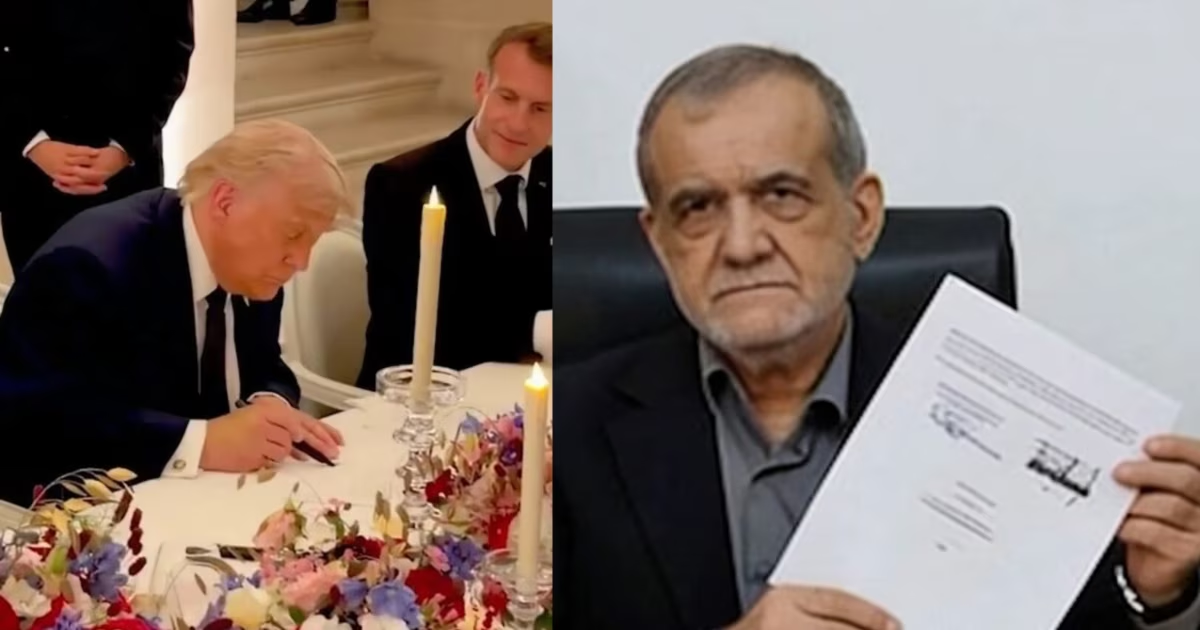
It now turns out that Trump wasn’t even negotiating with the right people. Now we learn that Iran’s Supreme Leader, the son of the last Supreme Leader, did not agree with whatever was being negotiated, so what was signed and ballyhooed this past weekend was worthless.
The new Supreme Leader apparently supports the position of the Iran Revolutionary Guard Corps (IRGC)—the militant group that will never surrender—and not the President of Iran who was negotiating the agreement. This is a new way to waste your adversary’s time: make sure the negotiators on the other side don’t have any authority to make a deal. And we fell for it.
The whole purpose of the attacks on Iran was to bring them to the table to discuss their nuclear ambitions. But somehow when Iran’s negotiators actually got to the table, they managed to move the whole issue of nuclear plans to a 60-day period after the current agreement is signed. Seeing how well Iran can delay, Trump will have to win a third term before that subject actually gets covered.
Giving Up on Negotiating Competence
While I’m on the “deal,” I have to say that using as the US negotiators the President’s golfing partner and Trump’s son-in-law does not reflect the seriousness with which he or we should have been approaching this matter. Is this the best the US can do on something so important? What could the Iranians have thought? I had hoped that what was happening in Pakistan or elsewhere was being transmitted to the US where Iran experts were commenting on the language under consideration, but apparently not.
When we finally saw it, we were all surprised by its low quality, its ambiguity, its failure to address some things that needed coverage, and its coverage of things where it should have said nothing. For example, how could the US have agreed to anything about Israel and Hezbollah when Israel was not even at the table? That was first class stupidity, and no way to treat an ally. Now we’re paying the price. Iran is refusing to negotiate further until Israel agrees to stop defending itself against Hezbollah. That will be enough to delay the nuclear negotiations for several months, if not years.
Patience, Plans, and Giving Up Finally
I’ve now given up on Trump’s negotiating skills. He doesn’t have a plan, or even the patience to follow a plan. We’re nowhere now on Iran’s potential to produce nuclear weapons, and that’s a tragedy for the world.